Introduction
Winning a contract is about much more than submitting a proposal before the deadline. Behind every successful bid lies a well-planned, structured, and collaborative process that ensures every requirement is addressed, every stakeholder contributes effectively, and the final submission represents the organization’s best capabilities.
Whether you’re responding to a government tender, a commercial Request for Proposal (RFP), or a private Invitation to Tender (ITT), following a defined bid management process can significantly improve proposal quality and increase your chances of success.
Organizations that consistently win competitive bids don’t rely on luck. They rely on repeatable processes, experienced teams, effective planning, and continuous improvement.
In this guide, we’ll walk through the complete bid management process—from identifying an opportunity to capturing lessons learned after contract award.
Table of Contents
What Is the Bid Management Process?
The bid management process is a structured series of activities that organizations follow to identify opportunities, evaluate them, prepare winning proposals, submit compliant responses, and manage post-submission activities until the contract is awarded.
A well-defined process ensures that every proposal:
- Meets customer requirements
- Is submitted on time
- Maintains high quality
- Demonstrates the organization’s strengths
- Maximizes the probability of winning
The process applies to organizations of all sizes and across industries, including:
- Information Technology
- Construction
- Healthcare
- Manufacturing
- Consulting
- Telecommunications
- Government Contracting
- Engineering Services
Regardless of industry, the fundamental stages remain largely the same.
Why Is a Structured Bid Management Process Important?
Many bids are lost because of avoidable mistakes rather than weak solutions. Common issues include poor planning, incomplete responses, unclear ownership, missed deadlines, and compliance failures.
A structured process helps organizations avoid these pitfalls by providing consistency and accountability.
Some of the key benefits include:
Improved Collaboration
Bid teams often involve sales professionals, solution architects, finance teams, legal advisors, subject matter experts (SMEs), and executive leadership. A structured process ensures everyone understands their responsibilities.
Better Proposal Quality
Planning ahead allows teams to produce well-written, customer-focused proposals instead of rushing to meet deadlines.
Reduced Risk
Compliance checks, quality reviews, and approval gates minimize the risk of submission errors.
Increased Win Rates
Organizations that follow a disciplined process typically submit more competitive proposals, resulting in higher success rates.
Continuous Improvement
Every completed bid provides valuable lessons that can improve future pursuits.
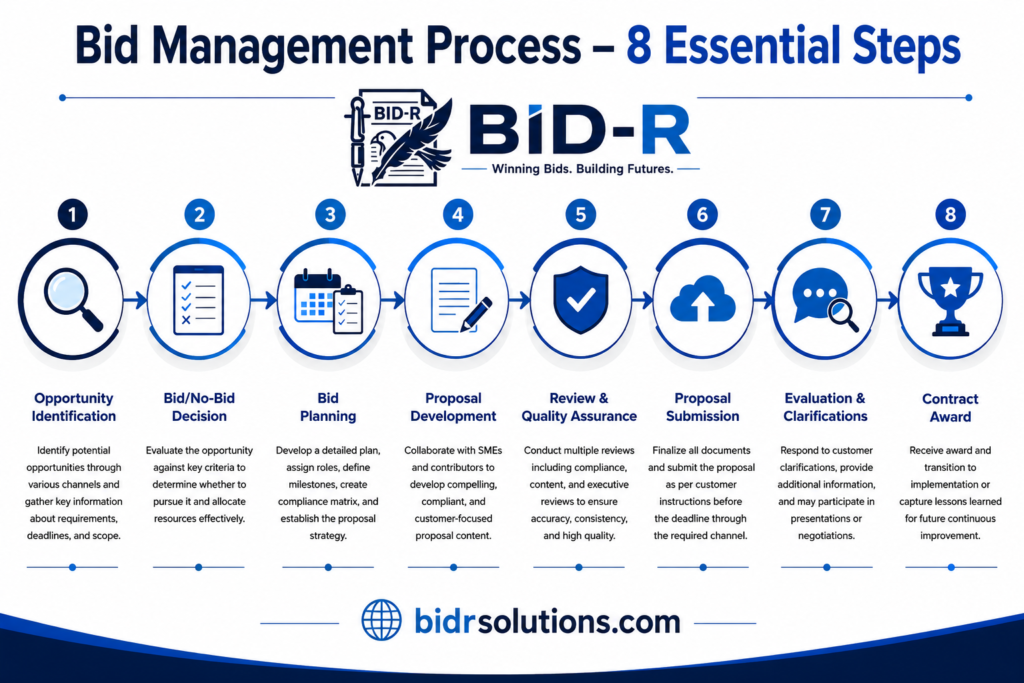
The Eight Stages of the Bid Management Process
Although every organization may have slight variations, most successful bid teams follow eight key stages.
Step 1: Opportunity Identification
Everything begins with finding the right opportunity.
Organizations identify opportunities through multiple channels, such as:
- Government procurement portals
- Existing customers
- Framework agreements
- Business development teams
- CRM systems
- Partner referrals
- Tender notification services
- Industry networking
At this stage, the objective is to gather as much information as possible, including:
- Customer requirements
- Submission deadlines
- Budget
- Eligibility criteria
- Scope of work
- Evaluation methodology
Early visibility gives the team more time to prepare a strong proposal.
Step 2: Bid/No-Bid Decision
Not every opportunity should be pursued.
Submitting proposals consumes significant time, money, and resources. Chasing every opportunity often reduces overall win rates.
A Bid/No-Bid review helps determine whether pursuing the opportunity is worthwhile.
Common evaluation criteria include:
- Strategic alignment
- Technical capability
- Previous experience
- Resource availability
- Revenue potential
- Expected profitability
- Competitive landscape
- Customer relationship
- Probability of winning
If the opportunity scores poorly, declining to bid may be the smarter business decision.
A disciplined Bid/No-Bid process allows organizations to focus their efforts on high-value opportunities.
Step 3: Bid Planning
Once the decision to pursue the opportunity is made, detailed planning begins.
This stage lays the foundation for the entire proposal effort.
Typical planning activities include:
- Conducting a kickoff meeting
- Reviewing customer requirements
- Developing a proposal schedule
- Assigning section owners
- Identifying subject matter experts
- Creating a compliance matrix
- Defining review milestones
- Identifying potential risks
The bid manager coordinates these activities and ensures every contributor understands their responsibilities and deadlines.
A well-prepared bid plan prevents confusion later in the proposal lifecycle.
Step 4: Proposal Development
Proposal development is usually the longest and most resource-intensive stage.
Multiple teams collaborate to prepare a compelling response that addresses every customer requirement.
Typical proposal sections include:
- Executive Summary
- Company Overview
- Technical Solution
- Project Methodology
- Implementation Plan
- Project Governance
- Team Structure
- Resource Profiles
- Pricing
- Risk Management
- Quality Assurance
- Case Studies
- References
- Certifications
- Appendices
During proposal development, the bid manager coordinates contributions from various stakeholders while ensuring consistency in formatting, messaging, and compliance.
Successful proposals focus not only on what the organization offers but also on how those offerings solve the customer’s business challenges.
Instead of simply describing products or services, high-performing proposals clearly demonstrate value, measurable outcomes, and competitive advantages.
Good proposal development also includes regular progress reviews, document version control, and continuous communication among contributors.
Step 5: Proposal Review and Quality Assurance
Before submitting a proposal, it should go through multiple review stages to ensure accuracy, compliance, and quality. A thorough review process helps identify gaps, inconsistencies, and errors that could reduce the chances of winning.
Most organizations conduct several types of reviews, including:
Compliance Review
The compliance review verifies that every customer requirement has been addressed. Missing even a single mandatory requirement may lead to proposal disqualification.
Reviewers typically check:
- Mandatory documents
- Eligibility criteria
- Technical requirements
- Pricing completeness
- Required certifications
- Submission instructions
Content Review
This review focuses on the quality of the proposal.
Questions reviewers ask include:
- Does the proposal answer every question?
- Is the value proposition clear?
- Is the solution customer-focused?
- Are claims supported with evidence?
- Is the language professional and consistent?
Executive Review
Senior management validates whether the proposal aligns with the organization’s business strategy, pricing expectations, and commercial objectives.
Proofreading
The final review eliminates:
- Grammar mistakes
- Formatting inconsistencies
- Incorrect references
- Broken hyperlinks
- Missing attachments
- Typographical errors
Many organizations also conduct Pink Team, Red Team, or Gold Team reviews to improve proposal quality before submission.
Step 6: Proposal Submission
Once all approvals are complete, the proposal is submitted according to the customer’s instructions.
Submission methods may include:
- Government procurement portals
- Customer procurement portals
- Email submissions
- Secure file-sharing platforms
- Physical hard-copy submissions
Before submission, the bid manager should verify:
- All mandatory documents are included.
- Required signatures have been obtained.
- Pricing files are correct.
- File names follow customer instructions.
- File formats are acceptable.
- Proposal size limits are not exceeded.
- Submission deadlines are met.
Submitting several hours before the deadline reduces the risk of technical failures and last-minute issues.
Step 7: Post-Submission Activities
The bid management process does not end once the proposal has been submitted.
During the evaluation period, customers may request:
- Clarifications
- Additional documentation
- Product demonstrations
- Technical presentations
- Commercial negotiations
- Best and Final Offer (BAFO)
The bid manager coordinates responses while ensuring that all communications remain consistent and compliant with procurement rules.
Maintaining professional communication throughout this stage strengthens customer confidence and demonstrates organizational maturity.
Step 8: Contract Award and Lessons Learned
Eventually, the customer announces the successful bidder.
If the proposal is successful:
- Begin contract transition.
- Conduct project handover.
- Archive proposal documents.
- Celebrate the team’s achievement.
If the proposal is unsuccessful:
- Request a customer debrief.
- Analyze competitor strengths.
- Identify internal improvement areas.
- Update reusable content.
- Capture lessons learned.
Every completed bid provides valuable insights that improve future proposals.
Organizations with mature bid management practices continuously refine their processes based on past experiences.
Common Challenges in the Bid Management Process
Even experienced bid teams encounter challenges. Recognizing these issues early allows organizations to mitigate risks effectively.
1. Poor Planning
Starting late often results in rushed proposals, reduced quality, and increased stress.
Solution: Develop a detailed proposal schedule immediately after the Bid/No-Bid decision.
2. Ineffective Communication
Lack of coordination among contributors can lead to inconsistent messaging and duplicated effort.
Solution: Schedule regular progress meetings and maintain clear communication channels.
3. Compliance Gaps
Missing mandatory requirements can lead to automatic rejection.
Solution: Create and maintain a compliance matrix throughout the proposal lifecycle.
4. Version Control Issues
Multiple contributors working on the same document can create confusion.
Solution: Use centralized document management and clear version naming conventions.
5. Limited SME Availability
Subject Matter Experts often have competing priorities.
Solution: Secure SME commitment during project planning and define clear deadlines.
Bid Management Process Best Practices
Successful organizations consistently follow these best practices:
- Develop a standardized bid management framework.
- Conduct formal Bid/No-Bid reviews.
- Assign clear ownership for every proposal section.
- Use proposal templates and reusable content libraries.
- Build a compliance matrix for every bid.
- Hold regular progress meetings.
- Perform multiple quality reviews.
- Submit proposals well before deadlines.
- Capture lessons learned after every bid.
- Continuously improve internal processes and templates.
Following these practices improves proposal quality, increases efficiency, and enhances win rates over time.
Example Bid Management Timeline
| Day | Activity |
|---|---|
| Day 1 | Opportunity Identified |
| Day 2 | Bid/No-Bid Decision |
| Day 3 | Kick-off Meeting |
| Day 4–8 | Proposal Development |
| Day 9 | Internal Review |
| Day 10 | Compliance Review |
| Day 11 | Executive Approval |
| Day 12 | Final Submission |
The actual timeline varies depending on proposal complexity, customer requirements, and submission deadlines.
Conclusion
A structured bid management process transforms proposal development from a reactive activity into a strategic business function. By following a clear sequence of planning, collaboration, quality assurance, and continuous improvement, organizations can consistently deliver high-quality proposals that stand out from the competition.
Whether your organization responds to commercial RFPs, government tenders, or private procurement opportunities, investing in a disciplined bid management process can significantly improve efficiency, reduce risk, and increase contract win rates.
Start by evaluating your current process, identifying bottlenecks, and implementing best practices one step at a time. Over time, these incremental improvements can lead to measurable gains in proposal quality and business success.
Related Articles
Want to build a winning bid management strategy? Explore our comprehensive guides on bid management frameworks, proposal management, bid manager responsibilities, and proven best practices to strengthen your organization’s competitive advantage.
Bid Management: Complete Guide to Winning More RFPs and Proposals
Bid Management Lifecycle: A Complete Guide to Every Stage
Bid Manager Roles and Responsibilities: A Complete Guide
Bid Management Best Practices: 15 Proven Strategies to Win More Bids
Bid Management Framework: A Complete Guide to Building a Winning Bid Process
Bid Management Methodologies: 8 Proven Approaches for Winning More Bids
Bid Management KPIs and Metrics: 20 Key Measures to Improve Bid Success
Bid Management Challenges and Solutions: 15 Common Problems and How to Overcome Them
Bid Management Checklist: The Complete Pre-Submission Checklist for Winning Bids
Complete Guide to Proposal Management (2026): Process, Best Practices & Career Guide
Frequently Asked Questions
Below are answers to some of the most common questions about the bid management process.
What is the bid management process?
The bid management process is a structured approach used to identify opportunities, evaluate them, develop proposals, conduct quality reviews, submit responses, and manage post-submission activities until the contract is awarded.
What are the stages of the bid management process?
The bid management process typically includes opportunity identification, Bid/No-Bid decision, bid planning, proposal development, quality reviews, proposal submission, post-submission activities, and contract award with lessons learned.
Why is the Bid/No-Bid decision important?
The Bid/No-Bid decision helps organizations evaluate whether an opportunity aligns with their capabilities, business strategy, available resources, and probability of winning before investing time and effort in preparing a proposal.
Who is responsible for managing the bid management process?
The Bid Manager is primarily responsible for coordinating the bid management process. They work with sales teams, solution architects, subject matter experts, finance, legal, and executive leadership to ensure a high-quality and compliant proposal is submitted on time.
How can organizations improve their bid management process?
Organizations can improve their bid management process by following standardized procedures, using reusable templates, creating compliance matrices, conducting regular reviews, leveraging collaboration tools, and capturing lessons learned after every bid.