Introduction
Bid Management Challenges and Solutions are essential topics for organizations that want to improve proposal quality and increase their chances of winning competitive contracts. Regardless of industry or organization size, proposal teams encounter obstacles such as tight deadlines, limited resources, changing customer requirements, compliance risks, and communication issues.
While these challenges are common, successful organizations overcome them through structured processes, effective planning, strong governance, and continuous improvement. Understanding the root causes of these problems allows proposal teams to develop practical solutions that improve efficiency and proposal quality.
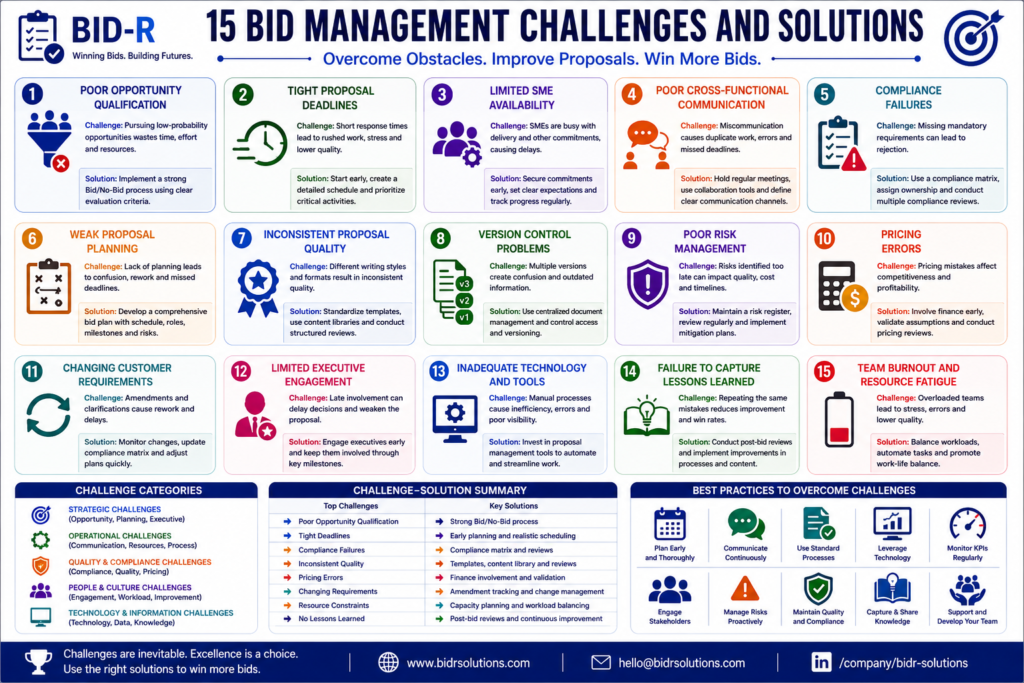
In this guide, we’ll explore the 15 most common bid management challenges, explain why they occur, and provide actionable solutions that can help your organization deliver better proposals and achieve higher bid win rates.
Table of Contents
Key Takeaways
- Every proposal team faces operational and strategic challenges.
- Most bid management problems can be reduced through planning, governance, and collaboration.
- Compliance, communication, and resource management are among the most common issues.
- Continuous improvement helps prevent recurring proposal problems.
- Addressing challenges proactively improves proposal quality and win rates.
Why Bid Management Challenges Occur
Bid management is a cross-functional activity involving sales, business development, solution architects, finance, legal, delivery teams, and executive leadership. Each proposal has unique requirements, deadlines, stakeholders, and risks.
Challenges typically arise because of:
- Limited preparation time
- Multiple contributors
- Complex customer requirements
- Poor planning
- Resource constraints
- Ineffective communication
- Inadequate governance
- Rapidly changing priorities
Organizations that recognize these challenges early are better positioned to mitigate risks before they affect proposal quality.
1. Poor Opportunity Qualification
Challenge
Many organizations pursue every available opportunity without evaluating whether they have a realistic chance of winning.
This often results in:
- Wasted effort
- Overloaded proposal teams
- Low win rates
- Reduced profitability
Solution
Implement a formal Bid/No-Bid process.
Evaluate each opportunity based on:
- Strategic alignment
- Technical capability
- Customer relationship
- Resource availability
- Competitive positioning
- Financial viability
Focusing on high-probability opportunities improves resource utilization and bid success.
2. Tight Proposal Deadlines
Challenge
Short response times force teams to rush proposal development.
Consequences include:
- Lower quality
- Increased stress
- Missed requirements
- Last-minute errors
Solution
- Begin planning immediately after the Bid/No-Bid decision.
- Develop a detailed proposal schedule.
- Prioritize critical activities.
- Maintain reusable proposal content.
- Submit before the final deadline.
Effective planning reduces the impact of compressed timelines.
3. Limited Subject Matter Expert (SME) Availability
Challenge
SMEs often balance proposal support with project delivery and customer commitments.
Delayed inputs can affect the entire proposal schedule.
Solution
- Secure SME commitments during kickoff.
- Clearly communicate deadlines.
- Track progress regularly.
- Maintain reusable technical content.
- Escalate delays when necessary.
4. Poor Cross-Functional Communication
Challenge
Proposal teams often consist of contributors from different departments who may have conflicting priorities.
Poor communication leads to:
- Duplicate work
- Conflicting information
- Missed deadlines
- Inconsistent messaging
Solution
- Hold regular status meetings.
- Share progress updates.
- Use collaboration platforms.
- Define communication channels.
- Escalate issues early.
5. Compliance Failures
Challenge
Missing mandatory requirements remains one of the leading causes of proposal rejection.
Examples include:
- Missing forms
- Incorrect pricing
- Incomplete responses
- Required certifications not attached
Solution
- Create a compliance matrix.
- Assign compliance ownership.
- Perform multiple compliance reviews.
- Verify every mandatory requirement before submission.
6. Weak Proposal Planning
Challenge
Without a structured plan, proposal teams often struggle to coordinate activities and manage deadlines.
Solution
Develop a comprehensive bid plan covering:
- Proposal schedule
- Responsibilities
- Review dates
- Risks
- Dependencies
- Milestones
A detailed plan keeps the team aligned throughout the proposal lifecycle.
7. Inconsistent Proposal Quality
Challenge
Proposal quality varies when contributors use different writing styles, formats, and messaging.
Solution
- Standardize proposal templates.
- Create content libraries.
- Use editorial guidelines.
- Conduct structured content reviews.
- Provide proposal writing training.
Consistency strengthens the organization’s professional image.
8. Version Control Problems
Challenge
Multiple contributors editing the same document can create confusion, duplicated effort, and outdated content.
Solution
- Use centralized document management.
- Apply version numbering.
- Assign document ownership.
- Restrict editing permissions where appropriate.
- Archive previous versions.
Strong version control prevents costly submission errors.
9. Poor Risk Management
Challenge
Every proposal involves risks that can impact quality, cost, timelines, or compliance. However, many organizations identify risks too late in the proposal process.
Common risks include:
- Resource shortages
- Technical uncertainties
- Pricing assumptions
- Customer requirement changes
- Supplier dependencies
- Tight submission timelines
Solution
Implement a formal risk management process.
Best practices include:
- Create a bid risk register.
- Assign risk owners.
- Review risks weekly.
- Develop mitigation plans.
- Escalate high-impact risks early.
Proactive risk management helps teams avoid costly surprises during proposal development.
10. Pricing Errors
Challenge
Pricing mistakes can significantly reduce the chances of winning a contract or negatively impact project profitability.
Common pricing issues include:
- Incorrect calculations
- Unrealistic assumptions
- Missing cost elements
- Inconsistent pricing across documents
- Margin miscalculations
Solution
- Involve finance teams early.
- Standardize pricing templates.
- Validate assumptions.
- Conduct pricing reviews.
- Obtain executive approval before submission.
Accurate pricing improves both competitiveness and profitability.
11. Changing Customer Requirements
Challenge
Customers frequently issue amendments, clarifications, or revised requirements during the bidding process.
Without proper management, these changes may lead to:
- Rework
- Schedule delays
- Compliance issues
- Conflicting proposal responses
Solution
- Monitor procurement portals regularly.
- Track every amendment.
- Update the compliance matrix.
- Communicate changes immediately.
- Revise proposal schedules when necessary.
Change management ensures proposals remain compliant throughout the bid lifecycle.
12. Limited Executive Engagement
Challenge
Executive leaders are often involved only at the final approval stage.
Late engagement can delay decision-making and affect proposal quality.
Solution
Engage executives throughout the proposal lifecycle.
Regular executive reviews should cover:
- Bid strategy
- Win themes
- Pricing
- Risks
- Resource requirements
- Customer positioning
Leadership involvement strengthens proposal quality and strategic alignment.
13. Inadequate Technology and Tools
Challenge
Many proposal teams still rely on manual spreadsheets, email threads, and disconnected document repositories.
This often results in:
- Lost documents
- Duplicate work
- Poor collaboration
- Version conflicts
- Reduced productivity
Solution
Invest in integrated proposal management tools that support:
- Document management
- Workflow automation
- Collaboration
- Version control
- Reporting
- Knowledge management
Technology should support—not replace—effective proposal processes.
14. Failure to Capture Lessons Learned
Challenge
Many organizations move directly to the next proposal without reviewing previous performance.
As a result, the same mistakes are repeated.
Solution
Conduct structured post-bid reviews after every opportunity.
Discuss:
- What worked well
- What could improve
- Customer feedback
- Proposal strengths
- Proposal weaknesses
- Process improvements
Document findings and update templates, processes, and training materials accordingly.
15. Team Burnout and Resource Fatigue
Challenge
Proposal teams often manage multiple high-pressure opportunities simultaneously.
This can lead to:
- Reduced productivity
- Lower proposal quality
- Increased errors
- Employee burnout
- Staff turnover
Solution
- Balance workloads across the team.
- Prioritize high-value opportunities.
- Use reusable content.
- Automate repetitive tasks.
- Encourage realistic schedules.
- Recognize team achievements.
- Promote work-life balance where possible.
Healthy, motivated teams consistently deliver stronger proposals.
Bid Management Challenges and Solutions Summary
| Challenge | Recommended Solution |
|---|---|
| Poor Opportunity Qualification | Formal Bid/No-Bid process |
| Tight Deadlines | Early planning and scheduling |
| Limited SME Availability | Secure commitments and monitor progress |
| Poor Communication | Regular meetings and collaboration tools |
| Compliance Failures | Compliance matrix and review process |
| Weak Planning | Comprehensive bid plan |
| Inconsistent Proposal Quality | Standard templates and content reviews |
| Version Control Issues | Centralized document management |
| Poor Risk Management | Risk register and mitigation plans |
| Pricing Errors | Finance reviews and pricing validation |
| Customer Requirement Changes | Amendment tracking and change management |
| Limited Executive Engagement | Regular executive reviews |
| Inadequate Technology | Proposal management tools |
| No Lessons Learned | Post-bid review sessions |
| Team Burnout | Balanced workloads and automation |
Best Practices for Overcoming Bid Management Challenges
Organizations that consistently overcome proposal challenges typically:
- Standardize proposal processes.
- Conduct disciplined Bid/No-Bid reviews.
- Build reusable content libraries.
- Maintain detailed proposal schedules.
- Hold regular progress meetings.
- Perform multiple proposal reviews.
- Monitor KPIs and dashboards.
- Invest in proposal technology.
- Capture lessons learned.
- Continuously train proposal teams.
These practices reduce operational risk while improving proposal quality and team performance.
Conclusion
Bid Management Challenges and Solutions are a critical part of building a mature proposal management function. Every organization encounters obstacles such as resource constraints, compliance risks, communication issues, pricing challenges, and changing customer requirements. However, these challenges do not have to limit proposal success.
By implementing structured processes, improving collaboration, strengthening governance, adopting appropriate technology, and fostering a culture of continuous improvement, organizations can overcome common proposal challenges and consistently deliver higher-quality submissions.
Successful proposal teams are not those that avoid challenges entirely—they are the teams that anticipate them, manage them proactively, and learn from every opportunity.
Call to Action
Want to build a more resilient proposal team? Explore our complete Bid Management Fundamentals series to learn about frameworks, methodologies, KPIs, best practices, and practical tools that help organizations improve proposal quality and win more business.
Related Articles
- What Is Bid Management?
- Bid Management Process Explained
- Bid Management Lifecycle
- Bid Manager Roles and Responsibilities
- Bid Management Best Practices
- Bid Management Framework
- Bid Management Methodologies
- Bid Management KPIs and Metrics
- Bid Management Checklist
Frequently Asked Questions (FAQs)
What are the biggest bid management challenges?
Common bid management challenges include poor opportunity qualification, tight deadlines, limited SME availability, compliance failures, weak communication, pricing errors, resource constraints, and changing customer requirements.
How can organizations improve bid management?
Organizations can improve bid management by implementing standardized processes, conducting Bid/No-Bid reviews, using compliance matrices, improving collaboration, adopting proposal management tools, and continuously reviewing lessons learned.
Why do proposals fail?
Proposals may fail because of poor planning, incomplete compliance, weak customer focus, inaccurate pricing, missed deadlines, inconsistent messaging, or insufficient executive support.
How can proposal teams reduce bid risks?
Proposal teams can reduce risks by maintaining a risk register, identifying issues early, assigning risk owners, reviewing risks regularly, and implementing mitigation plans throughout the proposal lifecycle.
What is the best way to improve bid win rates?
Improving bid win rates requires focusing on high-quality opportunities, strengthening proposal planning, ensuring compliance, conducting structured reviews, measuring performance through KPIs, and continuously refining processes based on lessons learned.