Introduction
Bid Management Checklist is one of the most valuable tools for ensuring that every proposal is complete, compliant, accurate, and submitted on time. Even experienced proposal teams can overlook critical requirements when working under pressure, especially during complex or high-value bids.
A structured checklist helps reduce errors, improve collaboration, strengthen compliance, and ensure that every stage of the bid lifecycle is completed before submission.
Whether your organization responds to government tenders, commercial RFPs, or private procurement opportunities, using a standardized bid management checklist improves consistency and increases the likelihood of submitting a winning proposal.
In this guide, you’ll find a comprehensive checklist covering every stage of the bid management lifecycle—from opportunity qualification to post-bid review.
Table of Contents
Key Takeaways
- A bid management checklist reduces proposal errors and omissions.
- It improves compliance with customer requirements.
- Standardized checklists increase proposal consistency.
- Checklists support collaboration and accountability.
- Using a checklist before submission helps improve bid win rates.
Why Every Proposal Team Needs a Bid Management Checklist
Managing a proposal involves dozens of activities across multiple departments.
Without a checklist, teams may accidentally overlook:
- Mandatory documents
- Customer instructions
- Pricing validation
- Executive approvals
- Compliance reviews
- Submission requirements
A structured checklist acts as a quality control tool that ensures every critical task has been completed before submission.
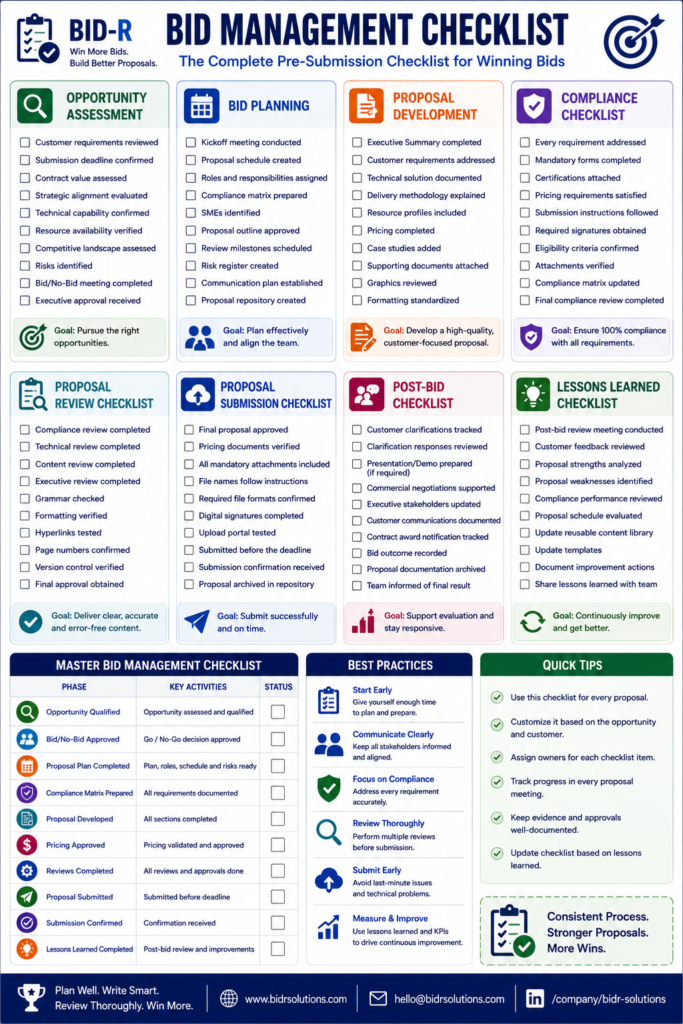
Phase 1: Opportunity Assessment Checklist
Before committing resources to a proposal, verify the opportunity.
Opportunity Qualification Checklist
☐ Customer requirements reviewed
☐ Submission deadline confirmed
☐ Contract value assessed
☐ Strategic alignment evaluated
☐ Technical capability confirmed
☐ Resource availability verified
☐ Competitive landscape assessed
☐ Risks identified
☐ Bid/No-Bid meeting completed
☐ Executive approval received
Phase 2: Bid Planning Checklist
Once the decision to pursue the opportunity has been made, prepare the proposal plan.
Bid Planning Checklist
☐ Kickoff meeting conducted
☐ Proposal schedule created
☐ Roles and responsibilities assigned
☐ Compliance matrix prepared
☐ SMEs identified
☐ Proposal outline approved
☐ Review milestones scheduled
☐ Risk register created
☐ Communication plan established
☐ Proposal repository created
Phase 3: Proposal Development Checklist
During proposal development, ensure all required content is prepared.
Proposal Development Checklist
☐ Executive Summary completed
☐ Customer requirements addressed
☐ Technical solution documented
☐ Delivery methodology explained
☐ Resource profiles included
☐ Pricing completed
☐ Case studies added
☐ Supporting documents attached
☐ Graphics reviewed
☐ Formatting standardized
Phase 4: Compliance Checklist
Compliance failures are among the leading causes of proposal rejection.
Compliance Checklist
☐ Every customer requirement addressed
☐ Mandatory forms completed
☐ Certifications attached
☐ Pricing requirements satisfied
☐ Submission instructions followed
☐ Required signatures obtained
☐ Eligibility criteria confirmed
☐ Attachments verified
☐ Compliance matrix updated
☐ Final compliance review completed
Phase 5: Proposal Review Checklist
Before submission, conduct structured reviews.
Proposal Review Checklist
☐ Compliance review completed
☐ Technical review completed
☐ Content review completed
☐ Executive review completed
☐ Grammar checked
☐ Formatting verified
☐ Hyperlinks tested
☐ Page numbers confirmed
☐ Version control verified
☐ Final approval obtained
Phase 6: Proposal Submission Checklist
Submitting a proposal is one of the most critical stages in the bid management lifecycle. Even a small oversight can result in disqualification.
Proposal Submission Checklist
☐ Final proposal approved by all stakeholders
☐ Pricing documents verified
☐ All mandatory attachments included
☐ File names follow customer instructions
☐ Required file formats confirmed
☐ Digital signatures completed
☐ Upload portal tested
☐ Submission completed before the deadline
☐ Submission confirmation received
☐ Proposal archived in the document repository
Phase 7: Post-Bid Checklist
The bid management process does not end with proposal submission. During the evaluation period, the Bid Manager should continue supporting the customer and internal stakeholders.
Post-Bid Checklist
☐ Customer clarification requests tracked
☐ Clarification responses reviewed
☐ Presentation/demo prepared (if required)
☐ Commercial negotiations supported
☐ Executive stakeholders updated
☐ Customer communications documented
☐ Contract award notification tracked
☐ Bid outcome recorded
☐ Proposal documentation archived
☐ Team informed of the final result
Phase 8: Lessons Learned Checklist
Every completed bid—whether won or lost—provides valuable insights that can improve future proposal performance.
Lessons Learned Checklist
☐ Conduct post-bid review meeting
☐ Review customer feedback
☐ Analyze proposal strengths
☐ Identify proposal weaknesses
☐ Review compliance performance
☐ Evaluate proposal schedule
☐ Update reusable content library
☐ Update templates
☐ Document improvement actions
☐ Share lessons learned with the proposal team
Master Bid Management Checklist
Use this master checklist before every proposal submission.
| Phase | Status |
|---|---|
| Opportunity Qualified | ☐ |
| Bid/No-Bid Approved | ☐ |
| Proposal Plan Completed | ☐ |
| Roles Assigned | ☐ |
| Compliance Matrix Prepared | ☐ |
| Proposal Developed | ☐ |
| Pricing Approved | ☐ |
| Technical Review Completed | ☐ |
| Compliance Review Completed | ☐ |
| Executive Review Completed | ☐ |
| Final Approval Obtained | ☐ |
| Proposal Submitted | ☐ |
| Submission Confirmation Received | ☐ |
| Customer Clarifications Managed | ☐ |
| Lessons Learned Completed | ☐ |
Printable Bid Management Checklist
For day-to-day proposal management, you can print or convert the following condensed checklist into a PDF.
Before You Start
☐ Opportunity qualified
☐ Bid/No-Bid approved
☐ Proposal schedule prepared
☐ Roles assigned
☐ Kickoff meeting completed
During Proposal Development
☐ Compliance matrix maintained
☐ Proposal sections completed
☐ Pricing finalized
☐ Graphics reviewed
☐ Supporting documents attached
Before Submission
☐ Compliance review passed
☐ Technical review completed
☐ Executive approval obtained
☐ Formatting verified
☐ Submission instructions followed
☐ Proposal submitted early
After Submission
☐ Confirmation received
☐ Clarifications managed
☐ Bid outcome recorded
☐ Lessons learned documented
Best Practices for Using a Bid Management Checklist
To maximize the value of your checklist:
- Customize it based on proposal complexity.
- Keep it updated as processes evolve.
- Assign ownership for each checklist item.
- Integrate it into your proposal workflow.
- Review it during every proposal meeting.
- Store completed checklists for audit purposes.
- Use digital checklists for easier collaboration.
- Update the checklist based on lessons learned.
A checklist is most effective when it becomes part of your organization’s standard operating procedure rather than an optional document.
Common Mistakes to Avoid
Even with a checklist, proposal teams should avoid these mistakes:
Treating the Checklist as a Formality
A checklist should guide actions—not simply be marked complete.
Skipping Reviews
Compliance, technical, and executive reviews remain essential even when a checklist is used.
Using Outdated Templates
Regularly update checklist items to reflect new customer requirements, procurement practices, and organizational processes.
Not Assigning Ownership
Every checklist item should have a clearly defined owner responsible for completion.
Ignoring Lessons Learned
The checklist should evolve continuously based on feedback from previous bids.
Conclusion
A Bid Management Checklist is one of the simplest yet most effective tools for improving proposal quality, reducing risk, and ensuring consistent execution across every bid. By following a structured checklist from opportunity qualification through post-bid review, proposal teams can minimize errors, strengthen compliance, improve collaboration, and submit higher-quality proposals with confidence.
Whether your organization manages a few strategic bids each year or hundreds of competitive proposals, incorporating a standardized checklist into your bid management process will help create repeatable success and support continuous improvement.
Call to Action
Download, customize, and use this Bid Management Checklist for every proposal your organization submits. Combine it with the guides in our Bid Management Fundamentals series to build a structured, efficient, and high-performing bid management function.
Related Articles
- What Is Bid Management?
- Bid Management Process Explained
- Bid Management Lifecycle
- Bid Manager Roles and Responsibilities
- Bid Management Best Practices
- Bid Management Framework
- Bid Management Methodologies
- Bid Management KPIs and Metrics
- Bid Management Challenges and Solutions
Frequently Asked Questions (FAQs)
What is a Bid Management Checklist?
A Bid Management Checklist is a structured list of tasks used to ensure that every stage of the bid lifecycle—from opportunity qualification to proposal submission and post-bid review—is completed accurately and consistently.
Why is a Bid Management Checklist important?
It helps proposal teams reduce errors, improve compliance, strengthen collaboration, maintain consistency, and ensure that all customer requirements are addressed before submission.
What should be included in a Bid Management Checklist?
A comprehensive checklist should include opportunity qualification, bid planning, proposal development, compliance verification, proposal reviews, submission activities, post-bid actions, and lessons learned.
Who should use a Bid Management Checklist?
Bid Managers, Proposal Managers, Business Development teams, Sales professionals, Solution Architects, and anyone involved in preparing competitive bids can benefit from using a standardized checklist.
How often should a Bid Management Checklist be updated?
Organizations should review and update their checklist regularly based on changes in procurement requirements, internal processes, customer feedback, and lessons learned from previous bids.