Introduction
Bid Management Best Practices help organizations create structured, efficient, and customer-focused proposal processes that improve quality and increase bid win rates. Whether you’re responding to government tenders, commercial RFPs, or private procurement opportunities, following proven best practices reduces risk, strengthens collaboration, and ensures every proposal is submitted on time.
Winning organizations rarely rely on individual effort or last-minute work. Instead, they follow standardized processes, use reusable templates, conduct thorough reviews, and continuously improve based on lessons learned.
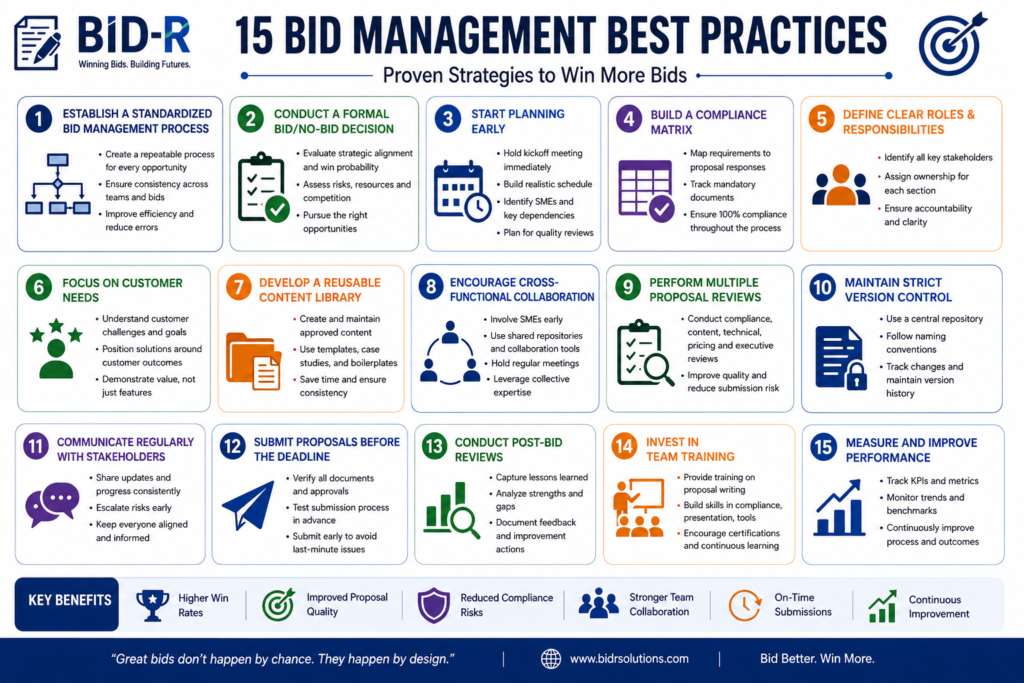
In this guide, you’ll discover 15 practical bid management best practices that successful organizations use to deliver high-quality proposals and improve their competitive advantage.
Table of Contents
Key Takeaways
- Standardized processes improve proposal consistency and quality.
- Early planning reduces last-minute pressure.
- Strong collaboration leads to better proposals.
- Multiple review stages improve compliance and accuracy.
- Continuous improvement helps increase future bid win rates.
Why Bid Management Best Practices Matter
Preparing a proposal involves multiple stakeholders, strict deadlines, technical requirements, pricing, compliance, and customer expectations. Without a structured approach, organizations often face missed deadlines, inconsistent messaging, and proposal errors.
Implementing best practices helps organizations:
- Improve proposal quality
- Increase bid win rates
- Reduce compliance risks
- Improve collaboration
- Enhance productivity
- Create repeatable processes
- Deliver proposals on time
- Build customer confidence
The organizations that consistently win contracts are usually those that have invested in mature bid management practices.
1. Establish a Standardized Bid Management Process
One of the most important best practices is to create a repeatable bid management process that every proposal team follows.
A standardized process ensures that each opportunity is managed consistently from qualification to submission.
Typical stages include:
- Opportunity Identification
- Bid/No-Bid Decision
- Planning
- Proposal Development
- Reviews
- Submission
- Lessons Learned
Standardization improves efficiency and reduces the likelihood of missing critical activities.
2. Conduct a Formal Bid/No-Bid Decision
Not every opportunity is worth pursuing.
Organizations should evaluate every opportunity before committing resources.
Consider factors such as:
- Strategic alignment
- Technical capability
- Customer relationship
- Revenue potential
- Competition
- Resource availability
- Probability of winning
A disciplined Bid/No-Bid process helps teams focus on opportunities with the greatest chance of success.
3. Start Planning Early
Successful proposals begin with careful planning.
Immediately after deciding to pursue an opportunity:
- Hold a kickoff meeting.
- Review customer requirements.
- Build a proposal schedule.
- Assign responsibilities.
- Identify subject matter experts.
- Establish review dates.
Early planning provides sufficient time for collaboration and quality reviews.
4. Build a Compliance Matrix
A compliance matrix maps every customer requirement to the corresponding proposal response.
It helps ensure that:
- Every requirement is addressed.
- Mandatory documents are included.
- Responsibilities are clearly assigned.
- Progress can be tracked efficiently.
Maintaining a compliance matrix throughout the proposal lifecycle significantly reduces the risk of non-compliant submissions.
5. Define Clear Roles and Responsibilities
Every contributor should understand their responsibilities from the beginning.
Typical stakeholders include:
- Bid Manager
- Sales Manager
- Solution Architect
- Subject Matter Experts
- Finance Team
- Legal Team
- Delivery Team
- Executive Sponsor
Clearly defined ownership improves accountability and minimizes confusion.
6. Focus on Customer Needs
Winning proposals focus on solving customer problems rather than simply describing products or services.
Instead of asking:
“What do we offer?”
Ask:
“How does our solution help the customer achieve their objectives?”
Customer-focused proposals consistently outperform product-focused proposals.
7. Develop a Reusable Content Library
Many proposal sections can be reused across multiple bids.
Examples include:
- Company profile
- Certifications
- Case studies
- Team biographies
- Methodologies
- Security information
- Quality processes
Maintaining a centralized content library reduces proposal preparation time while improving consistency.
8. Encourage Cross-Functional Collaboration
Winning proposals require contributions from multiple departments.
Effective collaboration includes:
- Regular progress meetings
- Shared document repositories
- Clear communication channels
- Early SME engagement
- Defined review schedules
Strong collaboration leads to higher-quality proposals and fewer last-minute issues.
9. Perform Multiple Proposal Reviews
One of the biggest differences between average proposals and winning proposals is the quality of the review process.
Rather than conducting a single review before submission, organizations should implement multiple review stages.
Typical reviews include:
- Compliance Review
- Content Review
- Technical Review
- Pricing Review
- Executive Review
- Final Proofreading
Each review has a different objective, helping identify issues before submission.
A structured review process improves proposal quality, consistency, and customer confidence.
10. Maintain Strict Version Control
Proposal documents often pass through multiple contributors and revisions.
Without proper version control, teams may accidentally overwrite changes, submit outdated content, or create inconsistencies.
Best practices include:
- Using a centralized document repository
- Defining file naming conventions
- Limiting editing permissions
- Maintaining version history
- Assigning a document owner
Effective version control reduces confusion and ensures everyone works on the latest proposal.
11. Communicate Regularly with Stakeholders
Communication is critical throughout the bid lifecycle.
The Bid Manager should keep all stakeholders informed through:
- Kickoff meetings
- Daily or weekly status meetings
- Progress reports
- Risk updates
- Executive briefings
- Clarification discussions
Regular communication helps resolve issues quickly and keeps the proposal on schedule.
12. Submit Proposals Before the Deadline
Submitting at the last minute increases the risk of technical failures, missing documents, and unnecessary stress.
Instead, aim to submit proposals several hours before the deadline.
Before submission, verify:
- All required documents are attached.
- Mandatory forms are completed.
- Pricing files are correct.
- File names follow customer instructions.
- Executive approvals have been obtained.
- The final proposal has been reviewed.
Early submission provides time to resolve unexpected issues if they arise.
13. Conduct Post-Bid Reviews
Whether the proposal is successful or unsuccessful, every bid should end with a structured review.
A post-bid review helps answer questions such as:
- What worked well?
- What challenges did we encounter?
- Were deadlines realistic?
- Did our compliance process work effectively?
- What feedback did the customer provide?
- How can we improve future proposals?
Documenting lessons learned helps organizations continuously improve their bid management process.
14. Invest in Team Training
Bid management continues to evolve as customer expectations, procurement processes, and proposal technologies change.
Organizations should regularly invest in training covering:
- Proposal writing
- Bid management methodologies
- Compliance management
- Presentation skills
- Project management
- Negotiation
- Industry certifications
- Proposal management software
Continuous learning strengthens proposal teams and improves long-term performance.
15. Measure and Improve Performance
Successful organizations regularly measure proposal performance using Key Performance Indicators (KPIs).
Useful metrics include:
- Bid win rate
- Proposal quality score
- On-time submission rate
- Compliance score
- Proposal turnaround time
- Customer satisfaction
- Resource utilization
- Cost of bidding
Reviewing these metrics helps identify trends and opportunities for improvement.
Common Bid Management Mistakes to Avoid
Even experienced proposal teams can make mistakes that reduce their chances of success.
Avoid these common pitfalls:
Chasing Every Opportunity
Submitting bids for every available opportunity often wastes valuable resources.
Focus on opportunities that align with your organization’s strengths and strategic goals.
Starting Too Late
Late planning leads to rushed proposals, increased stress, and lower-quality submissions.
Begin planning immediately after the Bid/No-Bid decision.
Ignoring Compliance
Missing mandatory requirements can result in immediate disqualification.
Always use a compliance matrix and review it throughout the proposal lifecycle.
Weak Executive Summaries
The executive summary is often the first section evaluators read.
Ensure it clearly explains:
- Customer challenges
- Proposed solution
- Business value
- Competitive advantages
Poor Collaboration
Proposal quality suffers when contributors work in isolation.
Encourage regular communication and collaborative review sessions.
Failing to Learn from Previous Bids
Organizations that ignore lessons learned repeat the same mistakes.
Capture feedback after every bid and incorporate improvements into future proposals.
Bid Management Best Practices Checklist
Use this checklist before every proposal.
| Best Practice | Status |
|---|---|
| Conduct Bid/No-Bid Review | ☐ |
| Develop Proposal Schedule | ☐ |
| Create Compliance Matrix | ☐ |
| Assign Proposal Owners | ☐ |
| Hold Kickoff Meeting | ☐ |
| Maintain Version Control | ☐ |
| Conduct Multiple Reviews | ☐ |
| Verify Customer Requirements | ☐ |
| Obtain Executive Approval | ☐ |
| Submit Before Deadline | ☐ |
| Conduct Lessons Learned Review | ☐ |
Conclusion
Following proven Bid Management Best Practices helps organizations create repeatable, efficient, and customer-focused proposal processes. By implementing structured planning, encouraging collaboration, ensuring compliance, conducting multiple reviews, and continuously improving through lessons learned, proposal teams can significantly increase their chances of winning competitive bids.
Winning proposals are rarely the result of last-minute effort. They are the outcome of disciplined processes, experienced teams, and a commitment to continuous improvement.
Whether your organization manages a few bids each year or hundreds of proposals across multiple business units, adopting these best practices will strengthen proposal quality, improve operational efficiency, and contribute to long-term business growth.
Call to Action
Ready to improve your proposal success rate? Explore our complete Bid Management Fundamentals series to learn more about bid management processes, frameworks, KPIs, methodologies, and practical strategies for building a high-performing bid management function.
Related Articles
- What Is Bid Management?
- Bid Management Process Explained
- Bid Management Lifecycle
- Bid Manager Roles and Responsibilities
- Bid Management Framework
- Bid Management Methodologies
- Bid Management KPIs and Metrics
- Bid Management Challenges and Solutions
- Bid Management Checklist
Frequently Asked Questions (FAQs)
What are bid management best practices?
Bid management best practices are proven methods that help organizations improve proposal quality, ensure compliance, strengthen collaboration, and increase the likelihood of winning competitive bids.
Why are bid management best practices important?
They provide a structured approach to planning, proposal development, reviews, submission, and continuous improvement, helping organizations deliver high-quality proposals while reducing risk.
How can organizations improve their bid management process?
Organizations can improve by standardizing their bid process, creating compliance matrices, using reusable templates, conducting multiple reviews, measuring KPIs, and capturing lessons learned after every bid.
What is the most important bid management best practice?
Although every practice adds value, establishing a standardized bid management process and conducting a disciplined Bid/No-Bid decision are among the most impactful steps for improving proposal quality and win rates.
How do bid management best practices improve win rates?
By improving planning, collaboration, compliance, proposal quality, and continuous improvement, organizations can submit stronger proposals that better address customer requirements and stand out from competitors.