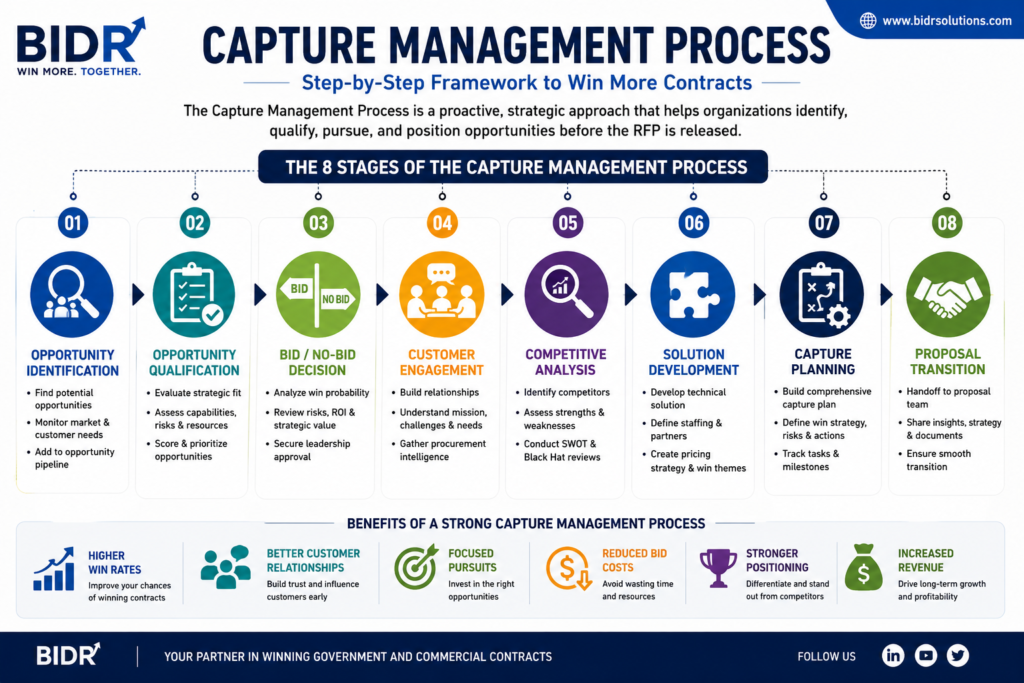
Capture Management Process is the structured approach organizations use to identify, qualify, pursue, and position business opportunities before a Request for Proposal (RFP) is released. It transforms a potential opportunity into a well-planned pursuit by combining customer engagement, competitive intelligence, solution development, and strategic planning.
Rather than waiting for an RFP to appear, organizations following a mature capture process begin months—or even years—in advance. This proactive approach significantly improves win rates, strengthens customer relationships, and enables proposal teams to respond with well-informed, customer-focused solutions.
For government contractors, IT service providers, engineering firms, consulting companies, and large enterprises, the capture management process is a critical component of successful business development.
Table of Contents
Why the Capture Management Process is Important
Winning contracts rarely starts when the RFP is published.
Most successful organizations have already invested time in:
- Understanding the customer’s mission
- Building relationships with decision-makers
- Identifying competitors
- Developing differentiated solutions
- Establishing pricing strategies
- Forming teaming partnerships
- Assessing risks
- Creating a capture plan
Without a structured process, organizations often:
- Pursue low-probability opportunities
- Waste proposal resources
- Miss customer expectations
- Struggle against incumbents
- Produce reactive instead of strategic proposals
A disciplined capture management process ensures that every pursuit is guided by data, planning, and informed decision-making.
Benefits of Following a Structured Capture Management Process
Organizations that implement a formal capture framework experience several advantages.
Higher Win Rates
Capture activities improve understanding of customer priorities and competitive positioning, leading to stronger proposals and a higher probability of award.
Better Resource Allocation
The capture process helps organizations focus proposal resources on opportunities that align with their capabilities and strategic goals.
Improved Customer Relationships
Early engagement builds trust and provides valuable insights into customer expectations before formal procurement begins.
Reduced Proposal Costs
Pursuing every opportunity is expensive.
A structured qualification process reduces unnecessary proposal effort by eliminating poor-fit opportunities early.
Stronger Competitive Positioning
Competitive intelligence gathered during capture enables organizations to develop clear differentiators and compelling win themes.
The 8 Stages of the Capture Management Process
A mature capture process follows a series of interconnected stages that progressively improve an organization’s readiness to compete.
Stage 1: Opportunity Identification
Every capture effort begins by identifying potential business opportunities.
Sources of opportunities include:
- Government procurement portals
- Procurement forecasts
- Existing customer contracts nearing expiration
- Business development activities
- Industry conferences
- Market research
- Customer referrals
- Strategic partnerships
During this stage, organizations evaluate whether an opportunity aligns with their business objectives, technical expertise, and long-term growth strategy.
Key Deliverables
- Opportunity summary
- Initial opportunity assessment
- Pipeline entry
- Customer overview
Stage 2: Opportunity Qualification
Not every opportunity deserves investment.
Qualification determines whether an opportunity is worth pursuing based on objective criteria.
Common qualification questions include:
- Does the opportunity align with our strategic goals?
- Do we have the required capabilities?
- Is funding available?
- Can we meet the schedule?
- Do we understand the customer?
- Can we compete effectively?
- Do we have relevant past performance?
- Is the expected return acceptable?
Many organizations use qualification frameworks such as Shipley, APMP guidance, or customized scoring models to support this decision.
Key Deliverables
- Qualification checklist
- Opportunity scorecard
- Risk assessment
- Qualification recommendation
Stage 3: Bid/No-Bid Decision
Once an opportunity has been qualified, executive leadership determines whether to invest in the pursuit.
Typical evaluation criteria include:
- Win probability
- Strategic importance
- Revenue potential
- Resource availability
- Technical capability
- Customer relationship strength
- Competitive position
- Financial return
- Delivery risks
A disciplined Bid/No-Bid process prevents organizations from investing significant effort in opportunities with a low chance of success.
Key Deliverables
- Bid/No-Bid decision
- Executive approval
- Pursuit authorization
- Capture kickoff
Stage 4: Customer Engagement
Customer engagement is one of the most valuable phases of the capture management process.
Capture Managers collaborate with Business Development teams to:
- Schedule customer meetings
- Conduct capability briefings
- Understand mission objectives
- Validate assumptions
- Identify pain points
- Gather procurement intelligence
- Build trust with stakeholders
The objective is not to sell a product immediately but to understand the customer’s needs and position the organization as a trusted partner.
Best Practices
- Listen more than you speak.
- Ask insightful questions.
- Document customer feedback.
- Build relationships across multiple stakeholder groups.
- Maintain regular communication while respecting procurement regulations.
Stage 5: Competitive Analysis
Understanding competitors is essential for developing an effective win strategy.
Capture teams analyze:
- Incumbent contractor performance
- Competitor strengths and weaknesses
- Pricing tendencies
- Technical differentiators
- Past contract awards
- Customer preferences
- Market positioning
A SWOT analysis and Black Hat review are commonly used techniques during this stage.
Key Deliverables
- Competitor profiles
- SWOT analysis
- Black Hat review findings
- Competitive assessment report
Stage 6: Solution Development
Once the opportunity has been qualified and sufficient customer intelligence has been gathered, the next step in the Capture Management Process is developing a solution that directly addresses the customer’s needs.
This phase is collaborative and typically involves:
- Solution Architects
- Technical Subject Matter Experts (SMEs)
- Delivery Managers
- Pricing Teams
- Business Development Managers
- Capture Managers
The objective is to create a compelling, technically sound, and commercially viable solution before the RFP is released.
Activities During Solution Development
Develop the Technical Solution
The proposed solution should:
- Address customer pain points
- Meet anticipated requirements
- Demonstrate innovation
- Minimize implementation risks
- Be scalable and cost-effective
Develop the Staffing Strategy
Capture teams identify:
- Key personnel
- Delivery teams
- Resource availability
- Subcontractors
- Strategic partners
Having a realistic staffing strategy early improves proposal readiness.
Define the Pricing Strategy
Pricing teams collaborate with Capture Managers to determine:
- Competitive pricing
- Profitability targets
- Contract assumptions
- Cost estimates
- Pricing risks
A well-balanced pricing strategy is often a key differentiator.
Create Win Themes
Win themes answer one critical customer question:
“Why should we choose your organization over everyone else?”
Strong win themes are:
- Customer-focused
- Evidence-based
- Relevant
- Measurable
- Differentiated
Examples include:
- Proven past performance
- Faster implementation
- Lower operational risk
- Innovative technology
- Experienced delivery team
- Cost savings
Stage 7: Capture Planning
The Capture Plan is the central document that guides the entire pursuit.
It consolidates all information gathered during the capture process into a structured action plan.
A comprehensive Capture Plan typically includes:
Executive Summary
A high-level overview of:
- Opportunity
- Customer
- Contract value
- Timeline
- Objectives
Customer Analysis
Includes:
- Customer mission
- Business challenges
- Procurement history
- Organizational structure
- Key stakeholders
- Decision-makers
Opportunity Analysis
Documents:
- Scope
- Expected requirements
- Risks
- Strategic importance
- Contract type
Competitor Assessment
Captures:
- Incumbent contractor
- Strengths
- Weaknesses
- Pricing assumptions
- Competitive positioning
Win Strategy
Defines:
- Differentiators
- Customer benefits
- Win themes
- Key messages
- Value proposition
Risk Register
Identifies:
- Technical risks
- Schedule risks
- Pricing risks
- Resource risks
- Customer risks
Each risk should include mitigation actions.
Action Plan
Tracks:
- Tasks
- Owners
- Due dates
- Status
- Dependencies
This keeps capture activities on schedule.
Stage 8: Proposal Transition
When the RFP is released, ownership transitions from the Capture Manager to the Proposal Manager.
A structured handover ensures that valuable knowledge gained during capture is not lost.
The Proposal Manager should receive:
- Customer intelligence
- Opportunity background
- Capture Plan
- Competitive analysis
- Win themes
- Compliance insights
- Solution strategy
- Pricing assumptions
- Risk register
- Partner agreements
- Key contacts
- Lessons learned
This allows the proposal team to focus on creating a compliant, persuasive response rather than rediscovering information.
Roles Throughout the Capture Management Process
Although the Capture Manager leads the process, success depends on cross-functional collaboration.
| Role | Primary Responsibility |
|---|---|
| Capture Manager | Leads the pursuit strategy and coordinates capture activities |
| Business Development Manager | Builds customer relationships and identifies opportunities |
| Proposal Manager | Manages proposal development after RFP release |
| Solution Architect | Designs the technical solution |
| Pricing Manager | Develops competitive pricing strategies |
| Executive Sponsor | Provides strategic direction and approvals |
| Subject Matter Experts | Contribute technical expertise and solution validation |
| Contracts Team | Reviews contractual and compliance considerations |
Capture Management Process Best Practices
Organizations with mature capture capabilities consistently follow these best practices.
Start Early
Begin capture activities 6–24 months before the expected RFP release whenever possible.
Understand the Customer
Invest time in learning:
- Mission objectives
- Pain points
- Procurement priorities
- Budget cycles
- Decision-making process
Focus on High-Probability Opportunities
Avoid pursuing every available opportunity.
Use qualification criteria to prioritize pursuits with the highest likelihood of success.
Develop Strong Win Themes
Your solution should clearly communicate:
- Why your organization is the best choice
- How customer challenges will be solved
- What differentiates your approach
Conduct Regular Capture Reviews
Periodic reviews ensure:
- Risks are addressed
- Strategies remain relevant
- Stakeholders stay aligned
- Actions are completed on time
Maintain a Living Capture Plan
Capture Plans should be updated continuously as new customer insights, competitive intelligence, or procurement information becomes available.
Common Challenges in the Capture Management Process
Even experienced organizations encounter obstacles.
Limited Customer Access
Procurement regulations may restrict direct interaction with customers, making intelligence gathering more difficult.
Strong Incumbent Advantage
Existing contractors often benefit from established relationships and deep knowledge of the customer’s environment.
Incomplete Information
Capture decisions are frequently made before final requirements are published.
Organizations must rely on market intelligence and customer engagement to reduce uncertainty.
Resource Constraints
Key SMEs and technical experts may be assigned to multiple pursuits simultaneously.
Proper prioritization is essential.
Aggressive Procurement Timelines
Unexpected changes in procurement schedules can compress capture activities and reduce preparation time.
Tools Used in the Capture Management Process
Successful capture teams use specialized tools to organize information, collaborate, and monitor progress.
Customer Relationship Management (CRM)
- Microsoft Dynamics 365
- Salesforce
- HubSpot
Government Opportunity Platforms
Collaboration Platforms
- Microsoft Teams
- SharePoint
- Confluence
Proposal Automation Tools
Project Management Tools
- Microsoft Project
- Jira
- Asana
- Monday.com
Key Deliverables of the Capture Management Process
A successful capture effort produces several important outputs before proposal development begins.
- Opportunity Qualification Checklist
- Bid/No-Bid Decision
- Customer Intelligence Report
- Stakeholder Map
- Competitor Analysis
- SWOT Analysis
- Black Hat Review
- Capture Plan
- Solution Strategy
- Pricing Strategy
- Win Themes
- Risk Register
- Proposal Transition Package
These deliverables provide the Proposal Manager with everything needed to begin proposal development efficiently.
Conclusion
A well-defined Capture Management Process enables organizations to move from reactive bidding to proactive opportunity pursuit. By following a structured framework—from opportunity identification and qualification through customer engagement, competitive analysis, solution development, capture planning, and proposal transition—organizations can improve decision-making, allocate resources more effectively, and significantly increase contract win rates.
The most successful organizations understand that winning begins long before proposal writing. Investing in disciplined capture activities creates stronger customer relationships, sharper competitive positioning, and more compelling proposals that stand out in competitive government and commercial procurements.
Whether you are a Capture Manager, Proposal Manager, Business Development professional, or government contractor, mastering the capture management process is essential for building a repeatable and scalable pursuit strategy.
Continue Learning with BidR
Deepen your expertise with these related resources:
- What is Capture Management? Complete Guide to Winning More Contracts (2026)
- Capture Manager Roles and Responsibilities
- Capture Planning: How to Build a Winning Capture Plan
- Capture Management Lifecycle
- Capture Management Best Practices
- Capture Manager Skills
- Capture Management Tools and Software
- Capture Management KPIs
- Capture Management vs Proposal Management
- What is Proposal Management? Complete Guide
- What is Bid Management? Complete Guide
Call to Action (CTA)
Build a Winning Capture Process with BidR
A repeatable capture management process is the foundation of consistent contract success. Explore BidR Solutions for expert guides, practical templates, checklists, and proven strategies to strengthen your capture, proposal, and bid management capabilities. Whether you’re pursuing government contracts or commercial opportunities, BidR provides the resources you need to improve win rates and build a high-performing pursuit organization.
Frequently Asked Questions (FAQs)
What is the Capture Management Process?
The Capture Management Process is a structured framework used to identify, qualify, pursue, and prepare for business opportunities before the Request for Proposal (RFP) is released.
How many stages are in the Capture Management Process?
A typical process includes eight stages:
1. Opportunity Identification
2. Opportunity Qualification
3. Bid/No-Bid Decision
4. Customer Engagement
5. Competitive Analysis
6. Solution Development
7. Capture Planning
8. Proposal Transition
Who owns the Capture Management Process?
The Capture Manager leads the process with support from Business Development, Solution Architects, Proposal Managers, Pricing Specialists, and executive leadership.
Why is a Capture Plan important?
A Capture Plan serves as the strategic roadmap for pursuing an opportunity by documenting customer insights, competitor analysis, win strategies, risks, and action plans.
When does the Capture Management Process end?
The process concludes when the opportunity is formally transitioned to the Proposal Manager after the RFP is released.