Introduction
Winning business through competitive bids requires much more than writing a persuasive proposal. Behind every successful submission is a structured lifecycle that guides an opportunity from initial discovery to contract award and continuous improvement.
The bid management lifecycle provides organizations with a systematic approach to managing every phase of the bidding process. By following a defined lifecycle, businesses can improve collaboration, reduce errors, increase compliance, and ultimately submit stronger, more competitive proposals.
Whether your organization responds to government tenders, commercial RFPs, or private procurement opportunities, understanding the bid management lifecycle helps ensure that every bid is managed consistently and efficiently.
In this guide, you’ll learn each stage of the bid management lifecycle, the activities involved, common challenges, and best practices for improving proposal success.
Table of Contents
What Is the Bid Management Lifecycle?
The bid management lifecycle is the end-to-end sequence of activities involved in managing a business opportunity from the moment it is identified until the proposal is submitted, evaluated, and the project is either won or lost.
Unlike the bid management process, which focuses on the operational steps required to complete a proposal, the lifecycle provides a broader perspective by emphasizing continuous improvement before, during, and after each bid.
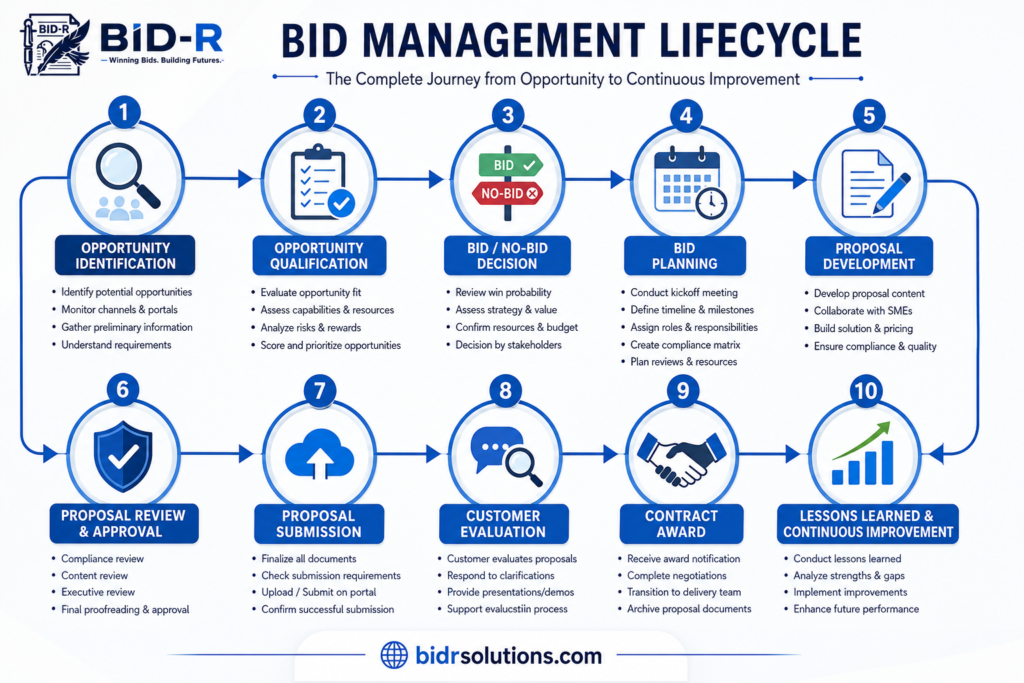
A typical bid management lifecycle includes:
- Opportunity Identification
- Qualification
- Bid/No-Bid Decision
- Bid Planning
- Proposal Development
- Review and Approval
- Submission
- Evaluation
- Contract Award
- Lessons Learned
Each stage contributes to the overall success of the bid and helps organizations continuously refine their proposal management practices.
Why Is the Bid Management Lifecycle Important?
Organizations that manage bids without a defined lifecycle often face problems such as missed deadlines, inconsistent proposal quality, poor collaboration, and compliance issues.
Implementing a structured lifecycle offers several advantages.
Improved Consistency
Every opportunity follows the same structured approach, ensuring that no critical activities are overlooked.
Better Resource Management
The lifecycle helps managers allocate the right people, tools, and time at each stage.
Higher Proposal Quality
Clearly defined review stages improve proposal accuracy, consistency, and customer focus.
Increased Win Rates
Organizations that follow mature bid management practices generally achieve higher success rates because they make better pursuit decisions and produce stronger proposals.
Continuous Improvement
One of the biggest advantages of the lifecycle is that every completed bid becomes an opportunity to improve future performance.
Stage 1: Opportunity Identification
Every bid begins with identifying a potential business opportunity.
Organizations discover opportunities through various sources, including:
- Government procurement portals
- Customer procurement platforms
- Existing clients
- CRM systems
- Sales teams
- Framework agreements
- Industry events
- Business development activities
At this stage, the objective is to determine whether the opportunity aligns with the organization’s capabilities and strategic goals.
Typical activities include:
- Monitoring tender portals
- Reviewing customer requirements
- Understanding submission deadlines
- Estimating contract value
- Identifying competitors
- Gathering preliminary information
The earlier an opportunity is identified, the more time the organization has to prepare a high-quality proposal.
Stage 2: Opportunity Qualification
Not every opportunity deserves equal attention.
Before investing significant resources, organizations should qualify the opportunity by evaluating several factors.
These include:
- Customer relationship
- Strategic alignment
- Technical capability
- Resource availability
- Budget expectations
- Delivery timeline
- Geographic considerations
- Risk level
- Competitive position
Many organizations use opportunity scoring models to rank potential bids according to their likelihood of success.
Effective qualification prevents teams from wasting time on low-probability pursuits and ensures resources are directed toward the most valuable opportunities.
Stage 3: Bid/No-Bid Decision
Once an opportunity has been qualified, senior stakeholders decide whether the organization should pursue it.
The Bid/No-Bid meeting typically includes representatives from:
- Sales
- Business Development
- Delivery
- Finance
- Legal
- Executive Leadership
- Bid Management
During this meeting, the team evaluates:
- Win probability
- Revenue potential
- Profitability
- Strategic value
- Available resources
- Customer relationship
- Compliance risks
If the opportunity meets the organization’s objectives, the proposal moves to the planning stage.
Otherwise, the opportunity is declined, allowing resources to be redirected toward more promising pursuits.
Stage 4: Bid Planning
After deciding to pursue the opportunity, the bid manager develops a comprehensive proposal plan.
Planning activities include:
- Conducting the kickoff meeting
- Defining proposal timelines
- Creating the compliance matrix
- Assigning proposal owners
- Identifying subject matter experts
- Scheduling review sessions
- Preparing the proposal outline
- Identifying risks and dependencies
A detailed bid plan ensures that everyone involved understands their responsibilities and deadlines.
It also minimizes confusion and reduces last-minute surprises during proposal development.
Stage 5: Proposal Development
Proposal development is the core stage of the bid management lifecycle. During this phase, the bid team collaborates to create a compelling, compliant, and customer-focused proposal that clearly demonstrates why the organization is the best choice.
Rather than simply describing products or services, the proposal should address the customer’s objectives, challenges, and evaluation criteria. Every section should add value and reinforce the organization’s ability to deliver the required outcomes.
A typical proposal includes:
- Executive Summary
- Company Profile
- Understanding of Customer Requirements
- Proposed Solution
- Technical Approach
- Implementation Methodology
- Project Governance
- Team Structure
- Resource Profiles
- Pricing and Commercials
- Risk Management Plan
- Quality Assurance
- Case Studies
- References
- Supporting Documents
Throughout this stage, the Bid Manager coordinates contributions from multiple stakeholders, including solution architects, subject matter experts (SMEs), sales teams, finance, legal, and project managers.
Effective collaboration, consistent messaging, and strong version control are essential to maintaining proposal quality.
Stage 6: Proposal Review and Approval
Before submitting a proposal, it should undergo multiple review cycles to ensure it is accurate, complete, and fully compliant with customer requirements.
Most organizations perform different types of reviews.
Compliance Review
The compliance review verifies that every customer requirement has been addressed and that all mandatory documents have been included.
Typical checks include:
- Mandatory forms
- Eligibility criteria
- Technical compliance
- Commercial requirements
- Submission instructions
- Required certifications
Content Review
The content review evaluates the quality and effectiveness of the proposal.
Reviewers assess whether:
- The proposal answers every question.
- The messaging is customer-focused.
- The value proposition is clear.
- The writing is concise and persuasive.
- Graphics and tables support the narrative.
Executive Review
Senior leadership validates:
- Commercial strategy
- Pricing
- Delivery capability
- Strategic alignment
- Overall competitiveness
Final Proofreading
Before submission, the proposal is carefully reviewed for:
- Grammar
- Formatting
- Spelling
- Page numbering
- Cross-references
- Hyperlinks
- Attachment completeness
Many organizations also conduct formal Pink Team, Red Team, or Gold Team reviews to further strengthen proposal quality.
Stage 7: Proposal Submission
Once all approvals have been received, the proposal is prepared for submission.
Depending on customer requirements, submissions may be completed through:
- Government procurement portals
- Customer procurement systems
- Secure file transfer portals
- Physical document submission
Before submitting, the Bid Manager should confirm:
- Every required document has been attached.
- Pricing files are correct.
- File names follow customer instructions.
- Digital signatures have been completed.
- Submission deadlines are met.
- The final version has executive approval.
Submitting well before the deadline helps avoid technical issues and reduces unnecessary stress.
Stage 8: Customer Evaluation
After submission, the customer begins evaluating all received proposals.
Evaluation activities may include:
- Technical assessment
- Commercial evaluation
- Compliance verification
- Risk analysis
- Vendor presentations
- Product demonstrations
- Clarification requests
- Reference checks
During this period, the Bid Manager serves as the primary point of contact and coordinates responses to customer questions.
Providing timely, accurate, and professional responses reinforces customer confidence.
Stage 9: Contract Award
Once evaluations are complete, the customer announces the successful bidder.
If the organization wins:
- Complete contract negotiations.
- Conduct project handover.
- Transition to delivery teams.
- Archive proposal documentation.
- Celebrate the team’s achievement.
Winning a contract marks the beginning of project delivery rather than the end of the lifecycle.
A smooth transition from bid to delivery helps ensure customer satisfaction and successful project execution.
Stage 10: Lessons Learned and Continuous Improvement
Whether the bid is won or lost, every opportunity should conclude with a structured lessons learned session.
Winning organizations continuously improve by reviewing:
- What worked well
- What could be improved
- Customer feedback
- Internal collaboration
- Proposal quality
- Review effectiveness
- Resource planning
- Compliance issues
Common improvement actions include:
- Updating proposal templates
- Improving reusable content libraries
- Enhancing compliance checklists
- Refining Bid/No-Bid criteria
- Updating pricing strategies
- Training proposal teams
Organizations that consistently capture and apply lessons learned develop increasingly mature bid management capabilities over time.
Common Challenges Throughout the Bid Management Lifecycle
Managing the complete lifecycle presents several challenges.
Poor Opportunity Qualification
Pursuing every opportunity often leads to wasted resources.
Solution: Use a structured qualification and scoring process.
Inadequate Planning
Poor planning results in rushed proposals and missed deadlines.
Solution: Develop a detailed bid schedule immediately after the Bid/No-Bid decision.
Limited SME Availability
Subject matter experts frequently have competing priorities.
Solution: Secure commitments during planning and monitor progress regularly.
Compliance Errors
Missing mandatory requirements can result in automatic disqualification.
Solution: Maintain a comprehensive compliance matrix throughout the lifecycle.
Weak Communication
Lack of coordination creates inconsistent messaging and duplicated effort.
Solution: Conduct regular status meetings and use collaborative document management tools.
Best Practices for Managing the Bid Lifecycle
Organizations with high proposal win rates typically follow these best practices:
- Standardize the bid management lifecycle.
- Conduct structured Bid/No-Bid reviews.
- Build reusable proposal content libraries.
- Develop detailed bid plans.
- Assign clear ownership for every proposal section.
- Use collaboration and document management tools.
- Schedule multiple review cycles.
- Maintain version control.
- Submit proposals before the deadline.
- Capture lessons learned after every opportunity.
These practices improve consistency, efficiency, and proposal quality while reducing operational risk.
Bid Management Lifecycle vs. Bid Management Process
Although these terms are often used interchangeably, they have distinct meanings.
| Bid Management Lifecycle | Bid Management Process |
|---|---|
| Covers the complete journey from opportunity identification to lessons learned | Focuses on the operational activities required to complete a proposal |
| Strategic and continuous | Operational and task-oriented |
| Includes post-award improvement | Usually ends with proposal submission or award |
| Emphasizes continuous improvement | Emphasizes execution |
Understanding this distinction helps organizations build both effective processes and mature bid management practices.
Conclusion
The bid management lifecycle provides organizations with a structured framework for managing every stage of a competitive pursuit. From identifying opportunities and qualifying prospects to developing proposals, managing reviews, submitting responses, and capturing lessons learned, each stage plays an essential role in improving proposal quality and increasing win rates.
Organizations that invest in a standardized lifecycle benefit from greater consistency, stronger collaboration, improved compliance, and continuous learning. Rather than treating each bid as an isolated event, they build repeatable processes that enhance performance over time.
Whether you are responding to government tenders, commercial RFPs, or strategic procurement opportunities, adopting a mature bid management lifecycle will help your organization compete more effectively and achieve sustainable business growth.
Key Takeaways
- The bid management lifecycle covers every stage from opportunity identification to lessons learned.
- A structured lifecycle improves proposal quality and submission efficiency.
- Each stage has specific objectives, deliverables, and stakeholders.
- Continuous improvement after every bid increases future win rates.
- Standardizing the lifecycle helps organizations build repeatable success.
Call to Action
A successful bid doesn’t end with proposal submission—it continues through evaluation, contract award, and continuous improvement. Explore our other BidR guides to learn about bid management frameworks, proposal best practices, KPIs, and the essential skills every Bid Manager should master.
Related Articles
- What Is Bid Management?
- Bid Management Process Explained
- Bid Manager Roles and Responsibilities: A Complete Guide
- Bid Management Best Practices: 15 Proven Strategies to Win More Bids
- Bid Management Framework: A Complete Guide to Building a Winning Bid Process
- Bid Management Methodologies: 8 Proven Approaches for Winning More Bids
- Bid Management KPIs and Metrics: 20 Key Measures to Improve Bid Success
- Bid Management Challenges and Solutions: 15 Common Problems and How to Overcome Them
- Bid Management Checklist: The Complete Pre-Submission Checklist for Winning Bids
Frequently Asked Questions (FAQs)
What is the bid management lifecycle?
The bid management lifecycle is the complete sequence of activities involved in managing a bid, from identifying an opportunity and qualifying it to developing the proposal, submitting it, managing customer evaluations, and capturing lessons learned after the contract award.
What are the stages of the bid management lifecycle?
The typical stages include Opportunity Identification, Opportunity Qualification, Bid/No-Bid Decision, Bid Planning, Proposal Development, Proposal Review, Submission, Customer Evaluation, Contract Award, and Lessons Learned.
What is the difference between the bid management lifecycle and the bid management process?
The bid management lifecycle covers the entire journey of a bid, including post-award activities and continuous improvement. The bid management process focuses on the operational tasks required to prepare and submit a proposal.
Why is the bid management lifecycle important?
A structured lifecycle improves collaboration, proposal quality, compliance, resource planning, and overall bid success while helping organizations continuously improve future proposals.
Who is responsible for managing the bid management lifecycle?
The Bid Manager typically oversees the lifecycle, coordinating sales teams, subject matter experts, solution architects, finance, legal, and executive leadership to ensure a successful bid from start to finish.