Introduction
Bid Management Framework is the foundation that enables organizations to manage bids consistently, efficiently, and successfully. Rather than relying on individual experience or ad hoc processes, a structured framework establishes standardized practices, governance, roles, templates, and quality controls that improve proposal quality and increase bid win rates.
Whether responding to government tenders, commercial RFPs, or private procurement opportunities, organizations with a mature bid management framework are better equipped to manage complex proposals, coordinate cross-functional teams, and deliver compliant, customer-focused submissions.
In this guide, you’ll learn what a bid management framework is, why it matters, its core components, implementation best practices, and how it supports long-term business growth.
Table of Contents
Key Takeaways
- A Bid Management Framework standardizes the entire proposal process.
- It defines governance, roles, workflows, templates, and quality controls.
- Frameworks improve consistency, collaboration, and compliance.
- Mature organizations continuously refine their framework using lessons learned.
- A structured framework contributes to higher proposal quality and improved bid win rates.
What Is a Bid Management Framework?
A Bid Management Framework is a structured model that defines how an organization manages bid opportunities from opportunity identification through proposal submission and post-bid improvement.
It provides clear guidance on:
- Processes
- Governance
- Roles and responsibilities
- Decision-making
- Templates
- Tools
- Quality reviews
- Performance measurement
- Continuous improvement
Instead of approaching each proposal differently, organizations use a common framework that promotes consistency, efficiency, and repeatable success.
The framework serves as the operational backbone of the bid management function.
Why Is a Bid Management Framework Important?
Without a structured framework, proposal teams often face:
- Inconsistent processes
- Missed deadlines
- Poor communication
- Compliance failures
- Resource conflicts
- Quality issues
- Higher proposal costs
A well-designed framework helps organizations:
- Standardize proposal delivery
- Improve collaboration
- Reduce operational risk
- Strengthen governance
- Improve proposal quality
- Increase customer confidence
- Support scalable growth
Ultimately, the framework transforms bid management into a repeatable business capability rather than a reactive activity.
Core Components of a Bid Management Framework
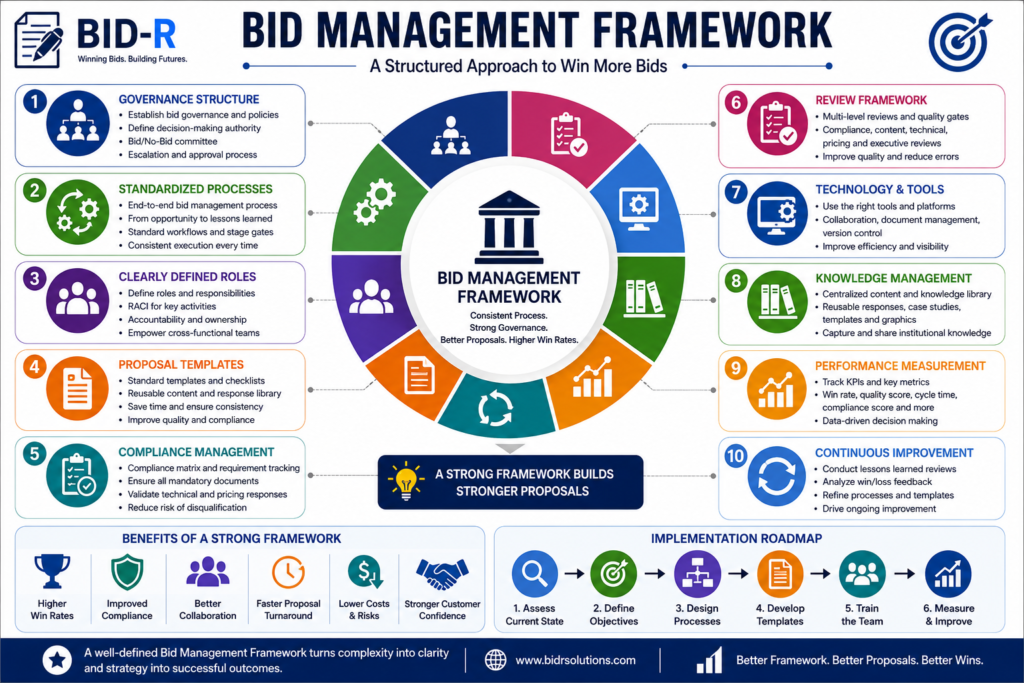
An effective framework consists of several interconnected components.
1. Governance Structure
Governance defines how decisions are made throughout the bid lifecycle.
Typical governance elements include:
- Bid approval process
- Bid/No-Bid committee
- Executive sponsorship
- Escalation procedures
- Review gates
- Approval authority
Good governance ensures accountability and reduces decision-making delays.
2. Standardized Processes
Every bid should follow a consistent process.
Typical stages include:
- Opportunity Identification
- Qualification
- Bid/No-Bid Decision
- Planning
- Proposal Development
- Reviews
- Submission
- Customer Evaluation
- Lessons Learned
Standardized workflows improve consistency and make proposal performance easier to measure.
3. Clearly Defined Roles
The framework should clearly define responsibilities for everyone involved.
Typical roles include:
- Bid Manager
- Sales Manager
- Business Development Manager
- Solution Architect
- Technical SMEs
- Finance
- Legal
- Delivery
- Executive Sponsor
Clear ownership minimizes confusion and improves accountability.
4. Proposal Templates
Templates help proposal teams maintain consistency across all submissions.
Common templates include:
- Executive Summary
- Compliance Matrix
- Proposal Schedule
- Risk Register
- Review Checklist
- Lessons Learned Template
- Pricing Workbook
Reusable templates reduce preparation time while improving quality.
5. Compliance Management
Compliance is one of the most critical components of the framework.
The framework should define how teams:
- Track customer requirements
- Verify mandatory documents
- Review technical responses
- Validate pricing
- Confirm submission readiness
A structured compliance process significantly reduces proposal risk.
6. Review Framework
Proposal quality improves through multiple review stages.
Typical reviews include:
- Compliance Review
- Content Review
- Technical Review
- Pricing Review
- Executive Review
- Final Quality Check
Each review has defined objectives and approval criteria.
7. Technology and Tools
Technology plays a crucial role in supporting a modern bid management framework. The right tools help teams collaborate efficiently, manage documents, track progress, and maintain version control.
Common categories of tools include:
- Customer Relationship Management (CRM)
- Proposal Management Software
- Document Management Systems
- Project Management Tools
- Collaboration Platforms
- e-Signature Solutions
- AI Writing Assistants
- Business Intelligence Dashboards
When selecting tools, organizations should prioritize ease of collaboration, security, scalability, and integration with existing systems.
Technology should support the framework—not replace sound processes and governance.
8. Knowledge Management
Winning organizations treat proposal knowledge as a strategic asset.
Instead of recreating content for every bid, they maintain a centralized knowledge repository containing reusable assets.
Typical knowledge assets include:
- Company profiles
- Case studies
- Project references
- Technical responses
- Team resumes
- Certifications
- Methodologies
- Frequently used graphics
- Customer success stories
- Proposal templates
A well-maintained knowledge base improves proposal consistency while reducing preparation time.
9. Performance Measurement
A mature Bid Management Framework includes measurable performance indicators.
Typical Key Performance Indicators (KPIs) include:
- Bid Win Rate
- Proposal Quality Score
- Compliance Score
- On-Time Submission Rate
- Proposal Development Cycle Time
- Cost per Bid
- Resource Utilization
- Customer Feedback
- Reuse of Proposal Content
- Lessons Learned Implementation Rate
Regular performance reviews help identify trends and improvement opportunities.
10. Continuous Improvement
No framework remains effective without continuous refinement.
Organizations should regularly evaluate:
- Proposal quality
- Review effectiveness
- Stakeholder feedback
- Customer feedback
- Win/Loss analysis
- Process bottlenecks
- Template effectiveness
- Technology adoption
Continuous improvement transforms the framework into a living system that evolves with changing business needs.
How to Implement a Bid Management Framework
Implementing a framework does not require rebuilding the entire proposal function overnight. A phased approach typically delivers the best results.
Step 1: Assess the Current State
Evaluate your existing bid management process.
Identify:
- Strengths
- Weaknesses
- Process gaps
- Resource constraints
- Technology limitations
Step 2: Define Objectives
Establish clear goals for the framework.
Examples include:
- Improve proposal quality
- Increase bid win rate
- Standardize processes
- Reduce proposal turnaround time
- Improve compliance
Step 3: Develop Standard Processes
Document the complete bid management lifecycle.
Create standard operating procedures for:
- Opportunity qualification
- Bid/No-Bid decisions
- Proposal planning
- Reviews
- Submission
- Lessons learned
Step 4: Create Templates
Develop standardized templates including:
- Bid Plan
- Proposal Schedule
- Compliance Matrix
- Review Checklist
- Risk Register
- Executive Summary
- Lessons Learned Template
Templates improve efficiency while maintaining consistency.
Step 5: Assign Roles
Clearly define responsibilities for every stakeholder.
Ensure everyone understands:
- Their role
- Deliverables
- Deadlines
- Approval authority
Step 6: Train the Team
Provide training on:
- Proposal writing
- Compliance
- Collaboration tools
- Review methodology
- Framework governance
Consistent training ensures successful adoption.
Step 7: Measure and Improve
Monitor KPIs regularly and refine the framework based on performance data and lessons learned.
Framework maturity increases through continuous evaluation and incremental improvements.
Bid Management Framework Maturity Model
Organizations typically progress through five levels of maturity.
| Maturity Level | Characteristics |
|---|---|
| Level 1 – Ad Hoc | No standardized process, reactive approach |
| Level 2 – Developing | Basic templates and informal processes |
| Level 3 – Standardized | Documented processes and defined roles |
| Level 4 – Managed | KPIs, governance, and regular reviews |
| Level 5 – Optimized | Continuous improvement, automation, and data-driven decision-making |
The goal is not simply to reach Level 5 but to continuously enhance the organization’s ability to deliver high-quality proposals efficiently.
Common Mistakes When Building a Bid Management Framework
Organizations often encounter avoidable challenges when implementing a framework.
Overcomplicating the Process
An overly complex framework creates unnecessary administrative work.
Keep processes practical and easy to follow.
Lack of Executive Support
Without leadership commitment, adoption becomes difficult.
Executive sponsorship is essential for long-term success.
Undefined Roles
Ambiguous responsibilities create delays and accountability issues.
Clearly document ownership for every activity.
Ignoring Lessons Learned
Failure to capture feedback limits continuous improvement.
Every completed bid should contribute to improving the framework.
Underestimating Training
Even the best framework will fail if employees do not understand how to use it.
Regular training and coaching are essential.
Benefits of a Strong Bid Management Framework
Organizations that implement a mature framework typically experience:
- Higher proposal quality
- Increased bid win rates
- Better collaboration
- Improved compliance
- Faster proposal development
- Reduced operational risk
- Better resource utilization
- Greater consistency
- Enhanced customer confidence
- Continuous business improvement
A structured framework becomes a competitive advantage over organizations that rely on informal proposal processes.
Conclusion
A Bid Management Framework provides the structure, governance, and consistency required to manage complex proposal activities successfully. By defining standardized processes, roles, templates, quality controls, technology, and performance measures, organizations can transform bid management into a repeatable business capability.
Rather than treating each proposal as a unique project, successful organizations use a common framework that promotes collaboration, improves compliance, reduces risk, and continuously enhances proposal quality.
Whether your organization manages a handful of bids each year or hundreds of competitive proposals, investing in a well-designed Bid Management Framework will strengthen operational efficiency and improve long-term business success.
Call to Action
Ready to build a more structured proposal function? Explore our Bid Management Fundamentals series to learn about bid processes, lifecycle management, methodologies, KPIs, best practices, and practical tools for creating a high-performing bid management organization.
Related Articles
- What Is Bid Management?
- Bid Management Process Explained
- Bid Management Lifecycle
- Bid Manager Roles and Responsibilities
- Bid Management Best Practices
- Bid Management Methodologies
- Bid Management KPIs and Metrics
- Bid Management Challenges and Solutions
- Bid Management Checklist
Frequently Asked Questions (FAQs)
What is a Bid Management Framework?
A Bid Management Framework is a structured approach that defines the processes, governance, roles, templates, tools, and quality controls used to manage bids consistently and improve proposal success.
Why is a Bid Management Framework important?
It helps organizations standardize proposal development, improve collaboration, strengthen compliance, reduce operational risks, and increase bid win rates through consistent processes and governance.
What are the key components of a Bid Management Framework?
The main components include governance, standardized processes, defined roles and responsibilities, proposal templates, compliance management, review processes, technology, knowledge management, performance measurement, and continuous improvement.
How can organizations implement a Bid Management Framework?
Organizations should assess their current processes, define objectives, document workflows, create templates, assign roles, train teams, measure KPIs, and continuously improve the framework based on lessons learned.
How does a Bid Management Framework improve proposal success?
By providing consistency, accountability, collaboration, governance, and quality assurance, a Bid Management Framework helps organizations produce stronger, more compliant proposals that have a higher chance of winning.