Introduction
Bid Management KPIs and Metrics help organizations measure the effectiveness of their proposal processes, identify performance gaps, and continuously improve bid success. Without meaningful performance data, proposal teams rely on assumptions rather than evidence when evaluating what works and what needs improvement.
Leading organizations monitor a combination of quality, efficiency, financial, and customer-focused metrics to assess every stage of the bid management lifecycle. These insights support better decision-making, stronger governance, and higher proposal win rates.
In this guide, you’ll learn the most important bid management KPIs and metrics, how to calculate them, and how to use them to improve proposal performance.
Table of Contents
Key Takeaways
- KPIs provide measurable insights into proposal performance.
- Tracking the right metrics helps improve quality, efficiency, and win rates.
- Organizations should monitor operational, financial, and customer-focused KPIs.
- KPIs support continuous improvement and better decision-making.
- Regular performance reviews strengthen proposal management maturity.
What Are Bid Management KPIs and Metrics?
Bid Management KPIs and Metrics are measurable indicators used to evaluate the effectiveness, efficiency, and success of an organization’s bid management activities.
They help answer important questions such as:
- Are we winning enough bids?
- Are proposals submitted on time?
- Is proposal quality improving?
- Are we spending resources efficiently?
- Where are our biggest process bottlenecks?
KPIs provide objective data that supports informed decisions rather than relying on assumptions.
Why Measuring Bid Performance Is Important
Organizations that measure proposal performance consistently outperform those that don’t.
Tracking KPIs helps organizations:
- Improve proposal quality
- Increase bid win rates
- Reduce proposal costs
- Improve resource planning
- Strengthen compliance
- Identify process bottlenecks
- Improve customer satisfaction
- Support continuous improvement
Regular KPI reviews also encourage accountability across proposal teams.
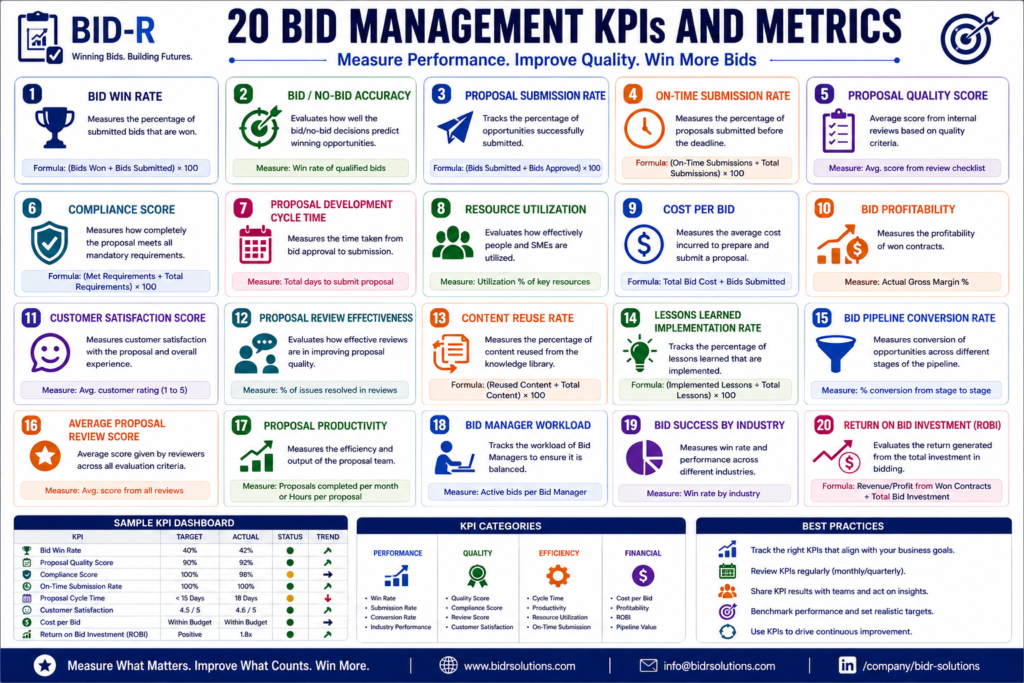
1. Bid Win Rate
The Bid Win Rate is one of the most important performance indicators.
It measures the percentage of submitted bids that result in contract awards.
Formula:
(Number of Bids Won ÷ Number of Bids Submitted) × 100
Why It Matters
- Measures overall proposal effectiveness
- Indicates competitiveness
- Helps evaluate bid strategy
2. Bid/No-Bid Accuracy
This KPI evaluates how effective the organization’s opportunity qualification process is.
A strong Bid/No-Bid process should improve the overall win rate by focusing resources on high-probability opportunities.
Measure:
- Percentage of qualified opportunities won
- Accuracy of opportunity scoring
- Return on bidding effort
3. Proposal Submission Rate
This metric measures the percentage of opportunities successfully submitted before the deadline.
Late submissions can result in automatic disqualification.
A healthy submission rate should approach 100%.
4. On-Time Submission Rate
Submitting before the deadline demonstrates process maturity.
Measure:
- Percentage of proposals submitted on time
- Average submission lead time
- Number of late submissions
Organizations should aim to submit proposals several hours before the deadline whenever possible.
5. Proposal Quality Score
Many organizations use internal review scorecards to assess proposal quality.
Typical evaluation criteria include:
- Compliance
- Technical quality
- Executive summary
- Customer focus
- Graphics
- Formatting
- Readability
- Persuasiveness
Quality reviews provide valuable feedback before submission.
6. Compliance Score
Compliance measures how effectively the proposal addresses mandatory customer requirements.
Track:
- Mandatory requirements addressed
- Missing responses
- Documentation completeness
- Submission accuracy
High compliance scores significantly reduce the risk of proposal rejection.
7. Proposal Development Cycle Time
This KPI measures the time required to prepare a proposal.
Measure:
- Days from Bid/No-Bid approval to submission
- Average proposal preparation time
- Time spent in each lifecycle stage
Reducing unnecessary delays improves operational efficiency.
8. Resource Utilization
Proposal teams should monitor how effectively people are utilized.
Metrics include:
- SME availability
- Proposal workload
- Bid Manager capacity
- Hours per proposal
- Team productivity
Balanced workloads improve both quality and employee satisfaction.
9. Cost per Bid
Preparing proposals requires significant investment in people, technology, travel, design, and subject matter expertise.
Tracking the Cost per Bid helps organizations understand the financial efficiency of their proposal function.
Formula
Total Bid Preparation Cost ÷ Number of Bids Submitted
Why It Matters
- Controls proposal costs
- Supports budgeting
- Identifies opportunities for automation
- Improves resource planning
10. Bid Profitability
Winning a contract is valuable only if it generates sustainable profit.
This KPI measures whether successful bids contribute positively to business performance.
Measure:
- Expected Gross Margin
- Actual Gross Margin
- Profit per Contract
- Return on Bid Investment
A lower win rate with higher profitability may be preferable to winning many low-margin contracts.
11. Customer Satisfaction Score
Customer feedback provides valuable insight into proposal quality and professionalism.
Organizations can gather feedback through:
- Customer debrief meetings
- Surveys
- Interviews
- Sales feedback
- Account Managers
Typical evaluation areas include:
- Proposal clarity
- Responsiveness
- Solution quality
- Professionalism
- Overall experience
12. Proposal Review Effectiveness
Proposal reviews consume considerable time and effort.
This KPI evaluates whether reviews successfully improve proposal quality.
Measure:
- Number of issues identified
- Number of issues resolved
- Review completion rate
- Review quality scores
- Review cycle duration
High-performing organizations continuously improve their review process.
13. Content Reuse Rate
Reusable proposal content improves consistency while reducing development time.
Measure:
- Percentage of reused content
- Time saved through reusable libraries
- Number of approved knowledge assets
Higher reuse rates generally improve proposal efficiency without sacrificing quality.
14. Lessons Learned Implementation Rate
Capturing lessons learned is valuable only if improvements are implemented.
Track:
- Number of lessons identified
- Number implemented
- Improvement initiatives completed
- Template updates
- Process enhancements
This KPI supports continuous improvement across the proposal function.
15. Bid Pipeline Conversion Rate
This KPI measures how effectively opportunities progress through the bid lifecycle.
Typical stages include:
- Opportunity Identified
- Qualified
- Bid Approved
- Proposal Submitted
- Shortlisted
- Won
Monitoring conversion rates helps identify where opportunities are being lost.
16. Average Proposal Review Score
Internal review teams often assign scores during proposal evaluations.
Typical assessment categories include:
- Executive Summary
- Compliance
- Technical Quality
- Customer Focus
- Solution Differentiation
- Grammar and Formatting
Tracking average review scores highlights long-term quality improvements.
17. Proposal Productivity
Proposal productivity measures how efficiently proposal teams produce high-quality submissions.
Useful metrics include:
- Proposals completed per month
- Average pages developed
- Hours per proposal
- Proposal sections completed per contributor
Improving productivity reduces proposal costs while increasing capacity.
18. Bid Manager Workload
Proposal leaders should monitor workload to prevent burnout and maintain proposal quality.
Measure:
- Active bids per Bid Manager
- Average proposal complexity
- Weekly workload
- Proposal overlap
Balanced workloads improve employee satisfaction and proposal outcomes.
19. Bid Success by Industry
Organizations often perform differently across industries.
Track performance by:
- Information Technology
- Healthcare
- Construction
- Manufacturing
- Telecommunications
- Government
- Financial Services
Industry-specific analysis helps organizations focus business development efforts where they are strongest.
20. Return on Bid Investment (ROBI)
Return on Bid Investment evaluates whether the organization’s proposal investment delivers meaningful business value.
Formula
Revenue Won ÷ Total Bid Investment
Some organizations calculate:
(Profit from Won Contracts ÷ Total Bid Cost)
ROBI helps executives assess the overall effectiveness of the proposal function.
Sample Bid Management KPI Dashboard
| KPI | Target | Status |
|---|---|---|
| Bid Win Rate | 40% | 🟢 |
| Proposal Quality Score | 90%+ | 🟢 |
| Compliance Score | 100% | 🟢 |
| On-Time Submission | 100% | 🟢 |
| Proposal Cycle Time | <15 Days | 🟡 |
| Customer Satisfaction | 4.5/5 | 🟢 |
| Cost per Bid | Within Budget | 🟡 |
| ROBI | Positive | 🟢 |
A dashboard like this gives leadership a quick view of proposal performance and highlights areas needing attention.
Best Practices for Measuring Bid Performance
To get the most value from KPIs:
- Track a balanced mix of quality, financial, operational, and customer metrics.
- Review KPI dashboards monthly or quarterly.
- Use consistent definitions for every metric.
- Benchmark performance over time.
- Share results with proposal teams.
- Link improvement initiatives to KPI trends.
- Avoid measuring too many KPIs—focus on those that drive decisions.
A well-designed KPI program supports continuous improvement without overwhelming the team.
Common Mistakes When Measuring Bid Performance
Avoid these common pitfalls:
Measuring Too Many KPIs
Tracking excessive metrics can distract teams from the indicators that truly matter.
Focusing Only on Win Rate
Win rate is important, but it should be evaluated alongside profitability, proposal quality, and customer satisfaction.
Ignoring Qualitative Feedback
Customer comments and reviewer observations often provide insights that numbers alone cannot.
Not Acting on Results
KPIs are valuable only when they lead to measurable improvements.
Inconsistent Definitions
Ensure everyone understands how each KPI is calculated and reported.
Conclusion
Bid Management KPIs and Metrics provide organizations with the data needed to improve proposal quality, increase efficiency, strengthen governance, and achieve higher bid win rates. By monitoring operational, financial, quality, and customer-focused indicators, proposal teams can identify strengths, address weaknesses, and make informed decisions that drive continuous improvement.
Rather than treating KPIs as simple reporting tools, successful organizations use them to shape strategy, allocate resources effectively, and build a mature, high-performing bid management function.
Call to Action
Want to build a data-driven bid management function? Explore our Bid Management Fundamentals series to learn about frameworks, methodologies, best practices, challenges, and practical tools that help organizations improve proposal performance and win more business.
Related Articles
- What Is Bid Management?
- Bid Management Process Explained
- Bid Management Lifecycle
- Bid Manager Roles and Responsibilities
- Bid Management Best Practices
- Bid Management Framework
- Bid Management Methodologies
- Bid Management Challenges and Solutions
- Bid Management Checklist
Frequently Asked Questions (FAQs)
What are Bid Management KPIs and Metrics?
Bid Management KPIs and Metrics are measurable indicators used to evaluate proposal quality, operational efficiency, compliance, financial performance, and bid win rates.
What is the most important Bid Management KPI?
The Bid Win Rate is one of the most widely used KPIs because it measures the percentage of submitted bids that result in contract awards. However, it should be considered alongside proposal quality, profitability, and customer satisfaction.
How often should Bid Management KPIs be reviewed?
Most organizations review KPIs monthly or quarterly to monitor trends, evaluate performance, and identify improvement opportunities.
Why is measuring proposal performance important?
Measuring proposal performance helps organizations improve quality, reduce costs, strengthen compliance, optimize resources, and increase bid win rates through data-driven decision-making.
Which KPIs should every Bid Manager track?
Every Bid Manager should monitor Bid Win Rate, Proposal Quality Score, Compliance Score, On-Time Submission Rate, Proposal Cycle Time, Customer Satisfaction, Cost per Bid, and Return on Bid Investment (ROBI).