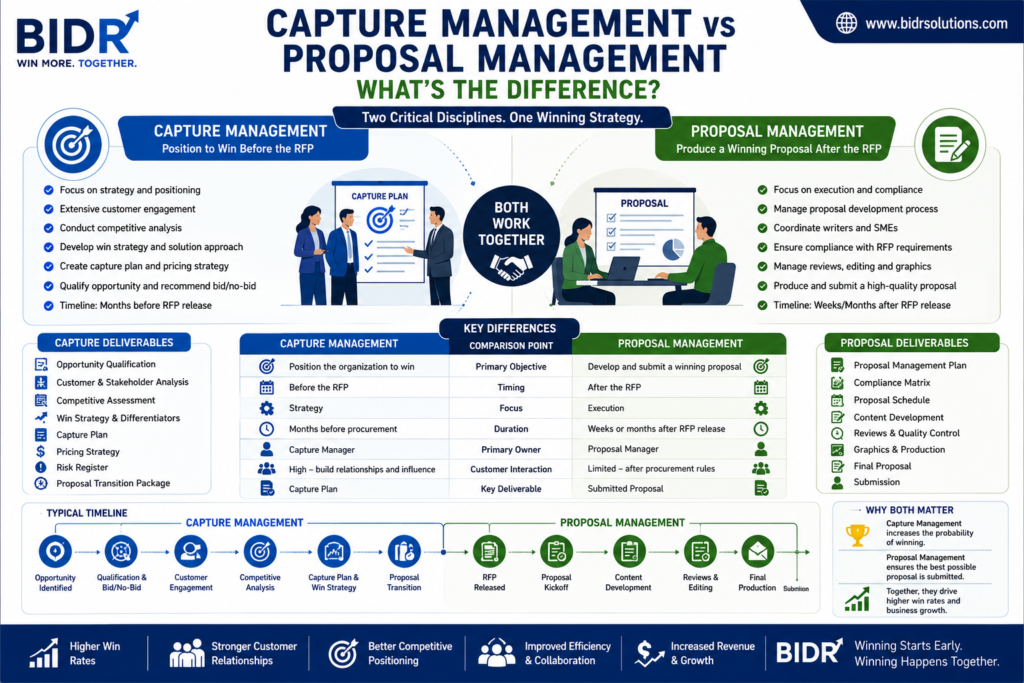
Capture Management vs Proposal Management is a common comparison among professionals working in business development, government contracting, and proposal operations. While the two disciplines work closely together, they have distinct objectives, timelines, responsibilities, and deliverables.
Capture Management focuses on positioning an organization to win an opportunity before the Request for Proposal (RFP) is released. Proposal Management begins after the RFP is published and focuses on producing a compliant, persuasive, and timely proposal.
Organizations that clearly define the relationship between these two functions improve collaboration, reduce rework, and significantly increase contract win rates.
Table of Contents
What is Capture Management?
Capture Management is the strategic pursuit phase that occurs before proposal development.
Its purpose is to prepare the organization for success by:
- Identifying opportunities
- Qualifying pursuits
- Understanding customer needs
- Building customer relationships
- Conducting competitive analysis
- Developing win strategies
- Coordinating solution development
- Creating the Capture Plan
- Preparing for proposal transition
Capture activities often begin 6–24 months before the anticipated RFP release.
The primary objective is simple:
Increase the probability of winning before proposal writing begins.
What is Proposal Management?
Proposal Management begins after the customer issues the Request for Proposal (RFP).
The Proposal Manager is responsible for transforming the capture strategy into a compliant, persuasive proposal.
Typical Proposal Management responsibilities include:
- Proposal kickoff meetings
- Compliance analysis
- Proposal schedule management
- Assigning writing responsibilities
- Coordinating Subject Matter Experts (SMEs)
- Managing proposal reviews
- Version control
- Graphics coordination
- Final production
- Proposal submission
Proposal Management is execution-focused, ensuring that the organization’s solution is clearly communicated within the customer’s requirements and submission deadlines.
Why Both Functions Are Important
Some organizations mistakenly believe Proposal Management alone wins contracts.
In reality:
- Capture Management determines whether you are positioned to win.
- Proposal Management determines how effectively you communicate that position.
Strong proposals rarely compensate for poor capture planning.
Likewise, an excellent capture strategy can still fail if the proposal is poorly managed.
The highest-performing organizations invest in both disciplines.
Capture Management vs Proposal Management: Side-by-Side Comparison
| Category | Capture Management | Proposal Management |
|---|---|---|
| Primary Objective | Position the organization to win | Develop and submit a winning proposal |
| Timing | Before the RFP | After the RFP |
| Focus | Strategy | Execution |
| Duration | Months before procurement | Weeks or months after RFP release |
| Primary Owner | Capture Manager | Proposal Manager |
| Customer Interaction | Extensive | Usually limited after RFP release |
| Competitive Analysis | Major responsibility | Supports proposal messaging |
| Capture Plan | Created | Used as input |
| Proposal Schedule | High-level planning | Detailed management |
| Deliverable | Capture Strategy | Submitted Proposal |
This comparison highlights that the two roles complement each other rather than compete.
Roles and Responsibilities Compared
Although both roles support contract pursuits, their daily responsibilities differ considerably.
Capture Manager Responsibilities
Capture Managers focus on strategic planning and customer positioning.
Typical responsibilities include:
- Opportunity identification
- Opportunity qualification
- Bid/No-Bid recommendations
- Customer engagement
- Stakeholder analysis
- Competitive intelligence
- Solution strategy
- Pricing strategy
- Win themes
- Capture planning
- Executive reviews
- Proposal transition
Their work begins well before proposal writing starts.
Proposal Manager Responsibilities
Proposal Managers focus on coordinating the development of a compliant, persuasive proposal.
Responsibilities include:
- Proposal kickoff
- Compliance matrix development
- Proposal schedule management
- Content planning
- Writer coordination
- Review management
- Graphics coordination
- Editing
- Production
- Submission
- Lessons learned
Proposal Managers ensure the proposal meets every customer requirement while communicating the capture strategy effectively.
Timeline Comparison
The biggest difference between the two disciplines is when they become involved.
Capture Management Timeline
- Opportunity identified
- Qualification completed
- Bid/No-Bid decision
- Customer engagement
- Competitive analysis
- Capture Plan developed
- Solution strategy created
- Proposal transition
Proposal Management Timeline
- RFP released
- Proposal kickoff
- Compliance analysis
- Content development
- Proposal reviews
- Final production
- Submission
- Post-submission support
Together, these phases create a seamless pursuit lifecycle.
Skills Comparison
Although there is some overlap, each role emphasizes different competencies.
Capture Manager Skills
- Strategic thinking
- Customer relationship management
- Business development
- Competitive intelligence
- Opportunity qualification
- Negotiation
- Leadership
- Financial awareness
- Executive communication
Proposal Manager Skills
- Project management
- Proposal writing
- Compliance management
- Scheduling
- Editing
- Communication
- Document production
- Team coordination
- Time management
- Quality assurance
Both roles require collaboration, but their primary focus differs significantly.
How Capture Managers and Proposal Managers Work Together
The most successful organizations do not treat Capture Management and Proposal Management as separate functions. Instead, they operate as complementary disciplines that work together throughout the opportunity lifecycle.
A successful pursuit depends on a smooth transition from strategic planning to proposal execution.
The typical collaboration looks like this:
| Capture Manager | Proposal Manager |
|---|---|
| Identifies the opportunity | Receives the opportunity after RFP release |
| Builds customer relationships | Plans proposal execution |
| Conducts competitive analysis | Develops the proposal schedule |
| Creates the Capture Plan | Uses the Capture Plan as guidance |
| Defines win themes | Incorporates win themes into proposal content |
| Coordinates solution strategy | Coordinates proposal writers and SMEs |
| Leads executive pursuit reviews | Leads proposal reviews |
| Transfers customer intelligence | Produces and submits the final proposal |
The strongest proposal teams involve both roles from the beginning of the proposal phase to ensure continuity.
Which Role Comes First?
The answer is straightforward:
Capture Management always comes before Proposal Management.
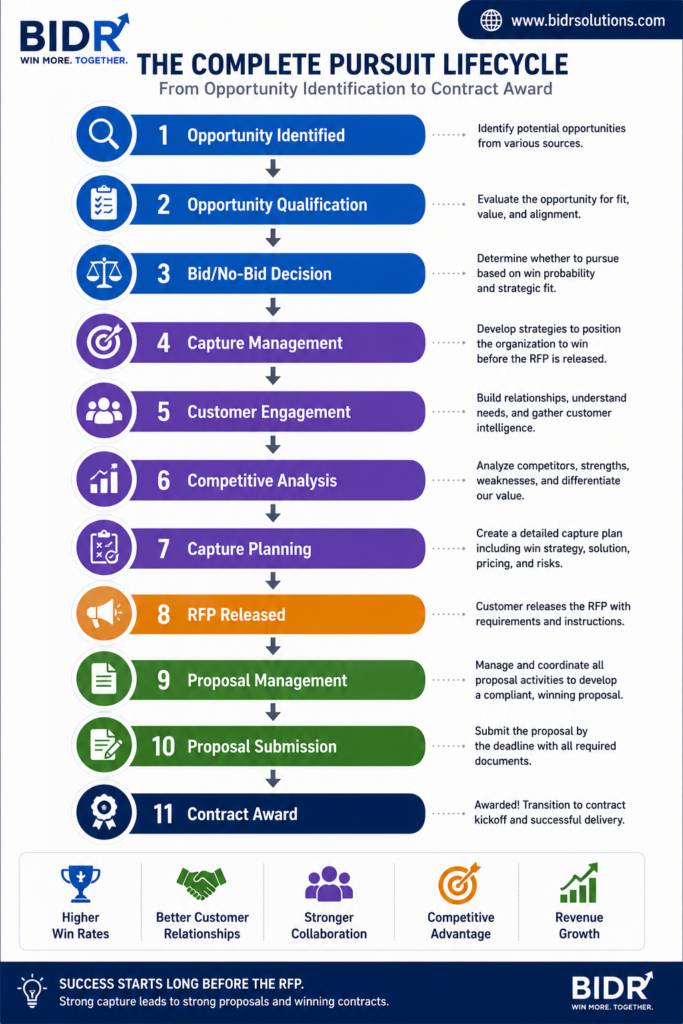
A typical opportunity lifecycle follows this sequence:
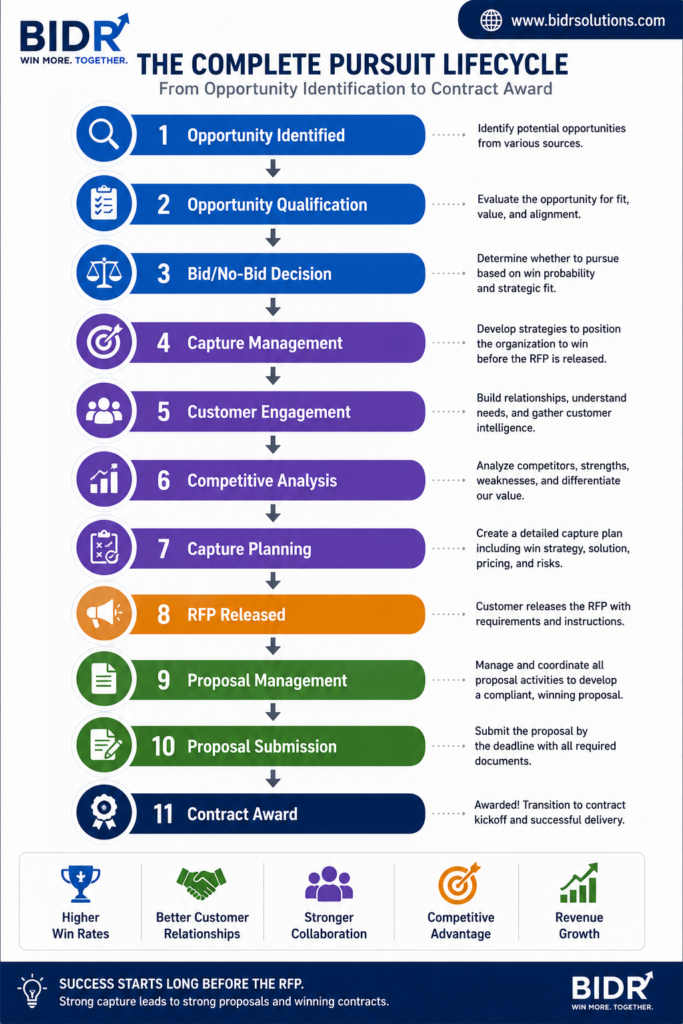
This sequence demonstrates that proposal development should be the result of a well-executed capture effort—not the starting point.
Deliverables Comparison
Both disciplines produce different outputs that contribute to a successful pursuit.
Capture Management Deliverables
- Opportunity Qualification Checklist
- Bid/No-Bid Recommendation
- Customer Profile
- Stakeholder Analysis
- Competitive Assessment
- SWOT Analysis
- Black Hat Review
- Capture Plan
- Win Strategy
- Pricing Strategy
- Risk Register
- Proposal Transition Package
Proposal Management Deliverables
- Proposal Management Plan
- Compliance Matrix
- Proposal Schedule
- Storyboard
- Content Assignments
- Proposal Drafts
- Review Comments
- Graphics Package
- Executive Summary
- Final Proposal
- Submission Confirmation
- Lessons Learned Report
Together, these deliverables ensure both strategic positioning and high-quality execution.
Career Path Comparison
Although professionals often transition between these roles, the career paths are slightly different.
Capture Management Career Path
Proposal Management Career Path
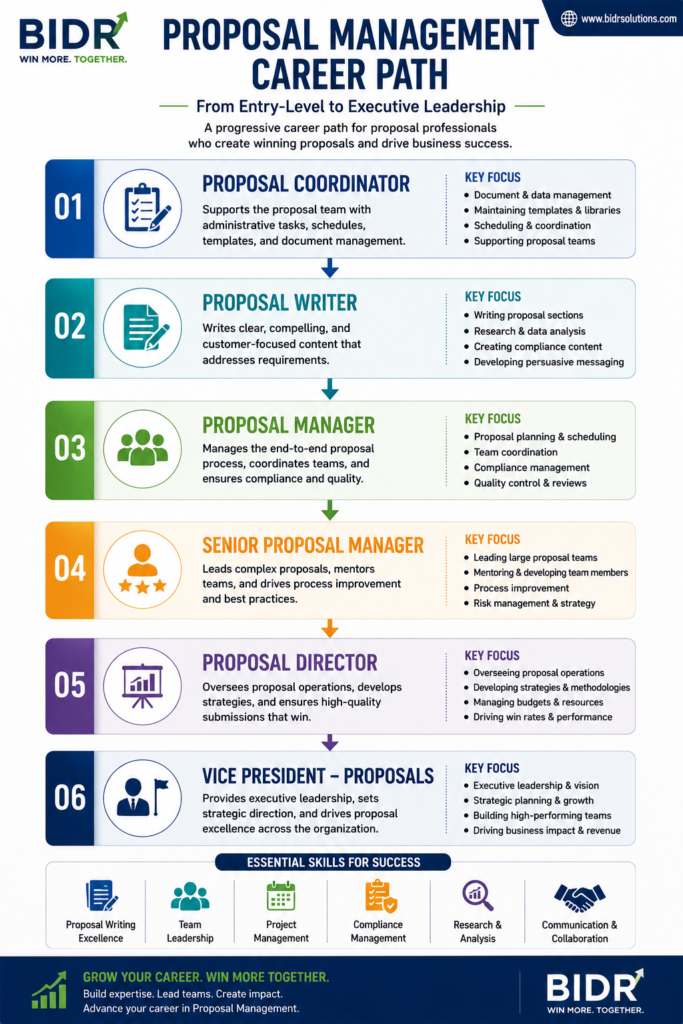
Many professionals eventually gain experience in both disciplines, making them highly valuable for leadership positions.
Salary Comparison
Compensation varies by country, industry, experience, and organization size.
| Role | Typical Annual Salary (US) |
|---|---|
| Proposal Manager | $90,000–$140,000 |
| Senior Proposal Manager | $130,000–$170,000 |
| Capture Manager | $100,000–$150,000 |
| Senior Capture Manager | $140,000–$180,000 |
| Capture Director | $180,000–$250,000+ |
In many government contracting organizations, experienced Capture Managers often earn slightly higher salaries because of their direct impact on revenue generation and strategic pursuits.
Common Misconceptions
“Proposal Managers Also Perform Capture”
Some Proposal Managers do participate in capture activities, especially in smaller organizations. However, in mature organizations, Capture Management and Proposal Management are distinct roles with different objectives.
“Capture Management Ends When the RFP is Released”
Not entirely.
Although the Proposal Manager takes ownership after the RFP release, the Capture Manager often continues to provide:
- Customer insights
- Competitive intelligence
- Executive support
- Solution clarification
- Win strategy guidance
“Proposal Writing Alone Wins Contracts”
Excellent proposal writing is essential, but it cannot compensate for weak customer relationships, poor qualification, or ineffective capture planning.
Winning begins long before the first proposal page is written.
Best Practices for Integrating Capture and Proposal Management
Organizations that consistently achieve high win rates follow these practices.
Involve Proposal Managers Early
Proposal Managers should participate in capture reviews before the RFP is released to understand the strategy and customer context.
Maintain a Living Capture Plan
Update the Capture Plan throughout the pursuit and use it as the primary input during proposal development.
Ensure Structured Knowledge Transfer
The transition from Capture Manager to Proposal Manager should include:
- Customer intelligence
- Win themes
- Competitive analysis
- Pricing assumptions
- Risks
- Action items
Conduct Joint Reviews
Hold regular reviews involving both Capture and Proposal teams to ensure alignment and resolve issues before submission.
Focus on Customer Value
Both teams should consistently communicate how the proposed solution addresses the customer’s mission, challenges, and desired outcomes.
Conclusion
When comparing Capture Management vs Proposal Management, it becomes clear that these disciplines are not competitors—they are complementary functions that work together to improve contract win rates.
Capture Management lays the strategic foundation by identifying opportunities, engaging customers, analyzing competitors, and developing a winning approach. Proposal Management transforms that strategy into a compliant, persuasive proposal that addresses customer requirements and demonstrates value.
Organizations that invest in both capabilities create a seamless pursuit process, reduce risk, improve collaboration, and consistently outperform competitors in government and commercial contracting.
Whether you are a Capture Manager, Proposal Manager, Business Development professional, or aspiring bid professional, understanding the relationship between these roles will help you contribute more effectively to successful contract pursuits.
Continue Learning with BidR
Expand your knowledge with these related resources:
- What is Capture Management? Complete Guide to Winning More Contracts (2026)
- Capture Management Process Explained: Step-by-Step Framework
- Capture Manager Roles and Responsibilities
- Capture Planning: How to Build a Winning Capture Plan
- Capture Management Lifecycle
- Capture Management Best Practices
- Capture Manager Skills
- Capture Management Tools and Software
- Capture Management KPIs
- What is Proposal Management? Complete Guide
- Proposal Development Process
- Proposal Planning Guide
- Proposal Kickoff Meetings
Build Stronger Capture and Proposal Teams with BidR
Winning more contracts requires excellence in both strategy and execution. At BidR Solutions, you’ll find expert guidance, practical templates, and proven best practices for Capture Management, Proposal Management, Bid Management, and Government Contracting. Explore our complete learning hub to strengthen your pursuit process, improve collaboration, and increase your organization’s contract win rate.
Frequently Asked Questions (FAQs)
What is the main difference between Capture Management and Proposal Management?
Capture Management focuses on positioning the organization to win before the RFP is released, while Proposal Management focuses on developing and submitting a compliant, persuasive proposal after the RFP is issued.
Can one person perform both roles?
Yes. In small organizations, one professional may handle both Capture Management and Proposal Management. In larger organizations, these responsibilities are usually assigned to separate specialists.
Which role has more customer interaction?
Capture Managers typically have more direct customer engagement because they work before procurement restrictions take effect.
Which role comes first?
Capture Management always precedes Proposal Management in the business development lifecycle.
Which role has a greater impact on win rates?
Both are critical. Capture Management improves the probability of winning through strategic positioning, while Proposal Management ensures that strategy is communicated effectively in the proposal.