Introduction
The Proposal Management Process is a structured framework used by organizations to plan, develop, review, and submit high-quality business proposals in response to Requests for Proposal (RFPs), Requests for Information (RFIs), Requests for Quotations (RFQs), and other procurement opportunities.
Rather than treating each proposal as a one-off activity, organizations use a repeatable process that improves collaboration, ensures compliance, reduces risk, and increases the likelihood of winning new business.
A mature proposal management process enables teams to:
- Deliver proposals on time
- Improve proposal quality
- Ensure customer compliance
- Reduce last-minute rework
- Increase proposal win rates
- Capture lessons for continuous improvement
Table of Contents
Why Every Organization Needs a Proposal Management Process
Without a defined process, proposal teams often face:
- Missed deadlines
- Poor coordination
- Inconsistent messaging
- Compliance issues
- Version control problems
- Last-minute stress
- Lower win rates
A standardized proposal process helps every stakeholder understand their role and ensures that proposal development follows a consistent methodology.
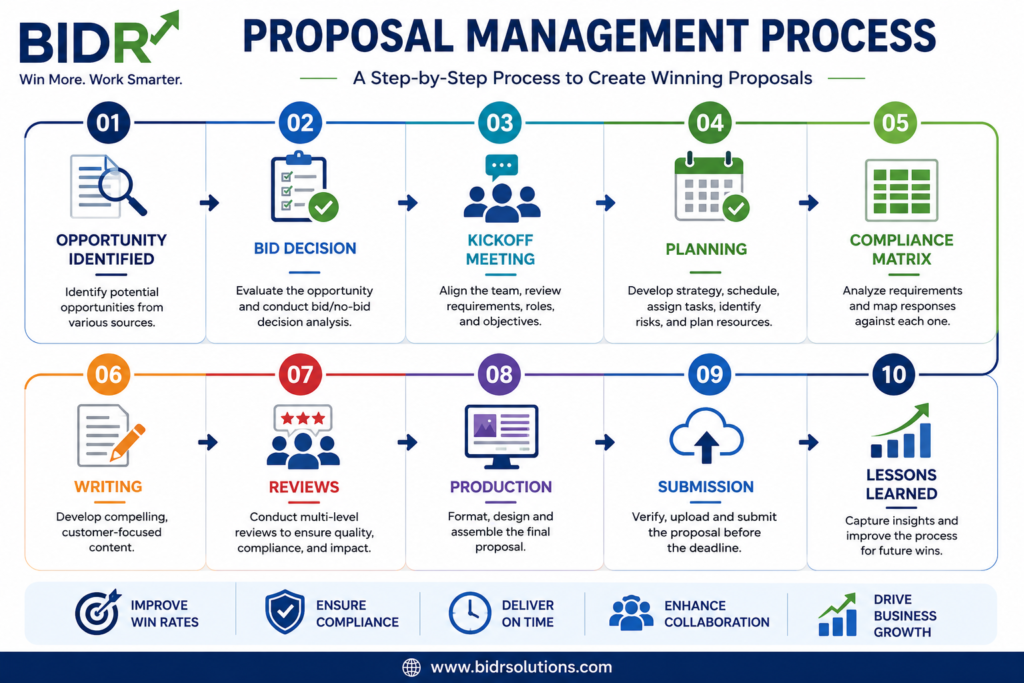
The 10 Stages of the Proposal Management Process
Stage 1: Opportunity Identification
Every proposal begins with identifying a business opportunity.
Sources may include:
- Customer RFPs
- Existing client requests
- Government tender portals
- Procurement websites
- Sales leads
- Strategic partnerships
During this stage, the sales or business development team evaluates whether the opportunity aligns with the organization’s capabilities and strategic goals.
Stage 2: Bid/No-Bid Decision
Not every opportunity should be pursued.
A Bid/No-Bid review assesses factors such as:
- Customer relationship
- Revenue potential
- Strategic importance
- Competition
- Technical capability
- Resource availability
- Probability of winning
This decision prevents organizations from investing time and resources in low-value pursuits.
Stage 3: Proposal Kickoff Meeting
Once the decision to bid is made, a kickoff meeting aligns the proposal team.
Typical agenda:
- Review customer requirements
- Define proposal objectives
- Explain evaluation criteria
- Assign section owners
- Confirm deadlines
- Identify risks
- Discuss win themes
A successful kickoff creates a shared understanding of expectations and responsibilities.
Stage 4: Proposal Planning
Planning transforms strategy into execution.
Activities include:
- Proposal schedule
- Work breakdown structure
- Content assignments
- Milestone planning
- Review schedule
- Risk management
- Communication plan
- Version control
Effective planning reduces delays and keeps the proposal on track.
Stage 5: Compliance Matrix Development
The compliance matrix is one of the most important proposal management documents.
It helps teams:
- Map every customer requirement
- Assign response owners
- Track completion status
- Ensure nothing is overlooked
A well-maintained compliance matrix significantly reduces the risk of non-compliance.
Stage 6: Proposal Writing
Subject Matter Experts (SMEs) and proposal writers develop customer-focused content.
Key sections may include:
- Executive Summary
- Company Overview
- Technical Solution
- Project Management
- Staffing Plan
- Quality Assurance
- Risk Management
- Implementation Methodology
- Pricing Support
Writers should focus on customer benefits rather than simply describing products or services.
Stage 7: Proposal Reviews
Structured reviews improve proposal quality and competitiveness.
Common review stages include:
Pink Team Review
- Early content review
- Compliance validation
- Initial feedback
Red Team Review
- Customer perspective
- Persuasiveness
- Competitive differentiation
Gold Team Review
- Executive approval
- Pricing validation
- Final risk assessment
Independent reviewers often identify gaps that proposal authors may overlook.
Stage 8: Proposal Production
Production prepares the proposal for submission.
Tasks include:
- Formatting
- Branding
- Graphics
- Hyperlinks
- Table of Contents
- Pagination
- PDF generation
- Print preparation (if required)
Attention to detail at this stage reflects professionalism and enhances the customer experience.
Stage 9: Proposal Submission
Before submitting the proposal, teams should verify:
- All required documents are included
- Pricing is accurate
- Signatures are complete
- File naming conventions are followed
- Portal uploads are successful
- Submission confirmations are received
Submitting early helps avoid technical issues and last-minute complications.
Stage 10: Lessons Learned
After submission, conduct a retrospective to capture valuable insights.
Discuss:
- What worked well?
- What challenges were encountered?
- Which processes need improvement?
- Were deadlines realistic?
- Were customer requirements fully understood?
- How can future proposals be improved?
Documenting lessons learned supports continuous improvement and strengthens future proposal efforts.
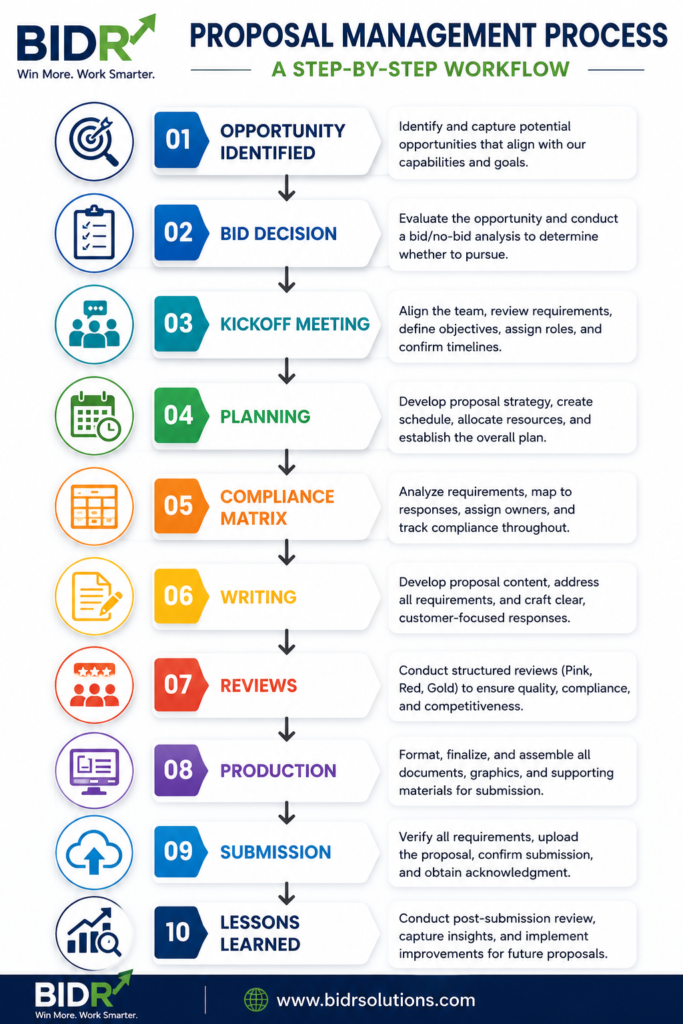
Proposal Management Process Workflow
Proposal Management Best Practices
- Start planning immediately after the Bid/No-Bid decision.
- Maintain a centralized content library.
- Use a compliance matrix throughout the proposal lifecycle.
- Schedule formal review milestones.
- Focus on customer outcomes rather than company achievements.
- Conduct a final compliance and quality check before submission.
- Capture lessons learned after every proposal.
Common Proposal Process Mistakes
Avoid these common pitfalls:
- Skipping the kickoff meeting
- Ignoring compliance requirements
- Waiting too long to start writing
- Poor version control
- Limited SME involvement
- Rushing reviews
- Submitting at the last minute
- Failing to document lessons learned
Proposal Management Tools
Organizations commonly use:
- Proposal management software
- Microsoft Word
- Microsoft Excel
- Microsoft Teams
- SharePoint
- CRM systems
- Project management platforms
- Document management systems
Choose tools that support collaboration, version control, and workflow automation.
Proposal Management Process Checklist
Before closing your proposal project, confirm that you have:
- Qualified the opportunity
- Completed the Bid/No-Bid review
- Conducted the kickoff meeting
- Finalized the proposal plan
- Created the compliance matrix
- Completed proposal writing
- Performed all required reviews
- Produced the final proposal
- Submitted successfully
- Conducted a lessons learned session
Conclusion
A well-defined Proposal Management Process provides the foundation for consistent, high-quality proposal development. From identifying opportunities and making informed Bid/No-Bid decisions to planning, writing, reviewing, submitting, and capturing lessons learned, each stage contributes to stronger proposals and higher win rates.
Organizations that invest in structured proposal processes are better equipped to meet customer expectations, reduce risk, and compete successfully in today’s demanding procurement environment.
Related Articles
- Complete Guide to Proposal Management
- Proposal Planning Guide
- Proposal Kickoff Meeting Checklist
- Proposal Writing Best Practices
- Proposal Review Process
- Proposal Submission Checklist
- Proposal Governance Framework
- Proposal Lessons Learned Template
- Complete Guide to Bid Management
Improve Your Proposal Success Rate
Looking to streamline your proposal development process? Explore BidR’s growing collection of free proposal management guides, compliance matrix templates, kickoff meeting checklists, proposal review checklists, and best practice resources to build more compliant, persuasive, and winning proposals.
Frequently Asked Questions (FAQs)
What is the Proposal Management Process?
It is a structured sequence of activities used to plan, develop, review, and submit proposals that meet customer requirements and improve win rates.
Why is a compliance matrix important?
It ensures every customer requirement is addressed, assigned, tracked, and validated before submission.
What is the most important stage of the proposal process?
While every stage is important, planning and compliance management have the greatest impact on proposal quality and on-time delivery.
How can organizations improve their proposal process?
By standardizing workflows, using reusable content, conducting structured reviews, and continuously improving through lessons learned.