Introduction
Proposal Manager Roles and Responsibilities are critical to the success of any business proposal. A Proposal Manager is responsible for planning, coordinating, reviewing, and delivering compliant, high-quality proposals that help organizations win new business opportunities.
Behind every winning proposal is a skilled Proposal Manager who coordinates people, processes, timelines, and deliverables to ensure the submission is compliant, persuasive, and delivered on time.
A Proposal Manager is much more than a project coordinator—they are the central point of communication for sales teams, solution architects, subject matter experts (SMEs), pricing specialists, legal teams, and executive leadership throughout the proposal lifecycle.
This guide explains the key roles, responsibilities, required skills, daily activities, tools, career path, and best practices for Proposal Managers.
Table of Contents
Who is a Proposal Manager?
A Proposal Manager is responsible for planning, coordinating, managing, and delivering high-quality business proposals in response to customer requests such as RFPs, RFIs, RFQs, and tenders.
They ensure proposals:
- Meet customer requirements
- Are completed on schedule
- Follow organizational standards
- Include high-quality content
- Undergo appropriate reviews
- Are submitted before the deadline
Rather than writing every section themselves, Proposal Managers orchestrate the efforts of multiple contributors across departments.
Why Proposal Managers Are Important
Proposal Managers play a critical role in improving an organization’s proposal success rate.
Their responsibilities help organizations:
- Increase proposal quality
- Improve compliance
- Meet submission deadlines
- Reduce project risks
- Coordinate cross-functional teams
- Standardize proposal development
- Improve customer confidence
- Increase win rates
Without effective proposal management, teams often experience delays, inconsistent messaging, and compliance issues.
Core Roles and Responsibilities of a Proposal Manager
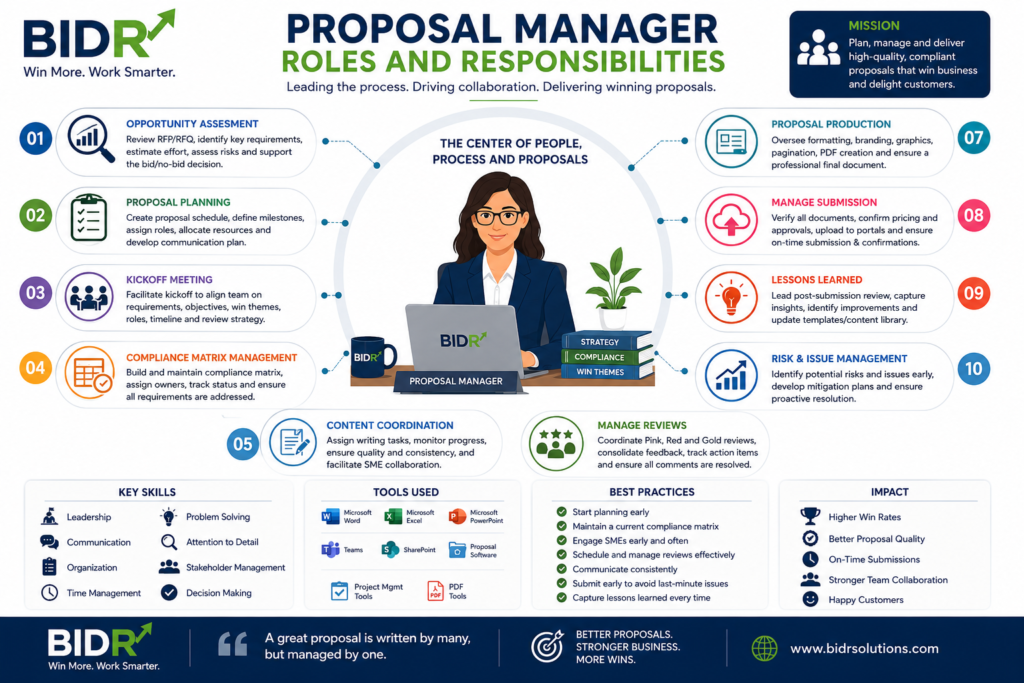
1. Opportunity Assessment
After an opportunity is identified, the Proposal Manager supports the Bid/No-Bid decision by:
- Reviewing solicitation documents
- Identifying key requirements
- Estimating proposal effort
- Assessing timelines
- Highlighting major risks
2. Proposal Planning
Planning is one of the Proposal Manager’s most important responsibilities.
Key tasks include:
- Creating proposal schedules
- Defining milestones
- Allocating resources
- Assigning section owners
- Establishing communication plans
- Managing proposal calendars
A well-planned proposal reduces last-minute stress and improves overall efficiency.
3. Conducting the Kickoff Meeting
The Proposal Manager organizes and facilitates the kickoff meeting to ensure all contributors understand:
- Customer requirements
- Proposal objectives
- Evaluation criteria
- Win themes
- Individual responsibilities
- Proposal timeline
- Review schedule
This meeting establishes a shared understanding and sets the direction for proposal development.
4. Managing the Compliance Matrix
One of the Proposal Manager’s key responsibilities is maintaining the compliance matrix.
This involves:
- Mapping customer requirements
- Assigning owners
- Tracking completion
- Identifying gaps
- Verifying compliance
The compliance matrix acts as the central control document throughout the proposal lifecycle.
5. Coordinating Content Development
Proposal Managers oversee content creation by:
- Assigning writing tasks
- Monitoring progress
- Ensuring consistency
- Resolving dependencies
- Reviewing content quality
- Encouraging collaboration among SMEs
Their goal is to ensure every proposal section aligns with customer expectations and organizational standards.
6. Managing Proposal Reviews
Proposal Managers coordinate structured review cycles such as:
Pink Team Review
- Initial content assessment
- Compliance check
- Early feedback
Red Team Review
- Customer-focused evaluation
- Persuasiveness
- Competitive differentiation
Gold Team Review
- Executive approval
- Pricing validation
- Final decision
They collect reviewer feedback, assign action items, and verify that all comments are addressed.
7. Proposal Production
Before submission, Proposal Managers oversee:
- Formatting
- Branding
- Graphics
- Page numbering
- Hyperlinks
- PDF generation
- Print production (if applicable)
Attention to detail ensures the proposal presents a professional image.
8. Managing Proposal Submission
The Proposal Manager is responsible for ensuring the proposal is submitted correctly and on time.
Final submission activities include:
- Verifying all required documents
- Confirming pricing accuracy
- Checking signatures
- Uploading proposal files
- Validating portal submissions
- Securing submission confirmations
Submitting early reduces the risk of technical issues.
9. Conducting Lessons Learned
After submission, Proposal Managers organize a lessons learned session to identify:
- Successes
- Challenges
- Process improvements
- Customer feedback
- Content updates
- Reusable assets
These insights strengthen future proposal efforts.
A Day in the Life of a Proposal Manager
A typical day may include:
- Reviewing customer amendments
- Tracking proposal progress
- Meeting with SMEs
- Updating proposal schedules
- Coordinating reviews
- Managing risks and issues
- Preparing executive status updates
- Resolving content conflicts
- Supporting pricing discussions
- Communicating with sales teams
Proposal Managers spend much of their time coordinating people rather than writing proposals themselves.
Essential Skills for Proposal Managers
Successful Proposal Managers possess a combination of technical, organizational, and interpersonal skills.
Technical Skills
- Proposal management
- Project management
- Proposal writing
- Compliance management
- Document management
- Microsoft Office
- Collaboration platforms
Soft Skills
- Leadership
- Communication
- Time management
- Organization
- Negotiation
- Problem solving
- Attention to detail
- Decision making
Proposal Management Tools
Proposal Managers commonly use:
- Microsoft Word
- Microsoft Excel
- Microsoft PowerPoint
- Microsoft Teams
- SharePoint
- Proposal management software
- Project management tools
- Collaboration platforms
- PDF editing software
Common Challenges Faced by Proposal Managers
Proposal Managers regularly deal with:
- Tight deadlines
- Limited SME availability
- Last-minute customer changes
- Version control issues
- Resource constraints
- Pricing delays
- Review bottlenecks
- Compliance gaps
Strong planning and communication help overcome these challenges.
Best Practices for Proposal Managers
- Establish a detailed proposal schedule.
- Conduct a comprehensive kickoff meeting.
- Maintain an up-to-date compliance matrix.
- Schedule formal review milestones.
- Track risks proactively.
- Encourage early SME engagement.
- Use standardized templates.
- Submit proposals before the deadline.
- Capture lessons learned after every proposal.
Career Path for Proposal Managers
A common career progression includes:
- Proposal Coordinator
- Proposal Writer
- Proposal Analyst
- Proposal Manager
- Senior Proposal Manager
- Bid Manager
- Capture Manager
- Proposal Director
- Business Development Director
With experience, Proposal Managers often move into leadership roles in business development, capture management, or strategic pursuits.
Conclusion
Proposal Managers are the driving force behind successful proposal development. By coordinating cross-functional teams, managing schedules, ensuring compliance, leading reviews, and overseeing submission, they transform complex customer requirements into compelling, high-quality proposals.
Organizations that invest in skilled Proposal Managers benefit from more efficient proposal processes, stronger collaboration, and improved win rates.
Related Articles
- Complete Guide to Proposal Management
- Proposal Management Process
- Proposal Planning Guide
- Proposal Kickoff Meeting Checklist
- Proposal Writing Best Practices
- Proposal Review Process
- Proposal Submission Checklist
- Proposal Governance Framework
- Complete Guide to Bid Management
Build Winning Proposal Teams with BIDR
Want to improve your proposal success rate? Explore our collection of free proposal management guides, proposal planning templates, compliance matrix templates, review checklists, and proposal best practices to help your team create compliant, persuasive, and winning proposals.
Frequently Asked Questions (FAQs)
What does a Proposal Manager do?
A Proposal Manager plans, coordinates, develops, reviews, and submits business proposals while ensuring compliance, quality, and on-time delivery.
Is Proposal Management a good career?
Yes. It offers strong career growth opportunities across IT services, consulting, engineering, healthcare, defense, and government contracting.
What skills are most important for a Proposal Manager?
Project management, communication, leadership, organization, proposal writing, stakeholder management, and compliance expertise.
Does a Proposal Manager write proposals?
Proposal Managers may write executive summaries or key sections, but their primary responsibility is coordinating the overall proposal development process.
What is the difference between a Proposal Manager and a Bid Manager?
A Proposal Manager focuses on developing and submitting proposals, while a Bid Manager oversees the entire bid lifecycle, including opportunity qualification, pursuit strategy, pricing, proposal development, and contract award.
What tools do Proposal Managers use?
Proposal Managers commonly use Microsoft Office, SharePoint, Microsoft Teams, proposal management software, document collaboration tools, project management platforms, and PDF editing applications.