Introduction
Winning large contracts rarely depends on price alone. Organizations that consistently secure business have one thing in common—they follow a structured proposal management process that transforms customer requirements into persuasive, compliant, and high-quality proposals.
Whether you’re responding to government tenders, enterprise RFPs, or private-sector opportunities, proposal management ensures every submission is organized, customer-focused, and delivered on time.
This comprehensive guide explains everything you need to know about proposal management—from its lifecycle and best practices to tools, templates, career opportunities, and common challenges.
Table of Contents
What is Proposal Management?
Proposal Management is the structured process of planning, creating, reviewing, coordinating, and submitting proposals in response to customer requests such as:
- Request for Proposal (RFP)
- Request for Information (RFI)
- Request for Quotation (RFQ)
- Invitation to Tender (ITT)
The primary objective is to produce a proposal that is:
- Compliant with customer requirements
- Persuasive
- Technically accurate
- Commercially viable
- Submitted before the deadline
Proposal management combines project management, technical writing, sales strategy, collaboration, and risk management into a single disciplined process.
Why Proposal Management Matters
A professionally managed proposal can significantly increase an organization’s win rate.
Benefits include:
- Improved proposal quality
- Better compliance
- Higher win probability
- Consistent branding
- Faster proposal turnaround
- Reduced last-minute stress
- Better collaboration across departments
- Reusable proposal content
- Improved customer confidence
Organizations that implement mature proposal management practices often reduce proposal development time while improving proposal quality.
Proposal Management vs Bid Management
Although these terms are frequently used interchangeably, they have distinct meanings.
| Proposal Management | Bid Management |
|---|---|
| Focuses on creating proposals | Manages the complete bidding lifecycle |
| Writing and coordinating responses | Opportunity qualification to contract award |
| Proposal-centric | Opportunity-centric |
| Usually starts after bid approval | Starts much earlier |
| Emphasizes proposal quality | Emphasizes overall pursuit strategy |
Think of proposal management as one of the most critical phases within the broader bid management process.
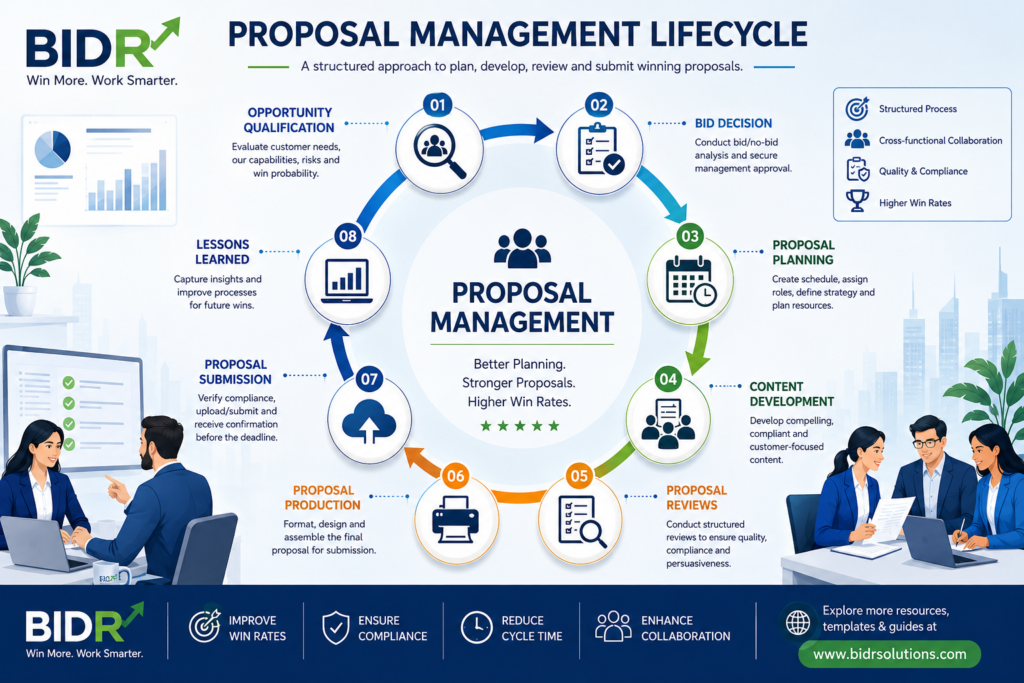
Proposal Management Lifecycle
A successful proposal follows a structured lifecycle.
1. Opportunity Qualification
Before investing resources, evaluate:
- Customer fit
- Technical capability
- Financial viability
- Competition
- Win probability
2. Bid Decision
Organizations conduct a Bid/No-Bid review to decide whether pursuing the opportunity is worthwhile.
Factors considered include:
- Revenue potential
- Strategic value
- Resource availability
- Customer relationship
- Risks
3. Proposal Planning
Planning activities include:
- Creating proposal schedules
- Assigning section owners
- Developing compliance matrices
- Conducting kickoff meetings
- Setting review milestones
Planning determines whether the proposal remains on schedule.
4. Content Development
Proposal contributors develop:
- Executive Summary
- Technical Solution
- Implementation Plan
- Project Management
- Risk Management
- Staffing
- Quality Assurance
- Pricing Support
- Company Information
Each section owner works according to the proposal schedule.
5. Proposal Reviews
Multiple reviews improve proposal quality.
Typical reviews include:
Pink Team Review
Checks:
- Initial direction
- Customer alignment
- Compliance
- Content completeness
Red Team Review
Focuses on:
- Customer perspective
- Competitive differentiation
- Persuasiveness
- Overall quality
Gold Team Review
Executive leadership validates:
- Business strategy
- Pricing
- Risks
- Final approval
6. Proposal Production
Production activities include:
- Formatting
- Branding
- Graphics
- Hyperlinks
- Table of Contents
- PDF generation
- Print quality (if required)
7. Proposal Submission
Final activities include:
- Compliance verification
- Portal upload
- File validation
- Digital signatures
- Submission confirmation
Never wait until the last hour to submit a proposal.
Proposal Management Process
A simplified proposal workflow looks like this:
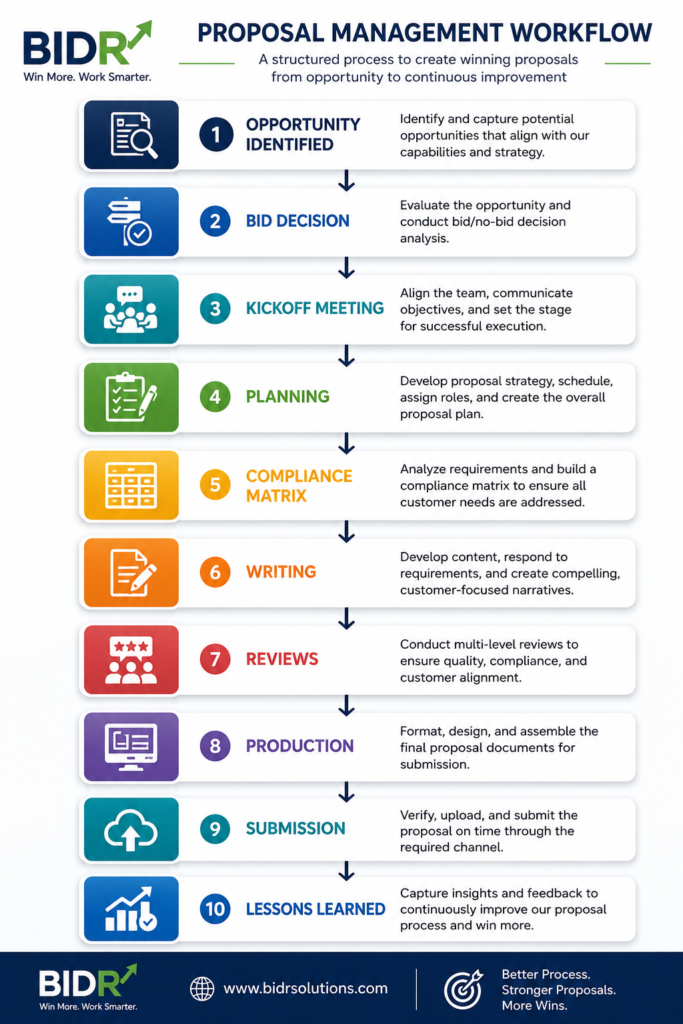
This structured process minimizes errors and ensures every proposal follows a repeatable methodology.
Proposal Team Roles
Proposal management is a collaborative effort involving multiple stakeholders.
Proposal Manager
Responsible for:
- Proposal schedule
- Resource coordination
- Reviews
- Risk management
- Submission
Sales Team
Provides:
- Customer intelligence
- Competitive insights
- Relationship management
- Win themes
Solution Architects
Responsible for:
- Technical solution
- Architecture diagrams
- Innovation
- Delivery model
SMEs
Provide:
- Technical expertise
- Product information
- Compliance responses
- Industry knowledge
Pricing Team
Develops:
- Pricing models
- Cost estimates
- Financial assumptions
- Commercial proposals
Legal Team
Reviews:
- Contracts
- Terms and conditions
- Compliance
- Regulatory issues
Proposal Planning
Effective planning is the foundation of proposal success.
Planning activities include:
- Proposal calendar
- Deliverable schedule
- Content assignments
- Review schedule
- Risk register
- Communication plan
- Version control
- Approval workflow
A well-planned proposal significantly reduces last-minute firefighting.
Proposal Writing Best Practices
Successful proposals are:
Customer Focused
Talk about customer outcomes instead of company achievements.
Easy to Read
Use:
- Short paragraphs
- Headings
- Bullet lists
- Tables
- Graphics
Compliant
Answer every customer requirement.
Missing even one mandatory requirement may result in disqualification.
Evidence Based
Support claims with:
- Case studies
- Metrics
- Certifications
- Testimonials
- Awards
Consistent
Maintain consistent:
- Terminology
- Formatting
- Fonts
- Colors
- Branding
Proposal Reviews
Never submit without reviews.
Review checklist:
- Grammar
- Compliance
- Customer focus
- Graphics
- Pricing accuracy
- References
- Formatting
- Spell check
- Page numbering
- Hyperlinks
Independent reviewers often identify issues missed by proposal writers.
Proposal Submission Checklist
Before submission, verify:
- All volumes completed
- Mandatory documents attached
- Pricing included
- Signatures obtained
- Portal upload successful
- File size limits met
- Naming conventions followed
- Submission confirmation received
Many organizations use standardized submission checklists to reduce avoidable errors.
Proposal Management Tools
Modern proposal teams rely on specialized tools for collaboration and automation.
Common categories include:
- Proposal management software
- Document collaboration platforms
- Content libraries
- CRM systems
- Project management tools
- eSignature solutions
- Graphic design software
Selecting the right toolset depends on proposal volume, team size, and organizational requirements.
Common Proposal Management Challenges
Proposal managers frequently face:
- Tight deadlines
- Limited SME availability
- Changing customer requirements
- Version control issues
- Incomplete information
- Pricing delays
- Resource conflicts
- Compliance gaps
- Last-minute changes
Organizations overcome these challenges through standardized processes, reusable content, and proactive planning.
Proposal Management Metrics
Measuring performance helps improve future proposals.
Key metrics include:
- Proposal win rate
- On-time submission rate
- Compliance score
- Proposal cycle time
- Review defect count
- Customer satisfaction
- Reuse percentage
- Cost per proposal
Tracking these metrics provides insights into process efficiency and proposal quality.
Career Opportunities in Proposal Management
Proposal management offers diverse career paths across industries such as IT services, consulting, engineering, healthcare, construction, and government contracting.
Typical progression includes:
- Proposal Coordinator
- Proposal Writer
- Proposal Analyst
- Proposal Manager
- Senior Proposal Manager
- Bid Manager
- Capture Manager
- Head of Proposals
- Director of Business Development
Professionals with expertise in proposal management are valued for their ability to coordinate cross-functional teams, manage deadlines, and improve win rates.
Final Thoughts
Proposal management is much more than writing documents—it is the discipline of turning opportunities into winning business through planning, collaboration, and execution. A mature proposal management process improves compliance, enhances customer confidence, and increases the likelihood of success.
Whether you are a new proposal professional or an experienced bid manager, mastering proposal management principles will help you deliver higher-quality proposals, work more efficiently, and contribute directly to your organization’s growth.
Related Articles
- Proposal Management Process
- Proposal Manager Roles and Responsibilities
- Proposal Planning Guide
- Proposal Kickoff Meeting Checklist
- Proposal Writing Best Practices
- Proposal Review Process
- Proposal Submission Checklist
- Proposal Governance Framework
- Proposal Lessons Learned Template
Frequently Asked Questions (FAQs)
Is proposal management a good career?
Yes. It offers opportunities across multiple industries, competitive salaries, and clear progression into leadership roles.
What skills are essential for proposal managers?
Key skills include project management, writing, communication, stakeholder management, attention to detail, planning, and risk management.
What is the biggest challenge in proposal management?
Managing multiple contributors while maintaining quality and meeting tight submission deadlines.
How long does proposal development take?
It depends on the complexity of the opportunity. Small proposals may take a few days, while large enterprise or government proposals can take several weeks or months.
Can AI help with proposal management?
Yes. AI can assist with drafting content, summarizing requirements, improving readability, checking consistency, and identifying reusable content. However, human review remains essential to ensure accuracy, compliance, and customer alignment.