Introduction
Bid Management Methodologies provide organizations with structured approaches for planning, developing, reviewing, and submitting competitive proposals. Rather than relying on informal practices or individual experience, proven methodologies establish repeatable processes that improve collaboration, proposal quality, compliance, and overall bid success.
Organizations that consistently win government tenders and commercial contracts rarely depend on a single approach. Instead, they combine different methodologies based on the complexity of the opportunity, customer requirements, available resources, and business objectives.
In this guide, you’ll learn eight widely used bid management methodologies, their advantages, limitations, and practical guidance on selecting the right approach for your organization.
Table of Contents
Key Takeaways
- Bid management methodologies provide structured approaches for managing proposals.
- Different methodologies are suitable for different types of bids.
- Organizations often combine multiple methodologies rather than relying on one.
- Standardized methodologies improve consistency, collaboration, and proposal quality.
- Selecting the right methodology depends on business needs, proposal complexity, and customer expectations.
What Are Bid Management Methodologies?
A Bid Management Methodology is a structured approach that defines how an organization plans, coordinates, develops, reviews, and submits proposals.
While a bid management framework establishes governance and overall structure, methodologies describe how the work is executed.
A methodology typically defines:
- Planning techniques
- Team collaboration
- Review processes
- Decision-making
- Documentation standards
- Quality controls
- Continuous improvement practices
Organizations often adopt a combination of methodologies to improve flexibility while maintaining consistency.
Why Are Bid Management Methodologies Important?
Without a defined methodology, proposal teams may work inconsistently, leading to communication gaps, duplicated effort, missed deadlines, and lower proposal quality.
Using proven methodologies helps organizations:
- Improve planning
- Increase collaboration
- Reduce proposal risks
- Strengthen compliance
- Improve proposal quality
- Increase bid win rates
- Standardize proposal delivery
- Support continuous improvement
Methodologies provide a common language that helps proposal teams work together more effectively.
1. Traditional Waterfall Methodology
The Waterfall methodology follows a structured, sequential approach where each stage is completed before the next begins.
Typical stages include:
- Opportunity Qualification
- Planning
- Proposal Development
- Review
- Approval
- Submission
Advantages
- Clear milestones
- Strong governance
- Easy progress tracking
- Well suited for government tenders
Limitations
- Less flexible when requirements change
- Changes can delay the proposal schedule
Waterfall remains one of the most widely used methodologies for formal procurement processes.
2. Agile Bid Management
Agile principles can also be applied to proposal development.
Instead of waiting until the end for reviews, Agile encourages:
- Frequent collaboration
- Short review cycles
- Continuous improvement
- Rapid feedback
- Incremental content development
Advantages
- Faster collaboration
- Better adaptability
- Continuous stakeholder involvement
Limitations
- Requires disciplined communication
- Less suitable for highly regulated procurement environments
Agile works particularly well for complex commercial proposals where customer requirements evolve during the pursuit.
3. Stage-Gate Methodology
The Stage-Gate approach divides the proposal lifecycle into clearly defined stages separated by decision gates.
Typical gates include:
- Opportunity Qualification
- Bid/No-Bid Approval
- Proposal Planning Approval
- Review Approval
- Submission Approval
Each gate requires formal approval before progressing.
Advantages
- Strong governance
- Reduced proposal risk
- Improved accountability
- Better executive visibility
This methodology is widely adopted by large enterprises managing high-value opportunities.
4. APMP Best Practice Methodology
Many organizations align their proposal processes with guidance from the Association of Proposal Management Professionals (APMP).
Common APMP practices include:
- Customer-focused proposals
- Structured planning
- Proposal reviews
- Executive summaries
- Win themes
- Storyboarding
- Lessons learned
Advantages
- Industry-recognized
- Comprehensive guidance
- Strong proposal quality
Organizations seeking proposal maturity often use APMP practices as the foundation of their methodology.
5. Lean Bid Management
Lean methodology focuses on eliminating unnecessary work and improving efficiency.
Typical Lean principles include:
- Removing duplicate effort
- Standardizing templates
- Improving workflow
- Reducing review delays
- Automating repetitive tasks
Advantages
- Faster proposal development
- Lower costs
- Improved productivity
Lean is particularly effective for organizations managing large proposal volumes.
6. PRINCE2-Inspired Bid Management Methodology
Many organizations adapt principles from PRINCE2, a widely recognized project management methodology, to improve bid governance and control.
This methodology emphasizes:
- Defined roles and responsibilities
- Business justification
- Stage-based planning
- Risk management
- Quality management
- Change control
- Lessons learned
Although PRINCE2 is designed for project management, its governance principles translate well to large and complex bid opportunities.
Advantages
- Strong governance
- Excellent documentation
- Effective risk management
- Clear decision-making
Limitations
- Can introduce additional administrative overhead
- Better suited to large or strategic bids than smaller opportunities
Organizations pursuing high-value government or enterprise contracts often benefit from adopting PRINCE2-inspired governance.
7. Hybrid Bid Management Methodology
Many organizations do not rely on a single methodology. Instead, they combine the strengths of multiple approaches to suit different types of opportunities.
A Hybrid methodology may combine:
- Waterfall planning
- Agile collaboration
- Stage-Gate governance
- APMP best practices
- Lean process improvements
For example:
- Formal approval gates for governance
- Agile content development for collaboration
- Lean templates to improve efficiency
- APMP review techniques to enhance proposal quality
Advantages
- Flexible
- Scalable
- Suitable for multiple industries
- Balances governance with adaptability
For most organizations, a Hybrid methodology provides the best balance between structure and flexibility.
8. Continuous Improvement Methodology
Winning organizations recognize that proposal management is an evolving capability rather than a one-time activity.
A Continuous Improvement methodology focuses on learning from every bid.
Typical activities include:
- Win/Loss analysis
- Customer feedback
- Lessons learned workshops
- Process reviews
- KPI monitoring
- Template updates
- Knowledge sharing
- Team training
Rather than repeating the same approach for every opportunity, teams refine their methodologies over time.
Advantages
- Better proposal quality
- Higher bid win rates
- Increased efficiency
- Strong organizational learning
Organizations with mature bid functions treat continuous improvement as part of every proposal lifecycle.
Comparison of Bid Management Methodologies
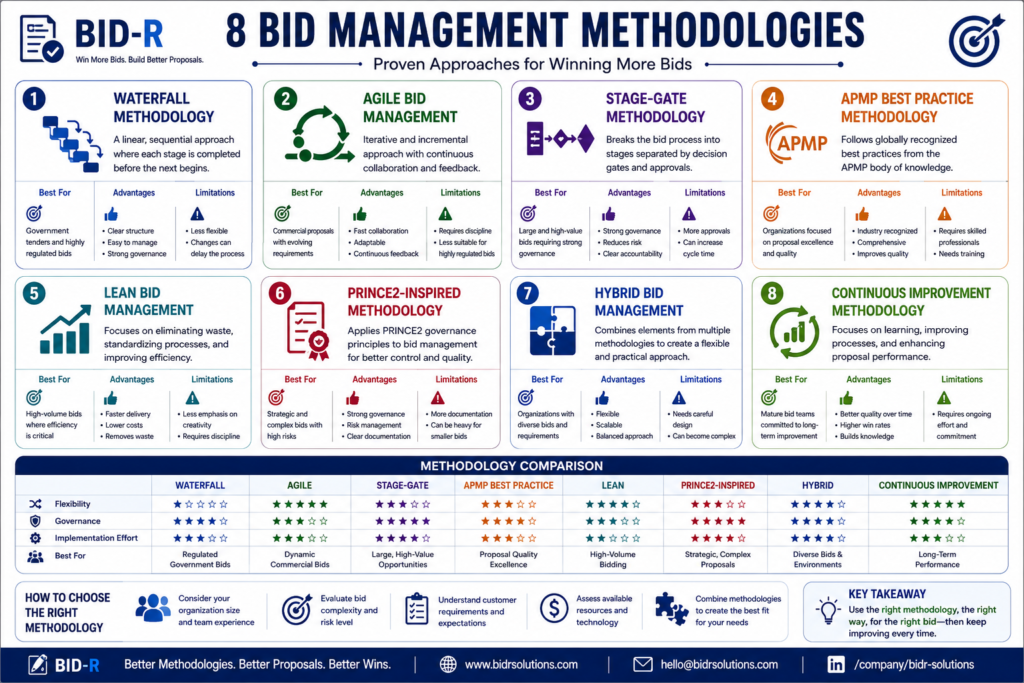
| Methodology | Best For | Strengths | Limitations |
|---|---|---|---|
| Waterfall | Government tenders | Structured, predictable | Less flexible |
| Agile | Commercial proposals | Fast collaboration | Requires disciplined communication |
| Stage-Gate | Enterprise bids | Strong governance | Additional approvals |
| APMP Best Practices | Proposal excellence | Industry-recognized guidance | Requires experienced proposal teams |
| Lean | High-volume proposals | Efficiency and standardization | Less emphasis on governance |
| PRINCE2-Inspired | Strategic bids | Governance and risk management | More documentation |
| Hybrid | Most organizations | Flexible and scalable | Requires careful implementation |
| Continuous Improvement | Mature bid teams | Long-term performance gains | Requires ongoing commitment |
How to Choose the Right Bid Management Methodology
Selecting the right methodology depends on several factors.
Consider:
Organization Size
Large organizations often benefit from Stage-Gate or Hybrid methodologies, while smaller teams may prefer Agile or Lean approaches.
Bid Complexity
Simple proposals may only require lightweight processes.
Large multi-million-dollar bids usually require formal governance.
Customer Requirements
Government procurement often demands structured documentation and compliance.
Commercial customers may value speed and flexibility.
Team Experience
Experienced proposal teams can successfully implement more sophisticated methodologies.
Less experienced teams should begin with simpler standardized approaches.
Available Resources
Organizations should adopt methodologies that match their available people, technology, and proposal volume.
The best methodology is one that the organization can consistently execute and continuously improve.
Common Mistakes When Implementing Bid Management Methodologies
Even well-designed methodologies can fail if they are not implemented effectively.
Avoid these common mistakes:
Applying One Methodology to Every Bid
Different opportunities require different approaches.
Tailor the methodology to the size and complexity of the bid.
Ignoring Team Training
A methodology is only effective when everyone understands how to apply it.
Invest in regular training and coaching.
Overcomplicating Processes
Excessive documentation can slow proposal development.
Keep processes practical and focused on adding value.
Poor Executive Support
Leadership commitment is essential for successful adoption.
Executive sponsors should actively support governance and continuous improvement.
Failing to Measure Performance
Without KPIs, organizations cannot determine whether the methodology is improving proposal outcomes.
Track results and refine the methodology regularly.
Benefits of Using Structured Bid Management Methodologies
Organizations that adopt proven methodologies typically achieve:
- Higher proposal quality
- Better collaboration
- Improved compliance
- Greater consistency
- Faster proposal development
- Better governance
- Improved resource utilization
- Increased customer confidence
- Higher bid win rates
- Stronger continuous improvement culture
A structured methodology enables organizations to deliver proposals more efficiently while maintaining high quality.
Conclusion
Bid management methodologies provide organizations with structured approaches for managing proposals consistently and effectively. Whether using Waterfall, Agile, Stage-Gate, APMP best practices, Lean, PRINCE2-inspired governance, or a Hybrid approach, the objective remains the same—delivering high-quality proposals that maximize the likelihood of winning new business.
There is no single methodology that fits every organization or every opportunity. The most successful proposal teams evaluate their business needs, customer requirements, and internal capabilities before selecting or combining methodologies that best support their objectives.
By continuously refining processes, learning from previous bids, and investing in team development, organizations can create a mature bid management capability that delivers sustainable competitive advantage.
Call to Action
Looking to strengthen your proposal management approach? Explore the BidR Fundamentals series to learn about bid management frameworks, processes, KPIs, best practices, and practical techniques that help organizations build high-performing proposal teams.
Related Articles
- What Is Bid Management?
- Bid Management Process Explained
- Bid Management Lifecycle
- Bid Manager Roles and Responsibilities
- Bid Management Best Practices
- Bid Management Framework
- Bid Management KPIs and Metrics
- Bid Management Challenges and Solutions
- Bid Management Checklist
Frequently Asked Questions (FAQs)
What are Bid Management Methodologies?
Bid Management Methodologies are structured approaches that guide organizations in planning, developing, reviewing, and submitting proposals consistently to improve quality, compliance, and bid win rates.
Which bid management methodology is best?
There is no single best methodology. The right approach depends on the organization’s size, proposal complexity, customer requirements, and available resources. Many organizations use a hybrid methodology that combines multiple best practices.
What is the difference between a bid management framework and a methodology?
A bid management framework defines the overall structure, governance, roles, and processes, while a methodology describes how proposal activities are executed within that framework.
Can Agile be used for bid management?
Yes. Agile principles such as iterative development, frequent collaboration, and continuous feedback can improve proposal quality and adaptability, particularly for commercial bids.
Why is continuous improvement important in bid management?
Continuous improvement enables organizations to learn from previous bids, refine their processes, update templates, improve collaboration, and increase future bid win rates.