Introduction
Proposal Writing Best Practices can make the difference between winning and losing a business opportunity. Even the best technical solution may fail if it is not presented in a clear, persuasive, and customer-focused proposal.
Successful proposal writing goes beyond answering customer requirements. It demonstrates a deep understanding of the client’s challenges, communicates value effectively, maintains compliance, and builds confidence in your organization’s ability to deliver.
In this guide, you’ll learn proven proposal writing techniques, best practices, common mistakes, and practical tips used by high-performing proposal teams to improve proposal quality and increase win rates.
Table of Contents
What is Proposal Writing?
Proposal writing is the process of developing clear, persuasive, and compliant responses to customer requirements in documents such as:
- Request for Proposal (RFP)
- Request for Information (RFI)
- Request for Quotation (RFQ)
- Invitation to Tender (ITT)
The objective is to convince the customer that your organization offers the best solution while meeting every stated requirement.
Proposal writing combines technical knowledge, business strategy, persuasive communication, and structured document development.
Why Proposal Writing Matters
Well-written proposals help organizations:
- Increase proposal win rates
- Improve customer confidence
- Demonstrate technical expertise
- Ensure compliance
- Differentiate from competitors
- Reduce clarification requests
- Build credibility
Poor proposal writing often results in lower evaluation scores, even when the proposed solution is technically strong.
Proposal Writing Principles
Every successful proposal should be:
- Customer-focused
- Compliant
- Clear and concise
- Well-organized
- Evidence-based
- Visually appealing
- Persuasive
- Error-free
These principles provide the foundation for every winning proposal.
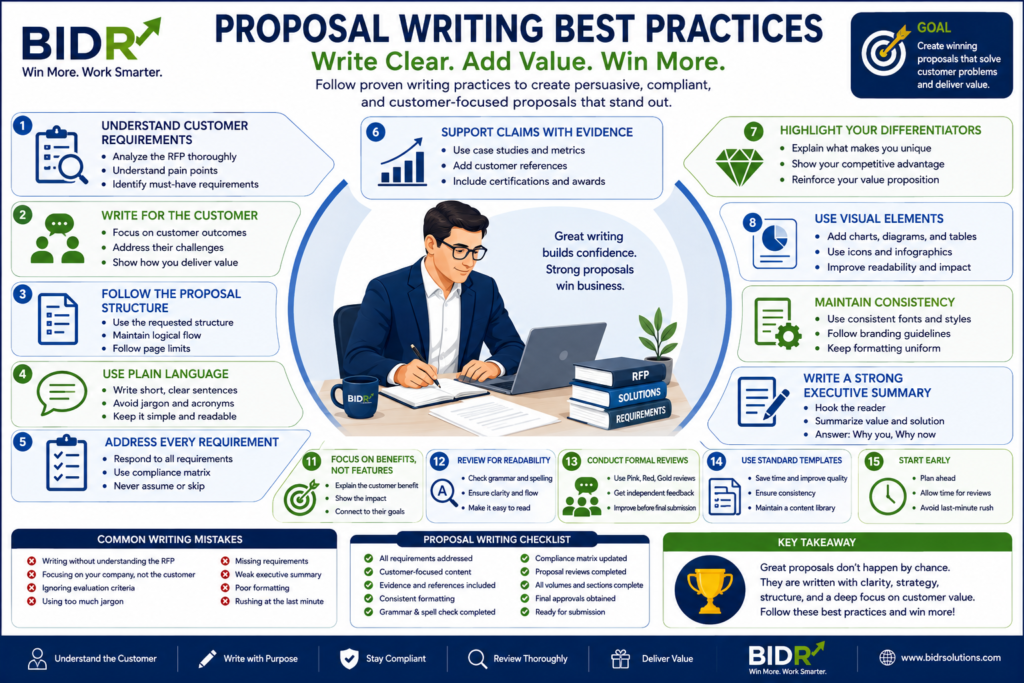
15 Proposal Writing Best Practices
1. Understand Customer Requirements
Before writing, thoroughly review the solicitation.
Pay close attention to:
- Scope of work
- Evaluation criteria
- Mandatory requirements
- Submission instructions
- Deliverables
Understanding the customer’s priorities ensures your proposal addresses their expectations effectively.
2. Write for the Customer
Avoid making the proposal entirely about your organization.
Instead of writing:
“We provide innovative IT solutions.”
Write:
“Our solution helps your organization reduce operational costs, improve efficiency, and achieve faster implementation.”
Focus on customer outcomes rather than company capabilities.
3. Follow the Proposal Structure
Use the customer’s requested structure whenever possible.
Typical sections include:
- Executive Summary
- Company Overview
- Technical Solution
- Project Management
- Staffing
- Implementation Plan
- Risk Management
- Pricing
- Appendices
A consistent structure improves readability and evaluator experience.
4. Use Plain Language
Avoid unnecessary jargon.
Write:
- Short sentences
- Clear paragraphs
- Active voice
- Simple terminology
Your goal is clarity—not complexity.
5. Address Every Requirement
Never assume evaluators will infer information.
Respond explicitly to every requirement using the compliance matrix as your guide.
Missing mandatory requirements can result in disqualification.
6. Support Claims with Evidence
Strengthen your proposal with:
- Case studies
- Performance metrics
- Customer testimonials
- Certifications
- Awards
- Project references
Evidence increases credibility and evaluator confidence.
7. Highlight Your Differentiators
Clearly explain:
- Why your solution is different
- What unique value you provide
- How you reduce customer risk
- Why your organization is the best choice
Avoid generic marketing language.
8. Use Visual Elements
Enhance readability with:
- Tables
- Process diagrams
- Icons
- Charts
- Infographics
- Timelines
Visuals help evaluators understand complex information quickly.
9. Maintain Consistency
Ensure consistency in:
- Fonts
- Headings
- Terminology
- Colors
- Formatting
- Numbering
Consistency creates a professional appearance.
10. Write a Strong Executive Summary
Your Executive Summary should answer:
- Why are you responding?
- What problem are you solving?
- Why are you the best choice?
- What value will you deliver?
Many evaluators read this section first.
11. Focus on Benefits, Not Features
Instead of listing product features, explain the benefits they provide to the customer.
Example:
Feature: 24/7 monitoring.
Benefit: Continuous monitoring reduces downtime and improves service availability.
12. Review for Readability
Check:
- Grammar
- Spelling
- Sentence structure
- Flow
- Consistency
A polished proposal reflects professionalism.
13. Conduct Formal Reviews
Use structured reviews such as:
- Pink Team Review
- Red Team Review
- Gold Team Review
Independent reviewers often identify opportunities for improvement.
14. Use Standard Templates
Standardized templates improve:
- Consistency
- Efficiency
- Branding
- Compliance
Maintain a centralized content library for frequently used responses.
15. Start Early
One of the most effective best practices is simply starting early.
Allow enough time for:
- Planning
- Writing
- Reviews
- Production
- Final quality checks
Rushed proposals often contain avoidable mistakes.
Common Proposal Writing Mistakes
Avoid these common errors:
- Writing without understanding the RFP
- Focusing too much on your company
- Ignoring evaluation criteria
- Using excessive jargon
- Poor formatting
- Weak executive summaries
- Missing customer requirements
- Lack of evidence
- Skipping proposal reviews
- Waiting until the last minute
Proposal Writing Checklist
Before submission, verify that you have:
- Addressed all customer requirements
- Used customer-focused language
- Included supporting evidence
- Maintained formatting consistency
- Completed grammar and spell checks
- Conducted proposal reviews
- Updated the compliance matrix
- Verified hyperlinks and references
- Confirmed final approvals
Conclusion
Proposal writing is both an art and a disciplined process. By following proven best practices, focusing on customer needs, maintaining compliance, and presenting information clearly, organizations can create proposals that stand out from the competition.
Consistently applying these proposal writing best practices helps improve quality, strengthen customer confidence, and increase the likelihood of winning valuable business opportunities.
Related Articles
- Complete Guide to Proposal Management
- Proposal Management Process
- Proposal Planning Guide
- Proposal Kickoff Meeting Checklist
- Proposal Manager Roles and Responsibilities
- Proposal Review Process
- Proposal Submission Checklist
- Proposal Governance Framework
- Complete Guide to Bid Management
Frequently Asked Questions (FAQs)
What is proposal writing?
Proposal writing is the process of creating persuasive, compliant, and customer-focused responses to business opportunities such as RFPs, RFIs, RFQs, and tenders.
Why is proposal writing important?
Effective proposal writing improves proposal quality, demonstrates value, increases evaluator confidence, and helps organizations win more business.
What are the characteristics of a winning proposal?
Winning proposals are customer-focused, compliant, persuasive, evidence-based, well-organized, visually appealing, and free from errors.
How can I improve my proposal writing?
Understand the customer, follow the solicitation requirements, use clear language, highlight differentiators, support claims with evidence, and conduct thorough reviews before submission.