Introduction
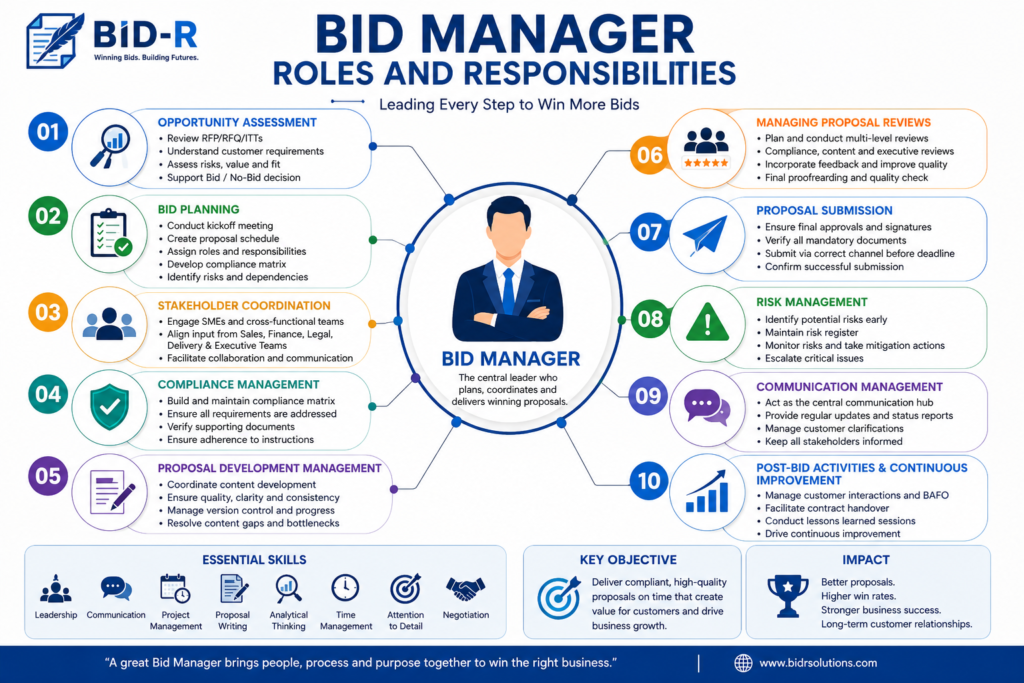
Bid Manager Roles and Responsibilities are critical to the success of any organization that competes for government tenders, commercial RFPs, or large procurement opportunities. A Bid Manager leads the entire proposal process, coordinating cross-functional teams, ensuring compliance, managing timelines, and delivering high-quality proposals that maximize the chances of winning new business.
Behind every successful proposal is a professional who ensures that hundreds of moving parts come together seamlessly. From coordinating cross-functional teams to managing deadlines, ensuring compliance, and delivering compelling proposals, the Bid Manager plays a pivotal role in winning new business.
As organizations increasingly compete for complex government tenders and commercial contracts, the demand for skilled Bid Managers continues to grow across industries such as IT services, construction, healthcare, engineering, telecommunications, and consulting.
A Bid Manager is far more than a project coordinator. They are responsible for leading the entire bid effort, ensuring that proposals meet customer requirements, reflect the organization’s strengths, and are submitted on time with the highest possible quality.
This guide explains the key roles and responsibilities of a Bid Manager, the skills required to succeed, common challenges, and best practices followed by high-performing bid professionals.
Table of Contents
Key Takeaways
- A Bid Manager leads the entire proposal process from opportunity qualification to submission.
- Success depends on strong leadership, planning, communication, and stakeholder management.
- Bid Managers coordinate sales, technical, finance, legal, and executive teams.
- Compliance, proposal quality, and deadline management are among their primary responsibilities.
- Experienced Bid Managers contribute significantly to improving proposal win rates.
Who Is a Bid Manager?
A Bid Manager is a professional responsible for planning, coordinating, and managing an organization’s response to Requests for Proposal (RFPs), Invitations to Tender (ITTs), Requests for Information (RFIs), and other procurement opportunities.
The Bid Manager acts as the central point of contact throughout the bid lifecycle, ensuring that every contributor understands their responsibilities and that the final proposal is compliant, compelling, and submitted on time.
Depending on the size of the organization, a Bid Manager may oversee multiple bids simultaneously while collaborating with sales teams, solution architects, subject matter experts (SMEs), finance, legal, delivery teams, and executive leadership.
Ultimately, the Bid Manager’s objective is to maximize the organization’s chances of winning new business while maintaining quality, consistency, and compliance.
Why Is the Bid Manager Role Important?
Preparing a competitive proposal requires input from multiple departments. Without effective coordination, organizations may experience missed deadlines, inconsistent messaging, incomplete responses, or compliance issues.
A skilled Bid Manager brings structure and accountability to the proposal process.
Key benefits of an effective Bid Manager include:
- Improved proposal quality
- Better cross-functional collaboration
- Stronger compliance management
- Efficient resource coordination
- Timely proposal submissions
- Higher customer satisfaction
- Increased bid win rates
By acting as the single point of accountability, the Bid Manager ensures that every proposal reflects the organization’s capabilities while meeting customer expectations.
Core Roles of a Bid Manager
Although responsibilities vary between organizations, most Bid Managers perform the following core functions throughout the bid lifecycle.
1. Opportunity Assessment
The Bid Manager reviews new opportunities to determine whether they align with the organization’s strategic objectives.
Typical activities include:
- Reviewing tender documents
- Understanding customer requirements
- Identifying submission deadlines
- Assessing risks
- Estimating resource requirements
- Supporting Bid/No-Bid decisions
Early evaluation helps organizations focus their efforts on opportunities with the highest probability of success.
2. Bid Planning
Once an opportunity is approved, the Bid Manager develops a comprehensive bid plan.
This includes:
- Conducting the kickoff meeting
- Preparing the proposal schedule
- Assigning section owners
- Creating the compliance matrix
- Defining review milestones
- Identifying dependencies
- Managing risks
A detailed plan provides clarity for the entire proposal team and minimizes last-minute surprises.
3. Stakeholder Coordination
One of the Bid Manager’s most important responsibilities is coordinating multiple stakeholders throughout the proposal process.
Common stakeholders include:
- Sales Teams
- Business Development Managers
- Solution Architects
- Subject Matter Experts
- Finance Teams
- Legal Teams
- Delivery Managers
- Executive Sponsors
- Marketing Teams
- Graphic Designers
The Bid Manager ensures that every contributor delivers high-quality input according to the agreed schedule.
4. Compliance Management
Compliance is one of the most critical aspects of proposal management.
The Bid Manager ensures that the proposal addresses every mandatory customer requirement and complies with all submission instructions.
Typical compliance activities include:
- Developing a compliance matrix
- Tracking mandatory responses
- Verifying supporting documents
- Confirming eligibility criteria
- Reviewing technical requirements
- Monitoring contractual obligations
Strong compliance management significantly reduces the risk of proposal disqualification.
5. Proposal Development Management
Although Bid Managers may not write every section themselves, they are responsible for managing the overall proposal development process.
Their responsibilities include:
- Coordinating content development
- Reviewing proposal quality
- Ensuring consistent messaging
- Managing document versions
- Monitoring progress
- Resolving content gaps
- Facilitating collaboration among contributors
The objective is to produce a persuasive, customer-focused proposal that clearly demonstrates value.
6. Managing Proposal Reviews
Proposal reviews are essential to producing a high-quality submission. The Bid Manager plans, coordinates, and facilitates multiple review stages to ensure the proposal is accurate, compliant, and compelling.
Typical review stages include:
Compliance Review
The compliance review verifies that every customer requirement has been addressed.
The Bid Manager checks:
- Mandatory requirements
- Supporting documents
- Pricing compliance
- Technical responses
- Certifications
- Submission instructions
Content Review
Content reviews evaluate whether the proposal effectively communicates the organization’s value.
Reviewers assess:
- Customer focus
- Solution quality
- Proposal flow
- Technical accuracy
- Competitive differentiation
- Overall readability
Executive Review
Senior management validates the commercial strategy before approval.
Typical focus areas include:
- Pricing
- Delivery capability
- Business risk
- Profitability
- Strategic alignment
Final Quality Check
Before submission, the Bid Manager performs a final review covering:
- Grammar
- Formatting
- Branding
- Page numbering
- Hyperlinks
- Attachments
- Version control
Multiple review cycles significantly improve proposal quality and reduce submission risks.
7. Proposal Submission
Submitting a proposal may appear straightforward, but it is one of the most critical responsibilities of a Bid Manager.
Submission errors can lead to automatic disqualification.
Before submitting, the Bid Manager confirms:
- Final approvals obtained
- Required signatures completed
- Pricing documents attached
- Mandatory forms included
- Correct file names
- Customer instructions followed
- Submission portal functioning properly
Whenever possible, proposals should be submitted several hours before the deadline to avoid technical issues.
8. Risk Management
Every proposal contains risks that could affect quality, timelines, or compliance.
A Bid Manager proactively identifies and manages risks such as:
- SME availability
- Tight submission deadlines
- Missing customer information
- Pricing uncertainties
- Resource conflicts
- Scope ambiguity
- Document version issues
Maintaining a risk register throughout the proposal lifecycle helps the team respond quickly when challenges arise.
9. Communication Management
Communication is one of the most underestimated responsibilities of a Bid Manager.
The Bid Manager serves as the communication hub between all stakeholders.
Typical communication activities include:
- Kickoff meetings
- Daily status updates
- Progress tracking
- Risk escalation
- Executive briefings
- Customer clarification coordination
- Review meeting facilitation
Strong communication prevents misunderstandings and keeps the proposal on schedule.
10. Post-Bid Activities
The Bid Manager’s responsibilities continue after submission.
Depending on the customer’s procurement process, post-submission activities may include:
- Clarification responses
- Customer presentations
- Product demonstrations
- Commercial negotiations
- Best and Final Offer (BAFO)
- Contract transition planning
Once the procurement process concludes, the Bid Manager conducts a lessons learned session to identify opportunities for improvement.
Essential Skills Every Bid Manager Should Have
Successful Bid Managers possess a combination of leadership, communication, business, and technical skills.
Key competencies include:
Leadership
Leading cross-functional teams without direct authority.
Project Management
Planning timelines, assigning tasks, monitoring progress, and managing deliverables.
Communication
Communicating clearly with customers, executives, SMEs, and proposal contributors.
Time Management
Managing multiple deadlines while balancing competing priorities.
Proposal Writing
Understanding persuasive writing techniques and customer-focused messaging.
Analytical Thinking
Evaluating opportunities, identifying risks, and making informed recommendations.
Attention to Detail
Ensuring compliance, accuracy, and consistency throughout the proposal.
Negotiation
Supporting commercial discussions and customer negotiations.
A Typical Day in the Life of a Bid Manager
Although no two days are identical, a typical workday may include:
- Reviewing newly received RFPs
- Conducting Bid/No-Bid meetings
- Organizing kickoff meetings
- Coordinating with SMEs
- Monitoring proposal progress
- Updating proposal schedules
- Reviewing proposal sections
- Managing executive reviews
- Responding to customer clarification requests
- Preparing final submissions
Experienced Bid Managers often manage multiple opportunities simultaneously.
Bid Manager KPIs
Organizations commonly measure Bid Manager performance using the following Key Performance Indicators (KPIs):
| KPI | Purpose |
|---|---|
| Bid Win Rate | Percentage of bids won |
| On-Time Submission Rate | Measures submission reliability |
| Proposal Quality Score | Internal review performance |
| Compliance Score | Percentage of mandatory requirements addressed |
| Proposal Cycle Time | Time required to complete proposals |
| Customer Satisfaction | Feedback from customers and sales teams |
| Resource Utilization | Efficiency of proposal teams |
| Lessons Learned Implementation | Continuous improvement tracking |
Monitoring these metrics helps organizations improve proposal performance over time.
Common Challenges Faced by Bid Managers
Bid Managers frequently encounter challenges such as:
Tight Deadlines
Limited response time can increase stress and reduce proposal quality.
Multiple Concurrent Bids
Managing several opportunities simultaneously requires exceptional organization.
Limited SME Availability
Subject Matter Experts often have competing business priorities.
Changing Customer Requirements
Amendments and clarification requests may require significant proposal updates.
Cross-Functional Coordination
Aligning multiple departments can be challenging without clear communication.
Compliance Risks
Missing even one mandatory requirement can result in proposal rejection.
Best Practices for Bid Managers
Experienced Bid Managers consistently follow these best practices:
- Conduct structured kickoff meetings.
- Develop realistic proposal schedules.
- Create a compliance matrix early.
- Hold regular progress meetings.
- Maintain strict version control.
- Encourage collaboration across departments.
- Perform multiple proposal reviews.
- Submit proposals well before deadlines.
- Capture lessons learned after every bid.
- Continuously improve proposal templates and processes.
Following these practices increases efficiency and contributes to higher bid win rates.
Conclusion
A Bid Manager plays a central role in helping organizations win new business. By leading proposal planning, coordinating stakeholders, managing compliance, ensuring quality, and overseeing timely submissions, they transform complex bidding activities into structured, repeatable processes.
The role demands strong leadership, communication, project management, and analytical skills. Organizations that invest in experienced Bid Managers benefit from improved proposal quality, stronger collaboration, reduced risk, and higher contract win rates.
As procurement becomes increasingly competitive, the Bid Manager will continue to be one of the most valuable professionals in business development and proposal management.
Call to Action
Looking to become a more effective Bid Manager? Explore our guides on bid management frameworks, proposal management, bid planning, KPIs, and best practices to strengthen your proposal leadership skills and improve your organization’s bid success.
Related Articles
- What Is Bid Management?
- Bid Management Process Explained
- Bid Management Lifecycle
- Bid Management Best Practices
- Bid Management Framework
- Bid Management Methodologies
- Bid Management KPIs and Metrics
- Bid Management Challenges and Solutions
- Bid Management Checklist
Frequently Asked Questions (FAQs)
What does a Bid Manager do?
A Bid Manager oversees the entire proposal process, coordinating stakeholders, managing proposal planning, ensuring compliance, conducting reviews, and submitting high-quality bids that meet customer requirements.
What skills are required to become a Bid Manager?
A successful Bid Manager needs leadership, communication, project management, proposal writing, analytical thinking, time management, negotiation, and attention to detail.
What is the difference between a Bid Manager and a Proposal Manager?
A Bid Manager typically manages the overall bid strategy, planning, stakeholder coordination, and submission process, while a Proposal Manager focuses primarily on developing and producing the proposal document. In many organizations, the responsibilities overlap depending on team size.
What industries employ Bid Managers?
Bid Managers are employed across industries including information technology, construction, engineering, healthcare, consulting, telecommunications, defense, manufacturing, and government contracting.
How does a Bid Manager contribute to business growth?
By improving proposal quality, ensuring compliance, coordinating cross-functional teams, and increasing bid win rates, Bid Managers help organizations secure new contracts and generate sustainable business growth.