Table of Contents
What is Capture Planning?
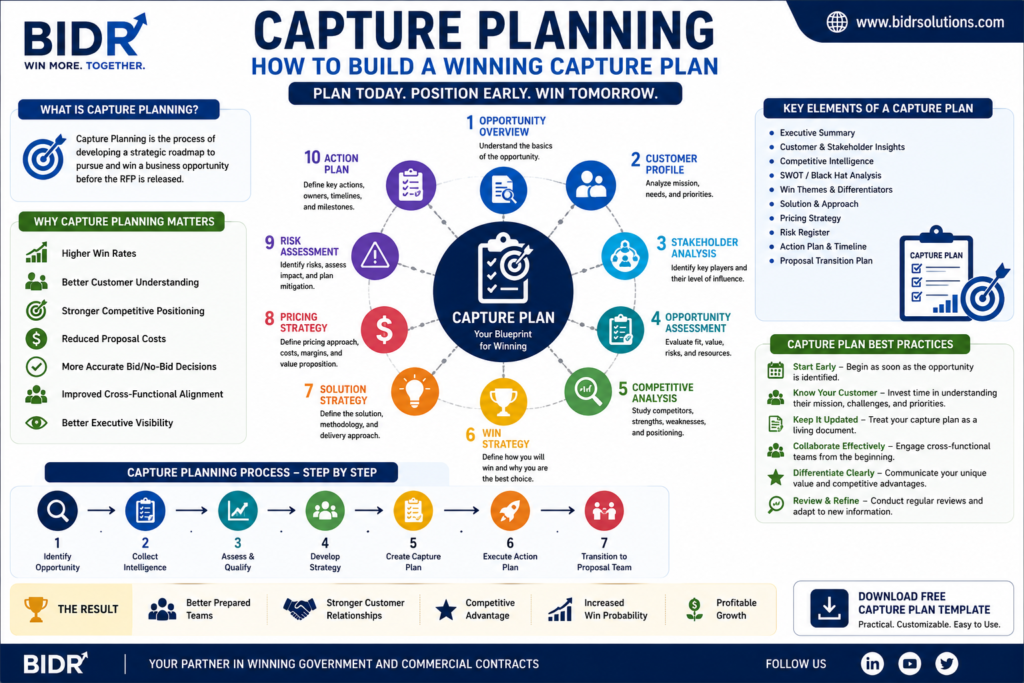
Capture Planning is the structured process of developing a comprehensive strategy to pursue and win a business opportunity before the Request for Proposal (RFP) is released. It involves gathering customer intelligence, analyzing competitors, defining win strategies, assessing risks, coordinating internal teams, and preparing the organization for a successful proposal effort.
A well-developed capture plan acts as the blueprint for the entire pursuit. Rather than reacting when the RFP is published, organizations following disciplined capture planning are already prepared with customer insights, solution concepts, pricing assumptions, and clear differentiators.
Capture Planning is widely used in:
- Government Contracting
- Federal Proposal Management
- IT Services
- Defense
- Engineering
- Consulting
- Healthcare
- Professional Services
Why Capture Planning is Important
Many organizations begin preparing only after the RFP is released.
By that stage:
- Requirements are largely fixed.
- Competitors may already have strong customer relationships.
- The incumbent may have a significant advantage.
- Time for strategic planning is limited.
Capture Planning enables organizations to prepare months before procurement begins.
Benefits include:
- Higher contract win rates
- Better customer understanding
- Stronger competitive positioning
- Reduced proposal costs
- More accurate Bid/No-Bid decisions
- Improved collaboration across teams
- Better executive visibility
Organizations with mature capture planning processes consistently outperform those that rely solely on proposal excellence.
Objectives of Capture Planning
An effective capture plan serves several strategic objectives.
Understand the Customer
The first objective is to build a complete picture of the customer.
This includes:
- Organizational mission
- Business priorities
- Procurement history
- Budget cycle
- Existing contracts
- Stakeholders
- Decision-makers
- Evaluation criteria
The more customer knowledge available, the stronger the pursuit strategy.
Qualify the Opportunity
Capture Planning helps determine whether an opportunity deserves investment.
Typical qualification factors include:
- Strategic alignment
- Technical capability
- Available resources
- Revenue potential
- Customer access
- Competitive position
- Past performance
- Risk level
A structured qualification process prevents unnecessary proposal effort.
Develop a Winning Strategy
The capture plan defines how the organization will differentiate itself.
Questions answered include:
- Why should the customer choose us?
- What customer problems will we solve?
- What are our strongest differentiators?
- How will we compete against the incumbent?
These answers become the foundation of the proposal.
Coordinate Cross-Functional Teams
Capture Planning brings together:
- Business Development
- Capture Management
- Proposal Management
- Solution Architects
- Pricing Specialists
- Delivery Teams
- Executive Sponsors
- Subject Matter Experts
A shared plan ensures alignment and accountability across all stakeholders.
Key Components of a Capture Plan
A comprehensive Capture Plan contains several interconnected sections.
1. Opportunity Overview
This section summarizes the opportunity at a high level.
Typical information includes:
- Opportunity name
- Customer
- Contract type
- Estimated value
- Expected RFP release date
- Incumbent contractor
- Pursuit status
This overview provides executives with a quick understanding of the opportunity.
2. Customer Profile
Understanding the customer is essential.
Include details such as:
- Mission
- Strategic objectives
- Current environment
- Organizational structure
- Key decision-makers
- Influencers
- Procurement officials
- Existing challenges
The customer profile should be updated throughout the capture lifecycle.
3. Stakeholder Analysis
Identify individuals who influence procurement decisions.
Typical stakeholder categories include:
- Executive sponsors
- Procurement officials
- Program managers
- Technical leaders
- End users
- Financial stakeholders
For each stakeholder, document:
- Role
- Influence level
- Interests
- Relationship status
- Engagement strategy
4. Opportunity Assessment
This section evaluates whether the opportunity aligns with organizational goals.
Areas to assess include:
- Strategic fit
- Revenue potential
- Contract complexity
- Technical capability
- Available resources
- Delivery readiness
- Competitive landscape
The assessment supports executive Bid/No-Bid decisions.
5. Competitive Analysis
One of the most valuable sections of the capture plan focuses on competitors.
Analyze:
- Incumbent contractor
- Competitor strengths
- Weaknesses
- Pricing tendencies
- Customer perception
- Past contract performance
- Differentiators
A SWOT analysis and Black Hat review are commonly included.
6. Win Strategy
The Win Strategy explains how your organization intends to secure the contract.
Typical elements include:
- Customer value proposition
- Competitive differentiators
- Innovation
- Past performance
- Risk reduction
- Cost optimization
- Delivery excellence
The strategy should answer the customer’s central question:
“Why should we choose your organization?”
7. Solution Strategy
The Solution Strategy describes how your organization will meet or exceed the customer’s anticipated requirements.
Rather than focusing solely on products or services, the solution strategy should demonstrate how your approach delivers measurable value to the customer.
Typical components include:
- Proposed technical solution
- Delivery methodology
- Staffing approach
- Transition strategy
- Innovation opportunities
- Automation and AI capabilities
- Quality assurance approach
- Risk mitigation strategy
An effective solution strategy aligns directly with the customer’s mission and business objectives.
8. Pricing Strategy
Pricing is often one of the most influential evaluation factors.
Capture Planning should define the overall pricing approach before proposal development begins.
Considerations include:
- Competitive pricing
- Target profit margin
- Cost assumptions
- Contract type
- Pricing risks
- Value-added services
- Total cost of ownership
Capture Managers work closely with pricing specialists to ensure the strategy remains both competitive and commercially viable.
9. Risk Assessment
Every opportunity involves uncertainty.
A Capture Plan should identify risks early and define mitigation strategies.
Common risks include:
Customer Risks
- Limited customer access
- Changing priorities
- Budget uncertainty
Competitive Risks
- Strong incumbent
- New market entrants
- Aggressive pricing
Technical Risks
- Complex requirements
- Resource availability
- Technology limitations
Delivery Risks
- Staffing shortages
- Supply chain constraints
- Schedule challenges
Financial Risks
- Reduced profitability
- Pricing assumptions
- Currency fluctuations (for global opportunities)
Each risk should include:
- Probability
- Impact
- Owner
- Mitigation actions
- Review date
10. Action Plan
The Action Plan converts strategy into execution.
Typical activities include:
| Activity | Owner | Due Date | Status |
|---|---|---|---|
| Customer Meeting | Business Development | Week 1 | Planned |
| Competitor Analysis | Capture Manager | Week 2 | In Progress |
| Solution Workshop | Solution Architect | Week 3 | Planned |
| Pricing Review | Pricing Team | Week 4 | Pending |
| Executive Review | Executive Sponsor | Week 5 | Scheduled |
Tracking action items helps ensure the capture effort remains on schedule.
Capture Planning Best Practices
Organizations with high capture win rates consistently follow these best practices.
Start Planning Early
Begin Capture Planning as soon as an opportunity enters the pipeline—ideally 6–24 months before the expected RFP release.
Understand the Customer
Invest significant effort in learning:
- Mission priorities
- Procurement history
- Pain points
- Budget cycles
- Evaluation criteria
- Decision-making process
Customer knowledge is the foundation of a winning capture strategy.
Keep the Capture Plan Updated
Treat the Capture Plan as a living document.
Update it whenever new information becomes available regarding:
- Customer priorities
- Competitive landscape
- Pricing assumptions
- Risks
- Teaming arrangements
Focus on Differentiation
Avoid generic messaging.
Clearly define why your organization is uniquely positioned to deliver greater value than competitors.
Involve Cross-Functional Teams
Capture Planning is not a one-person activity.
Engage:
- Business Development
- Proposal Management
- Solution Architects
- Pricing Teams
- Delivery Leaders
- Executive Sponsors
- Subject Matter Experts
Early collaboration results in stronger solutions and fewer surprises during proposal development.
Conduct Executive Reviews
Regular executive reviews help:
- Validate pursuit strategy
- Resolve issues
- Approve investments
- Ensure organizational alignment
Executive engagement improves accountability and decision-making.
Common Capture Planning Mistakes
Even experienced organizations can make avoidable mistakes.
Starting Too Late
Waiting until the RFP is released leaves little time for customer engagement or strategic positioning.
Weak Customer Intelligence
Assumptions should never replace verified customer insights.
Poor customer understanding often leads to weak win strategies.
Ignoring Competitor Analysis
Failing to evaluate competitors limits an organization’s ability to differentiate its solution.
Poor Team Communication
Capture activities involve multiple departments.
Lack of communication often leads to duplicated effort, inconsistent messaging, and missed deadlines.
No Risk Management
Ignoring risks during capture increases the likelihood of problems during proposal development and contract execution.
Sample Capture Plan Structure
A practical Capture Plan typically includes the following sections:
- Executive Summary
- Opportunity Overview
- Customer Profile
- Stakeholder Analysis
- Opportunity Qualification
- Competitive Analysis
- SWOT Analysis
- Win Strategy
- Solution Strategy
- Pricing Strategy
- Risk Register
- Action Plan
- Review Schedule
- Proposal Transition Checklist
This structure can be adapted to suit organizations of different sizes and industries.
Conclusion
Capture Planning is one of the most valuable investments an organization can make when pursuing competitive opportunities. A well-developed Capture Plan provides a clear roadmap for understanding the customer, evaluating competitors, managing risks, developing compelling win strategies, and coordinating cross-functional teams.
Organizations that consistently win contracts do not rely solely on proposal writing—they build success through disciplined planning long before the RFP is issued. By following the principles outlined in this guide, Capture Managers and Business Development teams can improve decision-making, strengthen customer relationships, and increase their probability of winning.
Whether you are pursuing government contracts, commercial opportunities, or strategic partnerships, effective Capture Planning provides the structure and clarity needed to compete with confidence.
Continue Learning with BidR
Build your capture expertise with these related resources:
- What is Capture Management? Complete Guide to Winning More Contracts (2026)
- Capture Management Process Explained: Step-by-Step Framework
- Capture Manager Roles and Responsibilities
- Capture Management Lifecycle
- Capture Management Best Practices
- Capture Manager Skills
- Capture Management Tools and Software
- Capture Management KPIs
- Capture Management vs Proposal Management
- What is Proposal Management? Complete Guide
- What is Bid Management? Complete Guide
Build Better Capture Plans with BidR
A successful proposal starts with a well-executed capture plan. Explore BidR Solutions for expert guides, downloadable templates, practical checklists, and proven strategies that help Capture Managers, Proposal Managers, and Business Development teams improve pursuit planning and increase contract win rates.
Frequently Asked Questions (FAQs)
What is Capture Planning?
Capture Planning is the process of developing a strategic plan to pursue and win a business opportunity before the Request for Proposal (RFP) is released.
What is included in a Capture Plan?
A Capture Plan typically includes an opportunity overview, customer profile, stakeholder analysis, competitive intelligence, win strategy, solution strategy, pricing approach, risk register, and action plan.
Who is responsible for Capture Planning?
Capture Planning is usually led by the Capture Manager with contributions from Business Development, Proposal Management, Solution Architects, Pricing Specialists, SMEs, and executive leadership.
Why is Capture Planning important?
Capture Planning helps organizations improve win rates by preparing early, understanding customer needs, developing competitive strategies, and aligning cross-functional teams before proposal development begins.
When should Capture Planning begin?
Ideally, Capture Planning should begin 6–24 months before the anticipated RFP release to maximize customer engagement and strategic positioning.