Table of Contents
What is a Capture Manager?
A Capture Manager is a strategic business development professional responsible for identifying, qualifying, and leading high-value business opportunities before a Request for Proposal (RFP) is released. Their primary objective is to position the organization for success by understanding customer needs, analyzing competitors, developing winning strategies, and coordinating cross-functional teams throughout the capture phase.
Unlike a Proposal Manager, who focuses on managing proposal development after an RFP is issued, a Capture Manager works proactively—often 6 to 24 months in advance—to influence opportunities and maximize the organization’s probability of winning.
Capture Managers are commonly found in industries such as:
- Government Contracting
- Information Technology
- Defense
- Aerospace
- Engineering
- Consulting
- Healthcare
- Telecommunications
- Professional Services
Why Capture Managers Are Important?
Winning a competitive contract requires much more than writing an excellent proposal.
Organizations that consistently win large contracts invest in Capture Managers because they:
- Identify the right opportunities
- Build long-term customer relationships
- Understand procurement priorities
- Shape winning solutions
- Analyze competitors
- Coordinate internal teams
- Improve bid qualification
- Increase overall win rates
Without an effective Capture Manager, proposal teams often work with incomplete information, weak customer insights, and limited competitive intelligence.
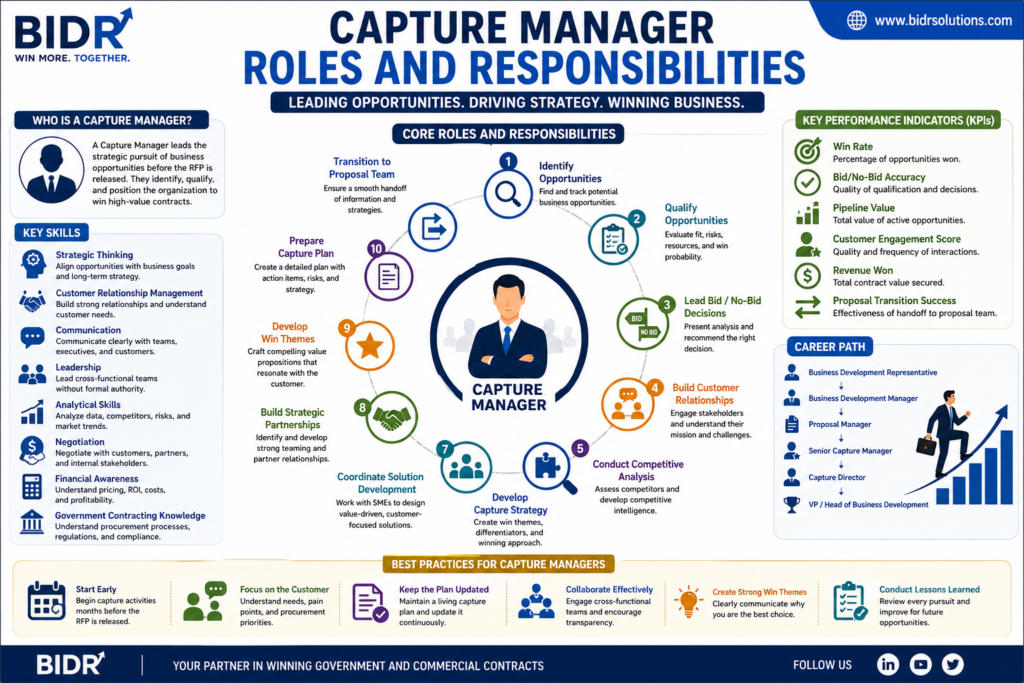
Capture Manager Roles and Responsibilities
The role of a Capture Manager spans the entire pre-proposal lifecycle and requires collaboration with executives, business development teams, solution architects, proposal managers, pricing specialists, and delivery leaders.
Below are the core responsibilities.
1. Identify Business Opportunities
One of the first responsibilities of a Capture Manager is identifying opportunities that align with the organization’s strategic objectives.
Typical opportunity sources include:
- Government procurement portals
- Customer forecasts
- Existing contracts nearing expiration
- Business development pipelines
- Industry conferences
- Market intelligence reports
- Customer referrals
The goal is to build a healthy pipeline of qualified opportunities.
2. Qualify Opportunities
Not every opportunity deserves investment.
Capture Managers evaluate opportunities using criteria such as:
- Strategic fit
- Technical capability
- Customer relationship strength
- Contract value
- Resource availability
- Competitive landscape
- Expected profitability
- Past performance
Formal qualification helps organizations avoid pursuing low-probability opportunities.
3. Lead Bid/No-Bid Decisions
Capture Managers facilitate executive decision-making by presenting opportunity assessments.
Factors considered include:
- Win probability
- Revenue potential
- Investment required
- Customer access
- Delivery capability
- Risks
- Strategic importance
A disciplined Bid/No-Bid process improves resource utilization and increases win rates.
4. Build Customer Relationships
Customer engagement is one of the most valuable aspects of the role.
Capture Managers collaborate with Business Development teams to:
- Conduct capability briefings
- Meet decision-makers
- Understand customer challenges
- Gather procurement intelligence
- Validate assumptions
- Establish credibility
Strong customer relationships often provide insights that shape successful capture strategies.
5. Conduct Competitive Analysis
Capture Managers continuously monitor the competitive landscape.
Typical activities include:
- Identifying likely competitors
- Assessing incumbent performance
- Reviewing competitor strengths
- Identifying weaknesses
- Evaluating pricing trends
- Understanding market positioning
Competitive intelligence enables organizations to develop stronger win themes and differentiators.
6. Develop the Capture Strategy
The Capture Strategy defines how the organization intends to win the opportunity.
It includes:
- Customer engagement plan
- Competitive positioning
- Win themes
- Pricing approach
- Risk mitigation
- Partnership strategy
- Solution positioning
This strategy becomes the foundation for proposal development.
7. Coordinate Solution Development
Capture Managers work closely with technical teams to ensure proposed solutions align with customer expectations.
Responsibilities include:
- Facilitating solution workshops
- Coordinating SMEs
- Reviewing technical approaches
- Validating delivery strategies
- Identifying innovation opportunities
The objective is to create a compelling, customer-focused solution before proposal writing begins.
8. Build Strategic Partnerships
Large opportunities often require teaming arrangements.
Capture Managers identify and evaluate potential partners based on:
- Complementary capabilities
- Past performance
- Customer relationships
- Geographic presence
- Certifications
- Resource availability
Successful partnerships strengthen overall competitiveness.
9. Develop Win Themes
Every capture effort should clearly answer one question:
“Why should the customer choose us?”
Capture Managers develop persuasive win themes that emphasize:
- Customer benefits
- Differentiators
- Innovation
- Past performance
- Reduced risk
- Cost savings
- Faster delivery
These win themes guide proposal messaging and executive presentations.
10. Prepare the Capture Plan
The Capture Plan serves as the strategic roadmap for the pursuit.
Typical sections include:
- Opportunity overview
- Customer profile
- Stakeholder map
- Competitor analysis
- SWOT analysis
- Win strategy
- Pricing strategy
- Risk register
- Action plan
- Timeline
The Capture Manager owns this document throughout the pursuit.
11. Transition to the Proposal Team
When the RFP is released, the Capture Manager ensures a structured handover to the Proposal Manager.
Key information transferred includes:
- Customer intelligence
- Capture Plan
- Competitive analysis
- Win themes
- Solution strategy
- Pricing assumptions
- Risks
- Partner information
A successful transition allows the proposal team to focus on producing a compelling, compliant response.
A Typical Day in the Life of a Capture Manager
Although responsibilities vary by organization, a typical day may include:
- Reviewing new opportunities
- Meeting with Business Development teams
- Speaking with customers
- Conducting competitor research
- Coordinating solution workshops
- Updating the Capture Plan
- Preparing executive reviews
- Tracking pursuit milestones
- Collaborating with Proposal Managers
- Reviewing pricing strategies
Capture Managers spend more time on strategic planning and relationship building than on document production.
Essential Skills Every Capture Manager Needs
Successful Capture Managers combine strategic thinking, business development expertise, leadership, and communication skills. They must coordinate cross-functional teams while maintaining a strong customer focus throughout the pursuit.
Below are the most important competencies.
1. Strategic Thinking
Capture Managers must understand how each opportunity aligns with the organization’s long-term business objectives.
Strategic thinking enables them to:
- Prioritize opportunities
- Develop win strategies
- Assess risks
- Allocate resources effectively
- Make informed Bid/No-Bid recommendations
2. Customer Relationship Management
Building trust with customers is one of the strongest predictors of capture success.
Capture Managers should be able to:
- Build long-term relationships
- Understand customer missions
- Identify pain points
- Maintain regular communication
- Gather valuable procurement insights
3. Communication Skills
The role involves constant communication with:
- Executives
- Customers
- Business Development teams
- Proposal Managers
- Solution Architects
- Pricing teams
- Subject Matter Experts
- Delivery leaders
Excellent written, verbal, and presentation skills are essential.
4. Leadership
Capture Managers often lead pursuit teams without having direct reporting authority.
They must:
- Influence stakeholders
- Resolve conflicts
- Coordinate multiple teams
- Drive accountability
- Keep the pursuit on schedule
5. Analytical Skills
Capture decisions should be based on data rather than assumptions.
Capture Managers analyze:
- Customer information
- Competitor intelligence
- Market trends
- Financial data
- Opportunity risks
- Win probability
6. Negotiation Skills
Negotiation is required throughout the capture lifecycle.
Examples include:
- Partner agreements
- Resource allocation
- Pricing discussions
- Customer expectations
- Internal priorities
7. Financial Awareness
Capture Managers should understand:
- Profit margins
- Pricing strategies
- Return on investment (ROI)
- Contract value
- Cost structures
- Revenue forecasting
Financial awareness ensures opportunities are commercially viable.
8. Government Contracting Knowledge
For organizations pursuing public sector contracts, Capture Managers should understand:
- Federal Acquisition Regulation (FAR)
- Procurement lifecycle
- Contract types
- Source selection processes
- Compliance requirements
- Evaluation criteria
This knowledge is particularly valuable in federal and defense contracting.
Education and Professional Certifications
There is no single educational path to becoming a Capture Manager, but many professionals hold degrees in:
- Business Administration
- Marketing
- Engineering
- Information Technology
- Management
- Finance
- Public Administration
Professional certifications further strengthen credibility.
Recommended certifications include:
- APMP Foundation
- APMP Practitioner
- APMP Professional
- PMP (Project Management Professional)
- Agile certifications
- ITIL Foundation
- Government contracting certifications
- Business Development certifications
Capture Manager Career Path
Many Capture Managers transition into the role after gaining experience in business development, proposal management, or technical leadership.
A typical progression may look like:
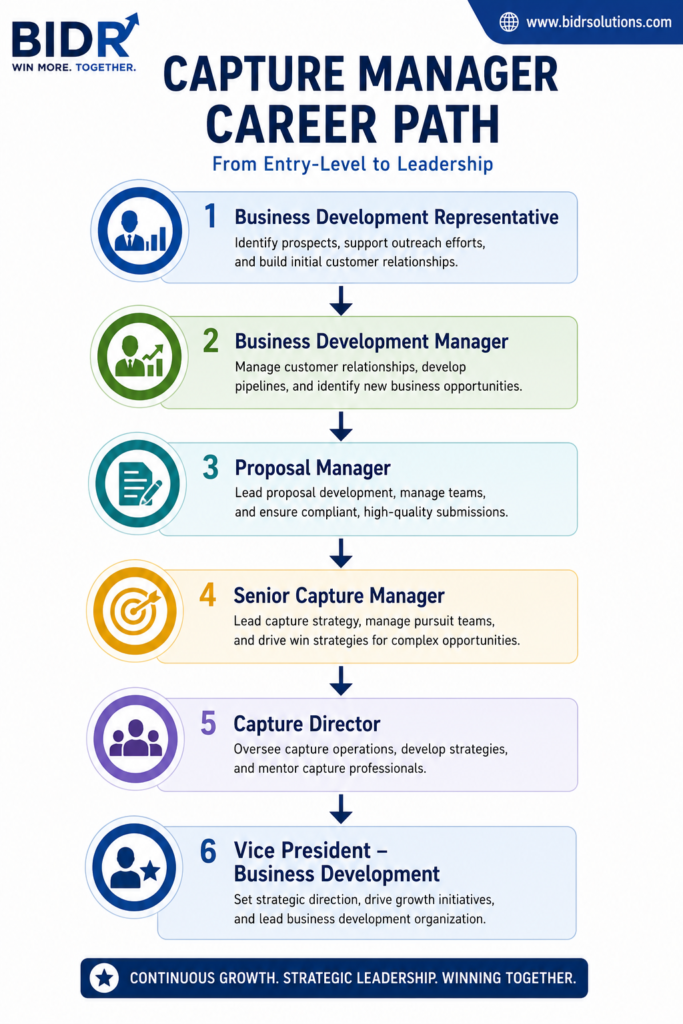
Professionals with strong customer engagement and strategic planning skills can also move into executive leadership roles.
Professionals with strong customer engagement and strategic planning skills can also move into executive leadership roles.
Capture Manager Salary
Compensation varies depending on industry, geography, and experience.
| Experience Level | Typical Annual Salary (US) |
|---|---|
| Entry-Level | $80,000–$100,000 |
| Mid-Level | $100,000–$140,000 |
| Senior | $140,000–$180,000 |
| Director | $180,000–$250,000+ |
In India, salaries vary significantly based on organization size and sector, with large IT services firms and multinational companies generally offering higher compensation.
Key Performance Indicators (KPIs)
Organizations evaluate Capture Managers using measurable performance indicators.
Common KPIs include:
| KPI | Purpose |
|---|---|
| Win Rate | Percentage of opportunities won |
| Bid/No-Bid Accuracy | Effectiveness of qualification decisions |
| Pipeline Value | Total value of active opportunities |
| Qualified Opportunity Rate | Percentage of opportunities meeting qualification criteria |
| Customer Engagement Score | Quality and frequency of customer interactions |
| Proposal Transition Success | Effectiveness of handover to proposal teams |
| Revenue Won | Total contract value secured |
| Competitive Win Rate | Success against key competitors |
Monitoring these KPIs helps organizations continuously improve their capture capability.
Common Challenges Faced by Capture Managers
Capture Managers often work in highly competitive and fast-moving environments.
Limited Customer Access
Government procurement rules may restrict direct communication with customers, making relationship-building more challenging.
Strong Incumbent Competition
Existing contractors often have established relationships, historical knowledge, and proven performance, creating a competitive advantage.
Resource Constraints
Subject Matter Experts (SMEs), Solution Architects, and pricing teams are frequently shared across multiple pursuits.
Prioritization becomes critical.
Changing Customer Requirements
Requirements may evolve before the RFP is issued, requiring capture strategies to be updated regularly.
Time Pressure
Unexpected procurement schedule changes can reduce preparation time and compress capture activities.
Best Practices for Capture Managers
Successful Capture Managers consistently apply proven practices.
Start Capture Early
Begin planning as soon as an opportunity is identified—ideally several months before the anticipated RFP release.
Build Relationships Continuously
Maintain regular customer engagement rather than waiting for procurement activities to begin.
Keep the Capture Plan Updated
Treat the Capture Plan as a living document and revise it whenever new information becomes available.
Focus on Customer Value
Instead of emphasizing organizational capabilities alone, demonstrate how your solution addresses the customer’s specific objectives and challenges.
Encourage Cross-Functional Collaboration
Capture success depends on collaboration between Business Development, Proposal Management, Solution Architecture, Pricing, Delivery, and executive leadership.
Conduct Lessons Learned Reviews
After each pursuit, document what worked well and identify opportunities for improvement to strengthen future capture efforts.
Conclusion
The role of a Capture Manager is central to winning competitive contracts. By leading opportunity qualification, customer engagement, competitive analysis, solution development, and capture planning, Capture Managers ensure organizations enter the proposal phase with a clear strategy and a higher probability of success.
As competition for government and commercial contracts continues to increase, organizations are investing more heavily in experienced Capture Managers who can build strong customer relationships, coordinate pursuit teams, and develop winning strategies.
Whether you are an aspiring Capture Manager, a Proposal Manager looking to expand your responsibilities, or a Business Development professional seeking career growth, mastering the roles and responsibilities of a Capture Manager can open the door to rewarding leadership opportunities.
Continue Learning with BidR
Expand your expertise with these related resources:
- What is Capture Management? Complete Guide to Winning More Contracts (2026)
- Capture Management Process Explained: Step-by-Step Framework
- Capture Planning: How to Build a Winning Capture Plan
- Capture Management Lifecycle
- Capture Management Best Practices
- Capture Manager Skills
- Capture Management Tools and Software
- Capture Management KPIs
- Capture Management vs Proposal Management
- What is Proposal Management? Complete Guide
- What is Bid Management? Complete Guide
Call to Action (CTA)
Advance Your Capture Management Career with BidR
Whether you’re preparing for your first Capture Manager role or leading strategic pursuits for large government contracts, BidR Solutions provides expert guidance, practical templates, career advice, and industry best practices to help you succeed. Explore our complete Capture Management learning hub and strengthen your ability to win more business with confidence.
Frequently Asked Questions (FAQs)
What does a Capture Manager do?
A Capture Manager leads the strategic pursuit of business opportunities before the RFP is released by qualifying opportunities, engaging customers, analyzing competitors, developing win strategies, and coordinating cross-functional teams.
Is a Capture Manager different from a Proposal Manager?
Yes. A Capture Manager focuses on activities before the RFP is released, while a Proposal Manager manages proposal development and submission after the RFP is issued.
What skills are required to become a Capture Manager?
Key skills include strategic thinking, customer relationship management, leadership, communication, analytical ability, negotiation, financial awareness, and knowledge of procurement processes.
Which industries hire Capture Managers?
Capture Managers are commonly employed in government contracting, IT services, defense, aerospace, consulting, engineering, healthcare, telecommunications, and professional services.
Is APMP certification useful for Capture Managers?
Yes. APMP certifications are widely recognized in the bid and proposal profession and help demonstrate expertise in capture, proposal, and bid management practices.