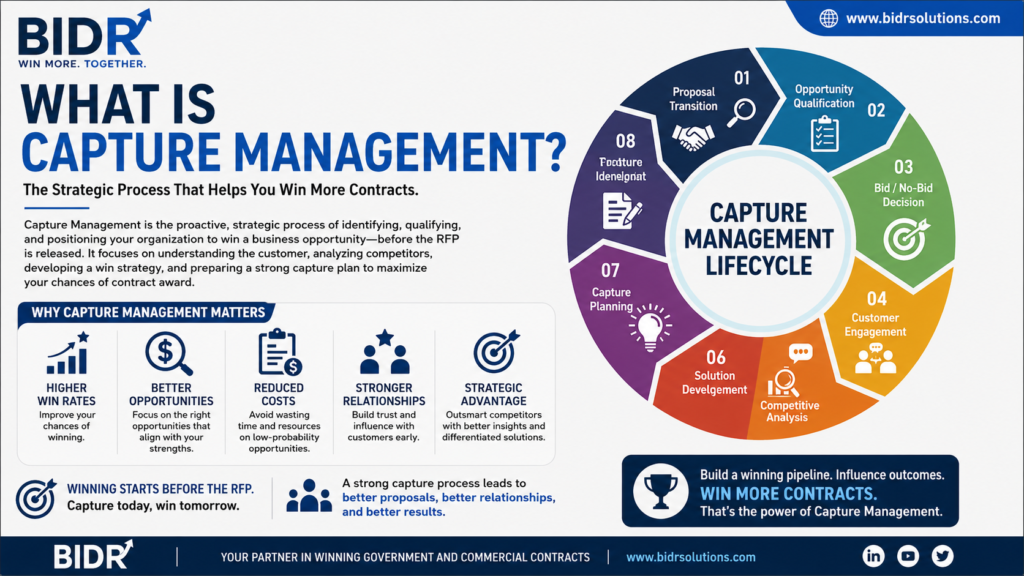
Capture Management is the strategic process of identifying, qualifying, pursuing, and positioning an organization to win business opportunities before the Request for Proposal (RFP) is released. It focuses on influencing the customer, understanding competitors, building relationships, shaping the opportunity, and developing a winning strategy long before proposal writing begins.
In highly competitive industries such as government contracting, IT services, engineering, consulting, defense, aerospace, healthcare, and telecommunications, successful organizations invest heavily in capture management because winning starts months before a proposal is written.
A well-executed capture strategy significantly improves bid quality, reduces unnecessary proposal costs, and increases overall contract win rates.
Table of Contents
Why Capture Management is Important
Many organizations lose contracts because they begin preparing only after the RFP is published. By then, competitors may already have:
- Built strong customer relationships
- Understood the buyer’s pain points
- Influenced requirements
- Positioned their solutions
- Formed strategic partnerships
- Developed pricing strategies
Capture Management shifts the focus from reacting to opportunities to proactively shaping them.
Organizations with mature capture processes consistently achieve:
- Higher win rates
- Better-qualified opportunities
- Reduced proposal costs
- Improved customer relationships
- More predictable revenue pipelines
- Stronger competitive positioning
What Does a Capture Manager Do?
A Capture Manager leads all strategic activities before proposal development begins. Their objective is to maximize the probability of winning by understanding the customer, competitors, market, and internal capabilities.
Typical responsibilities include:
- Identifying new business opportunities
- Qualifying opportunities
- Conducting Bid/No-Bid assessments
- Developing customer engagement strategies
- Creating capture plans
- Managing competitive intelligence
- Coordinating solution development
- Building teaming partnerships
- Leading pricing discussions
- Developing win themes
- Transitioning opportunities to proposal teams
Capture Managers work closely with:
- Business Development Managers
- Proposal Managers
- Solution Architects
- Pricing Teams
- Sales Leaders
- Executive Sponsors
- Technical SMEs
- Delivery Teams
Objectives of Capture Management
The primary goal is not simply to respond to an RFP—but to improve the likelihood of winning before the RFP is issued.
Key objectives include:
Understand Customer Needs
Capture teams invest time in learning:
- Customer challenges
- Current contracts
- Organizational priorities
- Budget cycles
- Procurement timelines
- Decision-makers
- Evaluation criteria
The better the understanding, the stronger the proposed solution.
Build Customer Relationships
Winning organizations don’t wait for procurement notices.
Instead, they:
- Attend industry events
- Conduct capability briefings
- Meet stakeholders
- Demonstrate thought leadership
- Share success stories
- Build trust over time
Relationship-building often influences future opportunities.
Analyze Competitors
Competitive intelligence helps answer questions such as:
- Who is likely to bid?
- Who is the incumbent?
- What are competitors’ strengths?
- Where are competitors vulnerable?
- What differentiators can we emphasize?
This information shapes the win strategy.
Develop Winning Strategies
Capture Managers define:
- Why should the customer choose us?
- What problems can we solve better?
- Which discriminators matter most?
- What evidence supports our claims?
These strategies become the foundation for proposal development.
Reduce Bid Costs
Submitting every available RFP wastes resources.
Capture Management helps organizations pursue only opportunities that align with:
- Strategic goals
- Capabilities
- Customer relationships
- Profitability
- Win probability
The Capture Management Lifecycle
A structured capture process generally includes the following phases:
1. Opportunity Identification
Potential opportunities are discovered through:
- Government procurement portals
- Customer meetings
- Market intelligence
- Industry conferences
- Business development activities
- Existing client relationships
At this stage, organizations decide whether an opportunity aligns with their strategic direction.
2. Opportunity Qualification
Not every opportunity is worth pursuing.
Qualification considers:
- Budget availability
- Customer relationship strength
- Technical capability
- Past performance
- Competitive landscape
- Resource availability
- Contract value
- Strategic importance
Many organizations use formal qualification frameworks before investing significant effort.
3. Bid/No-Bid Decision
Senior leadership evaluates:
- Win probability
- Investment required
- Strategic fit
- Profitability
- Delivery risks
- Available resources
Only qualified opportunities proceed to active capture.
4. Customer Engagement
Capture Managers work with sales and business development teams to:
- Meet stakeholders
- Validate assumptions
- Gather intelligence
- Clarify requirements
- Understand evaluation priorities
The goal is to gain insights that competitors may not have.
5. Competitive Analysis
Organizations evaluate:
- Incumbent contractor
- Competitor capabilities
- Pricing tendencies
- Past performance
- Customer preferences
- Strengths and weaknesses
Tools such as SWOT analysis and Black Hat reviews are commonly used.
6. Solution Development
Cross-functional teams collaborate to create:
- Technical solutions
- Staffing approaches
- Delivery models
- Innovation ideas
- Value-added services
Early solution development reduces proposal risk later.
7. Capture Planning
A comprehensive capture plan typically includes:
- Customer profile
- Opportunity summary
- Stakeholder map
- Competitor analysis
- Win strategy
- Risk assessment
- Pricing approach
- Action plan
- Timeline
- Decision gates
The capture plan serves as the roadmap for pursuit.
8. Proposal Transition
Once the RFP is released, ownership shifts from the Capture Manager to the Proposal Manager.
The Capture Manager transfers:
- Customer intelligence
- Win themes
- Competitive analysis
- Solution strategy
- Compliance insights
- Pricing assumptions
- Risk register
- Key relationships
A smooth handover ensures continuity between capture and proposal phases.
Capture Management vs Proposal Management
Although often used interchangeably, Capture Management and Proposal Management serve different purposes.
| Capture Management | Proposal Management |
|---|---|
| Starts before RFP release | Begins after RFP release |
| Strategic planning | Proposal execution |
| Customer engagement | Document development |
| Competitive positioning | Compliance management |
| Opportunity qualification | Schedule management |
| Win strategy | Proposal production |
| Solution shaping | Review coordination |
| Long-term pursuit | Short-term delivery |
Think of Capture Management as winning the opportunity before writing the proposal, while Proposal Management is executing the response effectively once the opportunity is released.
What Does a Capture Manager Do?
A Capture Manager is responsible for leading the strategic pursuit of an opportunity from qualification through proposal handoff. They ensure that the organization is well-positioned to win by understanding the customer, analyzing competitors, developing the win strategy, and coordinating internal teams.
Unlike a Proposal Manager, who focuses on creating the proposal document, the Capture Manager focuses on increasing the probability of winning before the proposal phase begins.
Typical responsibilities include:
- Identifying qualified business opportunities
- Leading Bid/No-Bid decisions
- Building customer relationships
- Conducting competitive intelligence
- Developing the capture plan
- Coordinating solution development
- Identifying teaming partners
- Defining win themes and discriminators
- Working with pricing teams
- Preparing for proposal transition
Roles and Responsibilities of a Capture Manager
The responsibilities of a Capture Manager span multiple business functions and require collaboration with leadership, sales, technical teams, and proposal professionals.
Opportunity Identification
Capture Managers continuously monitor:
- Government procurement portals
- Customer procurement forecasts
- Industry news
- Business development pipelines
- Existing contracts nearing expiration
The goal is to identify opportunities months before they are formally released.
Opportunity Qualification
Not every opportunity should be pursued.
A Capture Manager evaluates factors such as:
- Strategic alignment
- Revenue potential
- Customer relationship strength
- Technical capability
- Resource availability
- Contract risks
- Competitive landscape
This helps organizations focus resources on opportunities with the highest probability of success.
Customer Relationship Management
Strong customer relationships often influence contract outcomes.
Capture Managers work with Business Development teams to:
- Schedule capability briefings
- Attend industry events
- Meet program managers
- Understand mission priorities
- Gather procurement insights
- Build trust with stakeholders
Competitive Intelligence
Winning requires understanding competitors.
Capture Managers analyze:
- Incumbent contractors
- Competitor strengths
- Weaknesses
- Pricing strategies
- Customer perception
- Past contract performance
Competitive analysis enables organizations to develop stronger differentiators.
Capture Planning
A Capture Manager develops a comprehensive capture plan that includes:
- Opportunity overview
- Customer profile
- Stakeholder analysis
- Competitor assessment
- SWOT analysis
- Win strategy
- Pricing strategy
- Risk register
- Action items
- Timeline
- Review milestones
The capture plan serves as the blueprint for the entire pursuit.
Solution Development
Capture Managers coordinate with Solution Architects and technical SMEs to develop a solution that addresses customer needs while differentiating the organization from competitors.
Activities include:
- Technical workshops
- Brainstorming sessions
- Innovation planning
- Staffing strategies
- Delivery model discussions
Proposal Transition
When the RFP is released, Capture Managers transition the opportunity to the Proposal Manager.
A successful handoff includes:
- Customer intelligence
- Win themes
- Competitive assessment
- Solution strategy
- Compliance considerations
- Pricing assumptions
- Risks
- Action items
This ensures proposal teams begin with a strong strategic foundation.
Essential Skills Every Capture Manager Needs
Successful Capture Managers possess a blend of business, strategic, technical, and leadership skills.
Strategic Thinking
Capture Managers must understand market trends, customer missions, and organizational objectives to develop winning strategies.
Customer Relationship Management
Building trust with customers is essential for gathering valuable insights and positioning the organization effectively.
Communication Skills
Capture Managers communicate with executives, customers, proposal teams, technical experts, and partners.
Excellent written and verbal communication is critical.
Leadership
Capture Managers often lead cross-functional teams without direct authority.
Strong leadership helps align diverse stakeholders toward a common objective.
Analytical Skills
Capture Managers analyze:
- Market intelligence
- Competitor information
- Customer needs
- Pricing models
- Contract risks
- Opportunity data
Data-driven decision-making improves capture success.
Negotiation Skills
Negotiation is required when:
- Selecting teaming partners
- Discussing pricing
- Resolving internal conflicts
- Managing customer expectations
Government Contracting Knowledge
For federal opportunities, Capture Managers should understand:
- FAR regulations
- Procurement lifecycle
- Contract types
- Evaluation criteria
- Proposal compliance
Capture Planning Best Practices
Organizations with mature capture processes consistently outperform competitors by following proven best practices.
Start Early
Capture should begin 6–24 months before the anticipated RFP release whenever possible.
Early engagement provides opportunities to influence requirements and build customer relationships.
Know Your Customer
Invest time in understanding:
- Organizational goals
- Current challenges
- Procurement history
- Decision-makers
- Budget priorities
Customer knowledge forms the basis of an effective capture strategy.
Focus on Win Themes
Win themes should clearly answer the customer’s key question:
“Why should we choose your organization?”
Effective win themes are:
- Customer-focused
- Evidence-based
- Measurable
- Differentiated
- Relevant
Build Strong Relationships
Relationships should extend beyond procurement officials to include:
- End users
- Technical stakeholders
- Program managers
- Executive sponsors
Conduct Black Hat Reviews
A Black Hat review involves evaluating the opportunity from the competitor’s perspective.
This helps identify:
- Competitive advantages
- Weaknesses
- Pricing concerns
- Potential threats
- Areas requiring improvement
Update the Capture Plan Regularly
Capture plans should evolve as new information becomes available.
Regular reviews keep strategies aligned with changing customer requirements and competitive dynamics.
Common Capture Management Challenges
Even experienced organizations face obstacles during capture.
Limited Customer Access
Some procurement environments restrict direct communication with customers.
Organizations must leverage industry events, public information, and existing relationships to gather insights.
Intense Competition
Large government opportunities often attract numerous qualified bidders.
Strong differentiation becomes essential.
Resource Constraints
Subject matter experts may be committed to multiple pursuits simultaneously.
Effective prioritization helps maximize resource utilization.
Changing Requirements
Customer priorities may evolve before the RFP is released.
Capture teams should continuously monitor changes and adapt strategies accordingly.
Incomplete Information
Capture decisions are frequently made with limited information.
Experienced Capture Managers rely on market intelligence, historical data, and customer interactions to reduce uncertainty.
Popular Capture Management Tools
Modern capture teams use a variety of tools to manage opportunities effectively.
CRM Platforms
- Salesforce
- Microsoft Dynamics 365
- HubSpot
Government Opportunity Portals
- SAM.gov
- GovWin IQ
- GovTribe
Collaboration Tools
- Microsoft Teams
- SharePoint
- Confluence
Proposal Management Tools
- Loopio
- Responsive (formerly RFPIO)
- Qvidian
Project Management Tools
- Microsoft Project
- Asana
- Monday.com
- Jira
Key Performance Indicators (KPIs) for Capture Management
Organizations should measure capture performance using clear metrics.
Common KPIs include:
| KPI | Description |
|---|---|
| Opportunity Qualification Rate | Percentage of identified opportunities that meet qualification criteria |
| Bid/No-Bid Accuracy | Effectiveness of pursuit decisions |
| Capture Win Rate | Percentage of captured opportunities won |
| Pipeline Value | Total value of active pursuits |
| Customer Engagement Score | Frequency and quality of customer interactions |
| Competitive Win Rate | Success rate against identified competitors |
| Proposal Transition Success | Quality of handoff to proposal teams |
| Revenue Won | Total contract value secured |
Regular KPI reviews help organizations improve capture strategies and resource allocation.
Conclusion
Capture Management is one of the most critical disciplines in business development and government contracting. Winning organizations understand that success begins long before an RFP is published. By investing in early customer engagement, competitive intelligence, strategic planning, and solution development, Capture Managers position their organizations to submit stronger proposals and achieve higher win rates.
Whether you are a Proposal Manager looking to expand your career, a Business Development professional pursuing larger contracts, or a government contractor aiming to improve capture maturity, mastering Capture Management will provide a significant competitive advantage.
As organizations continue to invest in strategic pursuit processes, skilled Capture Managers will remain in high demand across industries such as IT services, consulting, defense, engineering, healthcare, and federal contracting.
Continue Learning with BidR
Expand your expertise with these related guides:
- Capture Management Process Explained: Step-by-Step Framework
- Capture Manager Roles and Responsibilities
- Capture Planning: How to Build a Winning Capture Plan
- Capture Management vs Proposal Management
- Capture Management Lifecycle
- Capture Management Best Practices
- Capture Manager Skills
- Capture Management Tools
- Capture Management KPIs
- What is Proposal Management? Complete Guide
- What is Bid Management? Complete Guide
Ready to Win More Contracts?
Successful contract wins begin long before proposal writing starts. By implementing a structured capture management process, your organization can improve qualification decisions, strengthen customer relationships, and consistently increase win rates.
Explore more expert guides, templates, and practical resources at BidR Solutions to build a world-class capture and proposal management capability.
Frequently Asked Questions (FAQs)
What is Capture Management?
Capture Management is the strategic process of preparing to win a contract before the Request for Proposal (RFP) is released. It includes opportunity qualification, customer engagement, competitive analysis, solution development, and capture planning.
What is the difference between Capture Management and Proposal Management?
Capture Management focuses on shaping and pursuing opportunities before an RFP is issued, while Proposal Management focuses on creating and submitting a compliant, persuasive proposal after the RFP is released.
When should Capture Management begin?
Ideally, capture activities should begin 6–24 months before an anticipated procurement to maximize customer engagement and opportunity shaping.
Who performs Capture Management?
Capture Managers typically work with Business Development Managers, Proposal Managers, Solution Architects, Pricing Specialists, and Executive Sponsors to pursue strategic opportunities.
Why is Capture Management important?
Effective Capture Management improves opportunity qualification, strengthens customer relationships, enhances competitive positioning, and significantly increases contract win rates.